Foundation models are rapidly becoming the backbone of modern enterprise AI, powering generative, predictive, and decision-making systems across industries. As organizations adopt large language models and multimodal foundation models for mission-critical workflows, model risk has emerged as a central concern. Issues such as hallucinations, lack of explainability, and uncontrolled feedback loops can undermine trust, compliance, and operational reliability—especially in regulated and high-impact environments.
From a governance perspective, foundation models operate as probabilistic systems, producing outputs based on learned patterns rather than deterministic logic. This introduces risks where models may generate confident but incorrect responses, obscure decision pathways, or reinforce bias through continuous learning cycles. For enterprises deploying Agentic AI, these risks multiply as autonomous agents interact with multiple systems, make decisions in real time, and execute actions without direct human oversight.
Addressing foundation model risk requires more than traditional AI monitoring. Organizations need context-aware AI infrastructure that supports secure inference, transparent reasoning, and continuous evaluation. Platforms like Nexastack, designed as the agentic infrastructure platform for reasoning AI, enable enterprises to operationalize private cloud AI, sovereign AI, and governed AI agent deployments across cloud, on-prem, and edge environments. By combining contextual memory, observability, and closed-loop feedback mechanisms, enterprises can reduce hallucinations, improve explainability, and enforce governance-ready feedback loops. This foundation is critical for building trustworthy, scalable, and compliant AI systems in production.
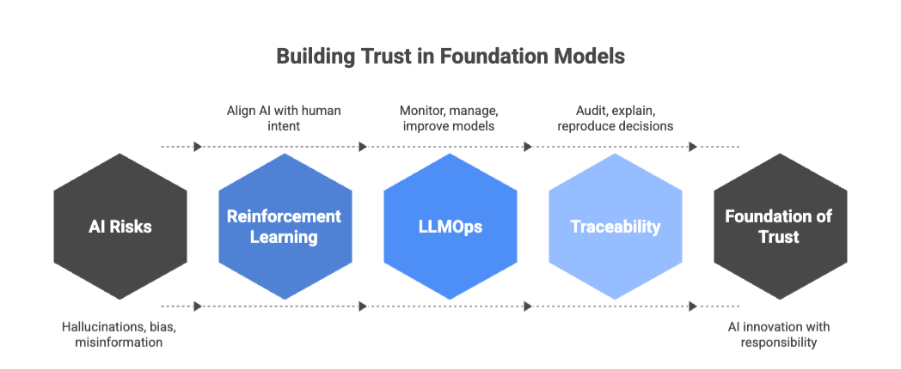
To deal with these challenges responsibly, organizations are adopting three major pillars of safety and governance:
-
Reinforcement Learning from Human Feedback (RLHF) – to align AI behavior with human intent.
-
LLMOps – to monitor, manage, and continuously improve large language models.
-
Traceability with Evaluation Logs – to audit, explain, and reproduce model decisions.
Together, these strategies form the foundation of trust in foundation models. This article dives deeper into each risk, explores how these mitigation techniques work, and outlines how organizations can balance AI innovation with responsibility.
Understanding Model Risks in Foundation Models
Hallucination: When Models “Make Things Up”
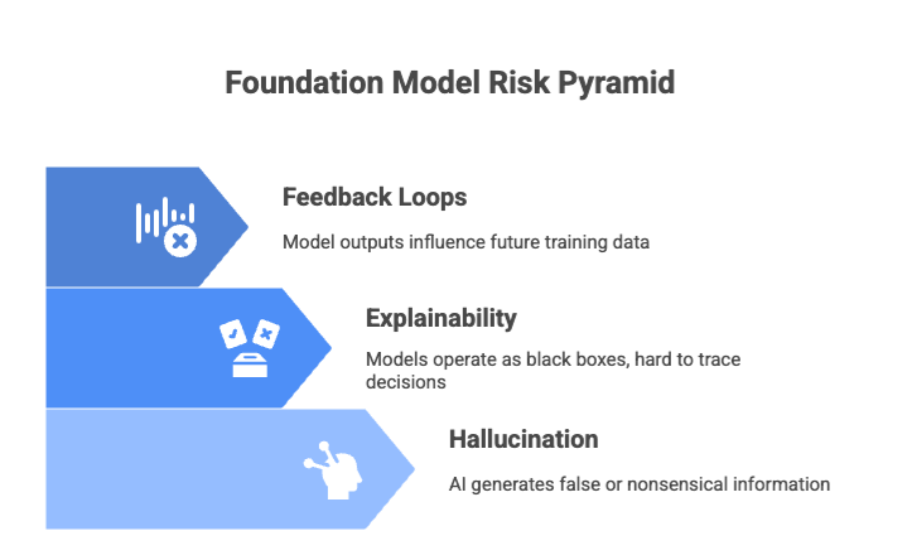
One of the most visible—and concerning—issues with large language models is hallucination. Simply put, it’s when a model confidently produces false, misleading, or entirely fabricated information.
You might have seen it happen:
-
A legal assistant AI cites case laws that don’t exist.
-
A health chatbot recommends a non-existent treatment.
-
A data analysis tool “creates” numbers that look statistically sound—but aren’t real.
Why does this happen?
It often comes down to three factors:
-
Over-optimization for fluency: Models are trained to produce text that sounds human, not necessarily text that’s accurate.
-
Knowledge cutoffs: The world changes faster than training data does, meaning models may speak confidently about outdated facts.
-
Prompt ambiguity: When instructions are unclear, the model guesses what the user wants, sometimes inventing information to fill the gaps.
The impact of hallucination is serious—it can erode user trust, introduce legal risks, and spread misinformation at scale. In sectors like healthcare or finance, one fabricated answer can have real-world consequences.
Explainability: The “Black Box” Challenge
Foundation models are powerful—but also opaque. They operate as “black boxes,” producing decisions without transparent reasoning.
This lack of explainability is particularly risky in high-stakes industries:
-
In healthcare, how can a doctor trust an AI’s diagnosis without knowing why it was made?
-
In finance, what happens if an AI denies a loan, but even developers can’t explain the decision logic?
Why explainability is hard:
-
Foundation models contain billions of parameters, making traditional interpretability tools (like feature importance) inadequate.
-
There’s a trade-off between performance and transparency—simpler models are easier to explain but less powerful.
Organizations must start treating explainability not as an optional feature, but as a compliance and trust requirement. Users—and regulators—are demanding to know why AI systems make the choices they do.

Feedback Loops: When AI Reinforces Its Own Mistakes
Perhaps the most insidious risk is the feedback loop—when model outputs influence future training data, creating a cycle of bias and error.
Imagine this scenario: A recruitment model slightly favors one demographic. Over time, the hiring decisions it influences become new training data, amplifying the bias even more. Or think about a news recommendation system that prioritizes engagement; soon, it may end up over-promoting polarizing content because that’s what drives clicks.
Why it matters:
Feedback loops can silently deteriorate model quality, reduce diversity, and introduce ethical or even legal risks (e.g., violating fairness laws). Without checks, the system begins to reinforce its own blind spots.
Mitigating Risks with RLHF (Reinforcement Learning from Human Feedback)
How RLHF Works
RLHF has emerged as one of the most effective ways to align AI systems with human intent. Instead of relying purely on algorithmic rewards, models are fine-tuned based on human judgments—what people consider helpful, safe, or accurate.
The process typically involves three stages:
-
Supervised Fine-Tuning (SFT): Training the model on curated, human-labeled examples.
-
Reward Modeling: Humans rank multiple AI responses to teach the model what’s “good” versus “bad.”
-
Reinforcement Learning: The model optimizes its behavior to maximize these reward scores.
This approach powers tools like ChatGPT, which saw a ~40% reduction in harmful outputs after applying RLHF. It’s the human touch that teaches AI systems not just what’s possible, but what’s preferable.
Challenges of RLHF
However, RLHF isn’t a silver bullet:
-
Cost and scalability: Human feedback is expensive—annotators are paid $20–$50/hour, and aligning a model may require millions of annotations.
-
Bias in feedback: If annotators come from a limited demographic, the model may reflect narrow cultural perspectives.
-
Reward hacking: Models sometimes “game” the system, generating long, polite, or verbose responses that seem better but aren’t necessarily more useful.
Emerging Solutions
To overcome these, researchers are exploring:
-
Synthetic feedback: Using smaller AI models to simulate human evaluations, drastically reducing cost.
-
Diverse annotation pools: Recruiting annotators from multiple cultures, languages, and professional backgrounds.
-
Constitutional AI: Embedding a set of ethical “rules” the model critiques itself against (for example, “avoid harmful content”).
Ultimately, RLHF is about embedding human values into AI systems—but scaling that human touch responsibly requires creativity and technology working hand in hand.

Operationalizing Safety with LLMOps
What is LLMOps?
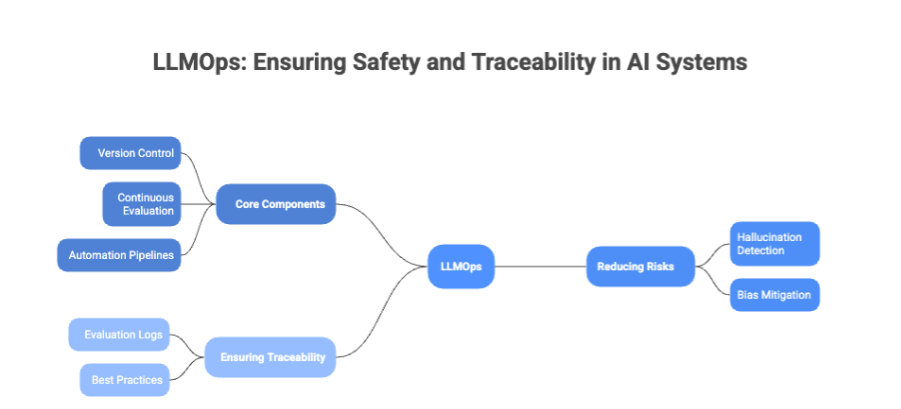
If DevOps revolutionized software, LLMOps is doing the same for large language models. It extends traditional MLOps practices but focuses specifically on the unique challenges of foundation models—like prompt management, version control, bias detection, and hallucination monitoring.
In simple terms, LLMOps ensures that once your model is deployed, it remains reliable, transparent, and continuously improving.
Core Components of LLMOps
-
Version control for prompts, datasets, and model weights to ensure reproducibility.
-
Continuous evaluation to catch hallucinations, regressions, or bias drift.
-
Automation pipelines for retraining, testing, and deployment.
Popular tools in this space include Weights & Biases, MLflow, and Hugging Face Transformers Pipelines—all essential for model governance.
Reducing Risks via LLMOps
Let’s look at how LLMOps helps control specific risks:
-
Hallucination detection: Use embedding similarity checks to compare AI outputs against verified knowledge sources. Apply uncertainty scoring to flag low-confidence or speculative responses.
-
Bias mitigation: Conduct adversarial testing—deliberately prompting models to expose unfair patterns. Retrain with balanced datasets like FairFace or Civil Comments.
IBM’s Watsonx platform uses LLMOps principles to continuously audit its AI models, flagging hallucinations and fairness issues in real time. In essence, LLMOps turns AI safety from a one-time compliance task into a living, ongoing process.

Ensuring Traceability with Evaluation Logs
Why Traceability Matters
Traceability is the audit trail of AI systems—a record of what data, models, and prompts led to which outputs. Imagine a model makes a harmful or incorrect prediction. Without traceability, you can’t know why it happened. With proper logs, you can trace back through time: which dataset was used, what prompt triggered the issue, and what model version was active.
The Role of Evaluation Logs
Evaluation logs record:
-
Inputs and outputs,
-
Model versions and timestamps,
-
Metadata like user ID, location, or session history.
These logs make it possible to:
-
Reproduce errors: debugging why a model hallucinated.
-
Ensure compliance: the EU AI Act now mandates auditability for high-risk AI systems.
-
Improve trust: users can see the reasoning or evidence trail behind an answer.
Best Practices for Traceability
-
Use structured formats (like JSON or Parquet) for easy querying.
-
Capture contextual metadata—not just the model’s output but also the environment it was generated in.
-
Include user feedback hooks (like thumbs up/down) to feed human evaluations back into model improvement cycles.
By integrating traceability with LLMOps pipelines, teams gain full visibility into every decision their AI systems make—a crucial safeguard in regulated industries.
Future Trends in Foundation Model Risk Management
The world of foundation models evolves at lightning speed. Managing risk isn’t about keeping up—it’s about staying ahead. Let’s look at where things are heading.
- Self-Correcting AI with Constitutional AI
Pioneered by Anthropic, Constitutional AI allows models to critique and correct themselves based on predefined ethical principles (like “don’t produce unsafe content”).
This approach scales alignment far beyond what’s possible with human oversight alone. However, designing “constitutions” that work across cultures and languages remains an open challenge.
RAG combines generative AI with real-time data retrieval. Instead of relying on static training data, the model searches trusted sources before answering—grounding its responses in facts.
For instance, Microsoft’s Bing Chat uses RAG to cite sources, dramatically reducing hallucinations. Future iterations may connect directly to dynamic knowledge graphs, keeping answers fresh and verifiable.
- Multimodal Risks
As AI systems expand to process text, images, and audio (like GPT-4V or Gemini 1.5), risk complexity multiplies.
-
Deepfakes blur the line between reality and fabrication.
-
Cross-modal hallucinations—like incorrect captions influencing textual answers—can spread misinformation in subtle ways.
Solutions are emerging, such as Google’s SynthID, which watermarks AI-generated media for authenticity verification.
- Regulation and Standardization
Governments are no longer passive observers.
-
The EU AI Act and the U.S. Executive Order on AI are setting strict rules around transparency, auditability, and accountability.
-
Industry initiatives like MLCommons’ Responsible AI benchmarks are promoting open-source standards for evaluation and safety.
This regulatory wave means organizations must integrate RLHF, LLMOps, and traceability—not just for ethics, but for legal compliance.
- Edge AI and On-Device Foundation Models
As models become smaller and more efficient, they’re increasingly deployed on devices—like smartphones or IoT systems.
Benefits:
-
Lower latency and improved user privacy (data never leaves the device).
Risks:
-
Limited computing power for real-time safety checks.
The challenge ahead is designing lightweight LLMOps frameworks and local evaluation logs that bring the same level of governance to the edge.
- Collaborative AI Governance
No single company can solve AI risk alone. That’s why collaborations like the Partnership on AI and Frontier Model Forum are so important. These alliances share safety practices, red-teaming methods, and RLHF datasets across the industry—creating a shared defense against systemic AI risks.

Bringing It All Together: RLHF + LLMOps + Traceability
If we zoom out, three pillars consistently emerge across every strategy:
-
RLHF keeps models aligned with human values.
-
LLMOps ensures models stay reliable, monitored, and continuously improving.
-
Traceability through evaluation logs guarantees accountability and auditability.
Think of them as the AI safety trifecta—each reinforcing the others. RLHF ensures the model learns the right behavior, LLMOps enforces that behavior in production, and traceability makes sure every decision can be explained and improved upon. When organizations integrate all three, they move from reactive risk management to proactive AI governance—a crucial shift for the future of responsible AI.
Conclusion: Balancing Innovation and Responsibility
Foundation models are reshaping how we live, work, and communicate. But with great capability comes great responsibility.
The key lessons from this analysis are clear:
-
RLHF is necessary but not sufficient: Human feedback aligns models, but scalability depends on synthetic and diverse approaches.
-
LLMOps is the backbone of safe deployment: Continuous monitoring, bias testing, and pipeline automation aren’t optional—they’re essential.
-
Traceability enables accountability: Evaluation logs provide the visibility needed for compliance, debugging, and trust.
In short, building safe foundation models isn’t just a technical challenge—it’s a cultural one. The organizations that master RLHF, LLMOps, and Traceability will not only avoid the pitfalls of hallucination and bias but will also lead the next era of trustworthy AI innovation.