Organizations in regulated sectors — finance, government, defense, and critical infrastructure—work with highly sensitive data that must remain protected and auditable at all times. These teams want to use AI to improve decision-making and automate complex processes, but moving data into public cloud AI services can introduce compliance risks around privacy, security, and data sovereignty.
This is where NexaStack makes a difference. Instead of choosing between innovation and control, enterprises can have both. NexaStack is a compliance-first, on-premise AI platform designed specifically for environments where data cannot leave the organization’s secured infrastructure.
With NexaStack, AI models, intelligent agents, and automated workflows run entirely inside the organization—whether in a private data center, a restricted government network, or an air-gapped facility. This allows teams to modernize with confidence, maintain full governance, and stay aligned with regulatory mandates—without increasing risk.
Why Regulated Industries Need On-Prem AI
Industries like healthcare, finance, government, and defense deal with highly sensitive information. A data leak isn’t just embarrassing—it can cause financial loss, legal penalties, or real harm. That’s why many of these organizations choose on-prem AI, where all data stays inside their own secure environment.
-
Protect Data Privacy and Sovereignty
Laws like GDPR, HIPAA, and PCI-DSS require strict control over where data is stored and who can access it. Public cloud systems may move data across regions, creating compliance risks. On-prem AI keeps data inside the organization, ensuring full privacy and sovereignty. -
Full Control of Security and Infrastructure
Regulated organizations often have custom security setups, strict access rules, and isolated networks. On-prem AI allows them to maintain and customize all these controls—something shared cloud platforms cannot offer. -
Reduce Third-Party and Legal Risk
Using cloud AI means depending on external providers who may be forced to share or replicate data under foreign laws. With on-prem AI, the organization retains full ownership and control, eliminating these external risks.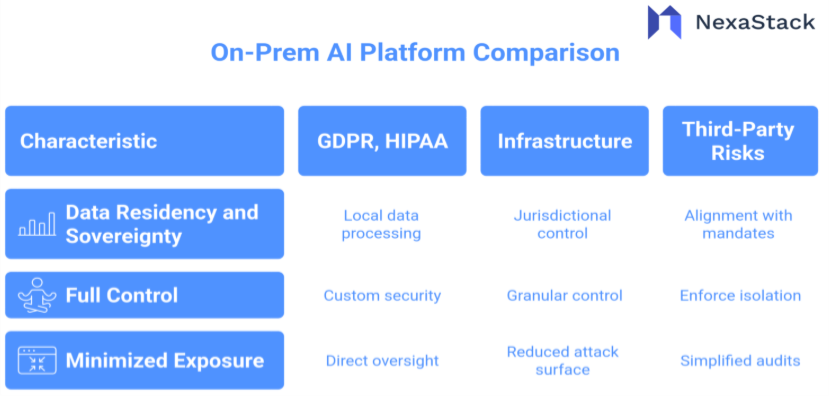 Fig 1: On-Prem AI Platform Comparison
How NexaStack Enables Compliance-First AI
NexaStack is designed for environments where governance, security, and accountability are non-negotiable. Instead of trying to retrofit cloud AI into regulated workflows, NexaStack builds compliance into the core of how AI operates.
-
Policy-Driven Agent Control
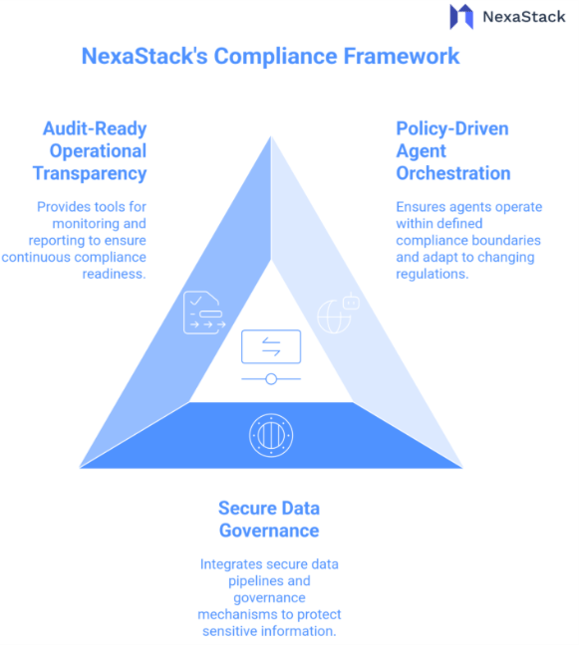
AI agents in NexaStack always work within defined rules. Organizations decide what data an agent can access, what tools it can use, and when human approval is required. Every action is logged, so AI behavior is predictable, traceable, and explainable—no “black box” decisions. -
Secure, Governed Data Usage
Data movement and processing are encrypted end-to-end. NexaStack tracks where data comes from, where it goes, and how it’s used. Retention and deletion policies are enforced centrally, giving compliance teams full visibility. -
Always Audit-Ready
All system events, decisions, and interactions are automatically recorded. NexaStack integrates smoothly with SIEM, GRC, and internal audit systems, so organizations don’t need last-minute reporting sprints. Compliance becomes continuous—not reactive.
Understanding the Regulatory Landscape
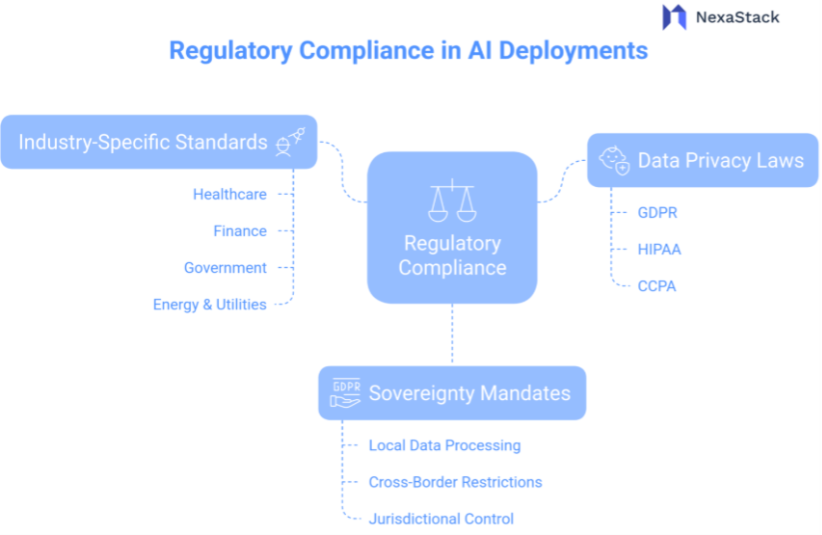
Regulated industries work under strict rules around data privacy, sovereignty, and operational control. NexaStack is built to fit directly into these environments, allowing organizations to adopt AI without violating compliance standards or moving sensitive data to external clouds.
Data Privacy and Sovereignty
Laws like GDPR, HIPAA, and CCPA require that sensitive data stay protected and often processed within specific geographic boundaries.
NexaStack’s on-prem and private cloud architecture ensures:
-
Data stays local and never leaves the organization's control
-
No dependency on external cloud providers or foreign jurisdiction laws
-
Full auditability and policy-based access at every step
This supports secure AI adoption without cross-border data risks.
Industry Compliance Alignment
-
Finance (PCI-DSS): Provides encrypted, isolated environments for payment and transaction AI workloads.
-
Government (FedRAMP/NIST): Supports zero-trust, air-gapped deployments and continuous monitoring.
-
Energy & Utilities (NERC CIP / ISO 27001): Enables resilient, secure AI systems integrated with operational infrastructure.
Why Cloud-Only AI Falls Short
Cloud-based AI platforms are powerful and convenient, but they are built on the assumption that data can move freely through shared cloud environments. For many organizations, that works fine. But in regulated industries, the story is different—data cannot simply be uploaded, processed, or stored wherever the vendor chooses. Every movement of data must be controlled, monitored, and legally compliant.
This is where cloud-only AI begins to fall short.
When your models run in a vendor’s cloud, you often don’t have full visibility into:
-
Where your data is physically stored
-
Which internal systems or people can access it
-
Whether the data is being replicated across regions
-
How it is being monitored or logged
You rely on the vendor’s assurances—not your own controls.
A Real-World Example
Consider a national healthcare provider using AI to help doctors analyze patient scans and medical records. This data is highly sensitive and regulated under laws like HIPAA.
If the organization sends this data to a public cloud AI service, the data could be stored or processed in another country, viewed by cloud administrators, or moved between datacenters without full visibility.
Even if the cloud provider’s security is strong, the healthcare provider cannot prove or control where the data goes—making it a compliance and governance risk, not just a technical one. 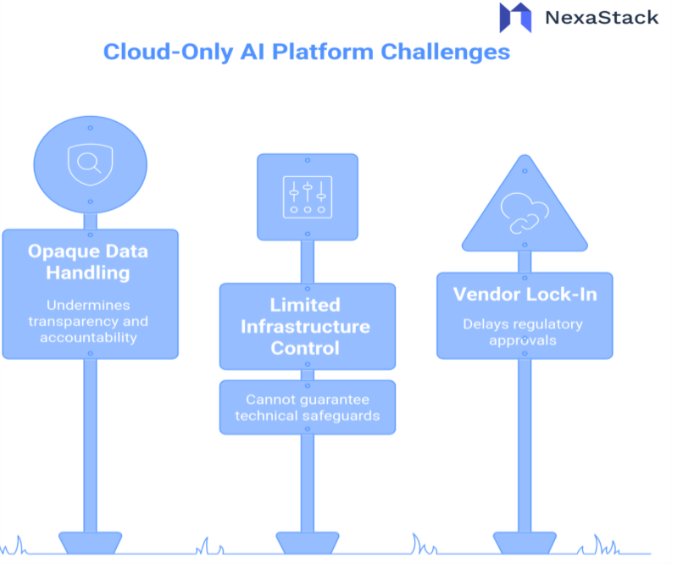
The NexaStack On-Prem Advantage
NexaStack allows organizations to keep:
-
Data inside their infrastructure
-
Compute controlled on dedicated hardware
-
Decision logic governed by internal policies
This means AI becomes an extension of the organization—not an outsourced system that must be trusted without transparency. The result is compliance confidence. Every decision made by an agent can be traced, justified, and audited.
Additionally, NexaStack fits into existing environments. It works with legacy systems, internal applications, private clouds, and operational networks. Organizations can modernize incrementally—without ripping out or replacing critical infrastructure.
Core Capabilities That Enable Trusted AI
NexaStack isn’t just about running AI models—it’s about ensuring those models operate safely inside strict regulatory environments. It provides four key capabilities that make AI deployment secure, traceable, and dependable:
Context-First Agent Infrastructure
AI agents don’t act blindly. They operate based on defined policies, business rules, and real-time context.
For example, in a hospital system, an AI assistant analyzing patient data will only access the records it is authorized for—and will follow care-team protocols before suggesting actions. It behaves like a trained professional, not a generic model.
Secure and Traceable Data Pipelines
Every movement of data is encrypted, logged, and tied to a governance policy.
For instance, when financial records move from a core banking system to an analytics engine, NexaStack automatically records who accessed what, when, and why—ensuring audit readiness without manual work.
Zero-Trust Access and Network Isolation
No interaction is trusted by default—not users, services, or internal systems. All access is continuously validated.
Example: In a government defense lab, only verified service identities can communicate—blocking lateral movement and insider risk.
Built-In Observability and Audit Reporting
Compliance reporting isn’t bolted on later—it’s built into the platform.
For example, when regulatory teams need evidence for HIPAA, RBI, PCI-DSS, or ISO audits, NexaStack can generate reports directly from system logs—accurately and instantly.
Together, these capabilities create a governed AI operating environment—not simply a place to host models. NexaStack ensures AI remains secure, compliant, and aligned with organizational and regulatory requirements from day one.

Deployment Considerations
Deploying NexaStack on-prem is straightforward, but a few foundational components ensure performance and security. Most organizations use GPU-powered compute nodes (such as A100, H100, or MI-series) to handle model inference efficiently. Tiered storage helps manage both high-activity data and long-term archives without unnecessary cost. Meanwhile, network segmentation keeps sensitive systems isolated—separating general IT networks from secured or operational zones.
As workloads grow, NexaStack scales horizontally, allowing teams to simply add more compute nodes without disrupting existing operations. This makes the platform adaptable, future-ready, and easy to expand as AI demand increases.
Use Cases Across Regulated Sectors
NexaStack is actively used in environments where security, privacy, and compliance cannot be compromised.
-
Financial institutions rely on NexaStack for fraud detection, risk scoring, and customer verification, where every model decision must be explainable and fully auditable.
-
Government and defense agencies use NexaStack to process classified intelligence, automate document workflows, and run secure analysis inside isolated or air-gapped networks.
-
Energy and critical infrastructure operators use NexaStack to detect equipment failures early and monitor grid or plant operations—without exposing sensitive operational telemetry to external clouds.

Best Practices for Deploying NexaStack
For an on-prem NexaStack deployment, start by enforcing least-privilege access so users and AI agents only access what they truly need. Enable continuous monitoring and compliance dashboards to catch risks in real time. If your data is spread across locations, use hybrid or federated models to keep data local while still enabling AI to work effectively. Finally, automate routine governance tasks with policy-based AI agents to reduce manual effort.
This turns compliance into a built-in, always-on capability rather than a periodic manual process.
Future-Proofing AI in Regulated Environments
AI regulations are changing quickly, with new requirements for transparency, accountability, and data protection. Organizations need AI systems that can evolve alongside these rules. NexaStack is designed for this future—offering features like explainability, bias detection, policy versioning, and controlled rollout of new model types. Even as AI becomes more powerful, NexaStack ensures every model remains traceable, compliant, and aligned with internal and regulatory policies. This allows regulated enterprises to scale AI confidently, without risking governance or compliance.
Conclusion
Regulated industries want to use AI, but they can’t risk their sensitive data leaving their control. NexaStack solves this by running AI inside your secure on-prem or private cloud environment — so data never leaves your infrastructure.
Its zero-trust and policy-based controls ensure every AI action is compliant and auditable. This allows healthcare, finance, and government organizations to use AI confidently without compromising security, privacy, or trust.
Strategic Advantage of NexaStack for Regulated Industries
-
Keeps Sensitive Data In-House: AI runs inside secure boundaries — no external exposure.
-
Built-In Compliance Controls: Logging, auditing, encryption, and role-based access are native.
-
Unified Governance: Ensures every AI workflow is explainable, monitored, and policy-aligned.
-
Future-Ready Architecture: Supports hybrid GPU environments, LLM fine-tuning, and AI agent orchestration.
This allows teams to adopt and scale AI without introducing operational or compliance risk.
Roadmap for Secure, Compliant, On-Prem AI Adoption
To successfully adopt AI within regulated environments, organizations can follow a practical staged approach:
-
Assess Data Sensitivity & Compliance Requirements
Identify which datasets and workflows require strict control and define policies around them. -
Establish a Secure AI Foundation
Deploy NexaStack (or similar secure AI infrastructure) within your internal environment or private cloud. -
Start with High-Value, Low-Risk Use Cases
Examples: knowledge assistance, document summarization, and standard report automation. -
Expand to Cross-Functional AI Workflows
Integrate AI into broader business systems (EHR, ERP, Financial Systems, Case Management, etc.). -
Enable Autonomous AI Agents (Safely)
Introduce governed agents that operate within defined boundaries — with full audit trails and override controls.
Frequently Asked Questions (FAQs)
Quick FAQs on on-prem AI for regulated environments.
Why use on-prem AI?
For full control over data, infrastructure, and compliance.
How does it improve security?
Data stays inside protected networks with restricted access.
Can it run large models?
Yes — modern GPU clusters support advanced workloads.
Who needs on-prem AI?
Healthcare, finance, government, and other regulated sectors.