Artificial Intelligence (AI) has evolved from experimental pilots into a foundational capability powering modern enterprises. Organizations now rely on AI to optimize operations, automate decision-making, forecast outcomes, and deliver personalized experiences at scale. Yet despite widespread adoption, many enterprises fail to translate AI investments into sustained business value.
The core challenge is not models or talent—it is the absence of a robust enterprise AI backbone. Without a secure, scalable, and governed infrastructure layer, AI initiatives remain fragmented, difficult to scale, and expensive to operate. This gap slows enterprise-wide adoption and limits AI’s strategic impact.
An enterprise AI backbone provides the structural foundation required to operationalize AI across its full lifecycle—from data ingestion and model training to inference, orchestration, and continuous optimization. NexaStack is purpose-built to deliver this foundation, enabling enterprises to move from isolated AI experiments to production-grade, autonomous AI systems deployed across private, hybrid, and multi-cloud environments.
Why Enterprises Need an AI Backbone
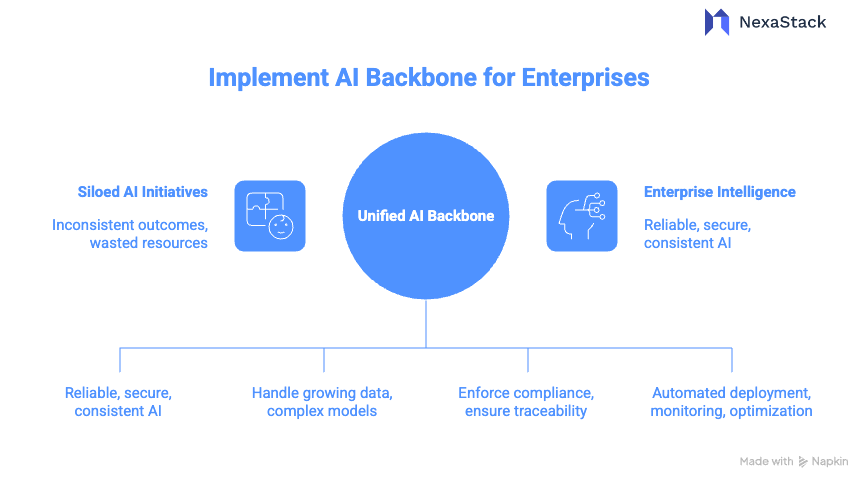
An enterprise AI backbone is not just infrastructure—it is the control plane for enterprise intelligence. It ensures that AI systems operate reliably, securely, and consistently across teams, environments, and business units.
Without a unified backbone, enterprises encounter recurring challenges:
-
Siloed AI Initiatives
Teams build models independently, duplicating effort and producing inconsistent outcomes, resulting in wasted resources and delayed value. -
Limited Scalability
As data volumes grow and models become more complex, infrastructure bottlenecks prevent AI systems from scaling reliably. -
Governance and Compliance Gaps
Distributed AI workflows make it difficult to enforce compliance, ensure traceability, and maintain explainability—especially in regulated environments. -
Operational Inefficiency
Manual deployment, monitoring, and optimization increase operational overhead and extend time-to-value.
Example:
A retail enterprise deploys AI for pricing optimization, inventory forecasting, and personalized recommendations. Without a unified AI backbone, each system uses separate datasets, compute pools, and deployment pipelines. The result is inconsistent insights, deployment delays, and rising operational costs—undermining AI’s promised efficiency gains.
Key Drivers for a Strong Enterprise AI Backbone
-
Scalability to support large datasets, complex models, and multi-agent systems
-
Interoperability across legacy systems and modern AI platforms
-
Governance for traceability, compliance, and explainability
-
Operational Efficiency through automation across deployment and monitoring
-
Security and Trust for sensitive data and regulated workloads

Role of NexaStack in Enterprise AI Infrastructure
Managing AI infrastructure across compute, storage, networking, and security introduces significant complexity. NexaStack simplifies this landscape by providing a unified, agent-first infrastructure platform that allows enterprises to focus on AI outcomes rather than infrastructure overhead.
1. Unified Orchestration Across Hybrid Environments
NexaStack abstracts infrastructure across private cloud, on-premises, and public cloud environments, enabling seamless workload mobility and consistent performance.
-
Dynamic Compute Allocation
CPUs, GPUs, and AI accelerators are provisioned automatically based on workload requirements. -
Intelligent Storage Integration
Object, block, and file storage are tiered with awareness of data locality and performance needs. -
Secure Network Virtualization
SDN and service mesh technologies enable low-latency, policy-driven connectivity across distributed environments.
This unified orchestration reduces latency, improves resource utilization, and ensures consistent AI performance at scale.
2. Agent-First Architecture for Multi-Agent AI Systems
Modern enterprise AI is increasingly agentic—built on autonomous agents that reason, collaborate, and act across systems. NexaStack is designed specifically to support this paradigm.
-
Context-First Agents
Agents maintain persistent memory and contextual awareness across tasks and workflows. -
Multi-Agent Orchestration
Coordinated agent execution enables collaboration, delegation, and parallel task execution. -
AgentOps and RLaaS Support
Reinforcement learning workflows and lifecycle management tools support continuous agent optimization.
Example:
In supply chain operations, NexaStack-powered agents monitor inventory levels, forecast demand, and coordinate logistics autonomously—optimizing efficiency without human intervention.
3. Integrated FinOps and Observability
AI infrastructure costs can escalate rapidly without visibility and control. NexaStack embeds FinOps and observability directly into the AI backbone.
-
Real-Time Cost Attribution by project, team, or workload
-
Usage-Based Optimization to identify underutilized resources
-
Full-Stack Observability across infrastructure, models, and agent workflows
This ensures AI investments remain aligned with business outcomes while avoiding overprovisioning.
4. Enterprise-Grade Security and Compliance
Security and compliance are non-negotiable for enterprise AI—especially in regulated industries.
-
Zero-Trust Architecture with identity-based access and encryption
-
Compliance Acceleration for GDPR, HIPAA, SOC 2, and industry frameworks
-
Model and Data Governance with lineage tracking and explainability
These capabilities make NexaStack suitable for various use cases, including healthcare, finance, manufacturing, and government.
5. Abstraction of Infrastructure Complexity
NexaStack abstracts operational complexity so teams can focus on innovation:
-
Developers deploy AI workloads without managing GPU provisioning
-
Data scientists access governed datasets seamlessly
-
Operations teams monitor performance and costs from a unified dashboard
This abstraction accelerates time-to-value and reduces operational friction.

Core Pillars of Enterprise AI Infrastructure
1. Compute Power and Scalability
AI workloads demand elastic, high-performance compute.
-
GPU and AI accelerator orchestration across on-prem and cloud
-
Elastic scaling for bursty AI workloads
-
Workload-aware scheduling to maximize throughput
Best Practice: Auto-scaling ensures peak performance without overprovisioning.
2. Data Infrastructure and Governance
Enterprise AI depends on secure, governed access to data.
-
Unified access across data silos without duplication
-
Dataset versioning and lineage for auditability
-
Policy-driven governance with encryption and access controls
3. Networking and Connectivity
Distributed AI requires intelligent networking.
-
Software-defined networking for dynamic routing
-
Edge-to-core connectivity for low-latency inference
-
Secure, compliance-aware data pipelines
4. Security, Compliance, and Trust
Trust is foundational for enterprise AI adoption.
-
Zero-trust access controls
-
Compliance-ready templates
-
Explainable, traceable AI decisions
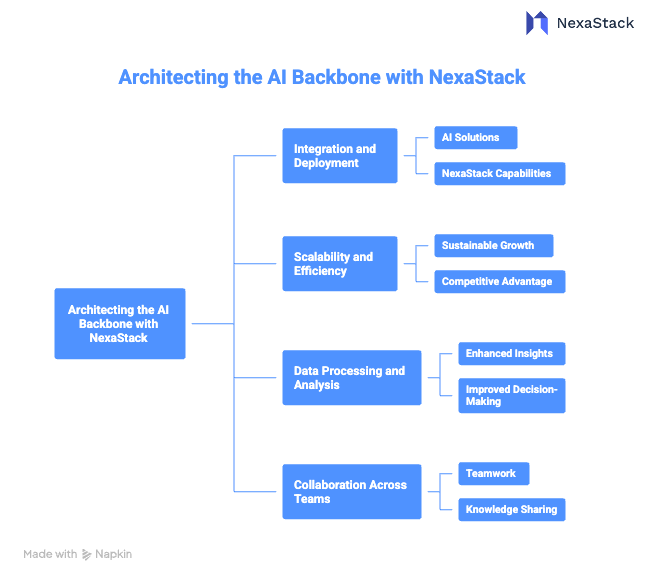
Architecting the AI Backbone with NexaStack
Context-First Agent Infrastructure
NexaStack enables autonomous agents that adapt in real time:
-
Memory-augmented agents for continuous learning
-
Multi-agent coordination and delegation
-
Real-time context switching
Integration with Legacy and Cloud-Native Systems
-
API-first integration with ERP, CRM, and data platforms
-
Flexible deployment across Kubernetes, OpenShift, and serverless
-
Data virtualization across systems
Orchestration of AI Agents and Workflows
-
Agent lifecycle management
-
Event-driven workflow automation
-
Policy-based task routing

Key Considerations for Deployment at Scale
-
Performance and Latency Optimization
-
Reliability and High Availability
-
Cost Management and FinOps Alignment
-
Monitoring, Observability, and Feedback Loops
Future-Proofing the Enterprise AI Backbone
-
Support for LLMs, multi-modal, and diffusion models
-
Compatibility with modern AI frameworks and runtimes
-
Foundation for autonomous enterprise operations
Conclusion: Strategic Importance of NexaStack
AI is now a strategic differentiator for enterprise competitiveness. NexaStack provides the enterprise AI backbone required to deploy agentic AI systems securely, scalably, and efficiently across hybrid environments.
By unifying compute, data, networking, security, and agent orchestration, NexaStack enables enterprises to move beyond experimentation, building autonomous and intelligent operations that deliver measurable business value today and remain future-ready.