Computer vision has rapidly evolved from a niche research field into one of the most transformative forces in modern enterprises. From automating quality inspection to enhancing customer analytics and improving healthcare diagnostics, Vision AI has become the foundation of next-generation business intelligence. However, while the promise is enormous, the path to production is complex.
Enterprises face the daunting challenge of scaling Vision AI workloads — training deep learning models on massive image and video datasets, orchestrating distributed compute infrastructure, and maintaining consistent performance across diverse deployment environments.
NexaStack bridges this gap. It provides a scalable, composable, and cloud-native Vision AI stack that enables organisations to build, deploy, and manage computer vision systems with unmatched efficiency and reliability. Designed for enterprise-grade use, NexaStack unifies data, model, and infrastructure management under one platform — empowering businesses to move from experimentation to large-scale production effortlessly.
Why Enterprises Need Scalable Vision AI
Enterprises today operate in a visually rich, sensor-driven environment. Manufacturing lines generate continuous inspection footage; healthcare systems process terabytes of imaging data; retail environments depend on visual analytics for customer behaviour insights; and smart cities rely on surveillance and IoT vision feeds for public safety.
The challenge lies not in generating data but in deriving intelligence from it — at scale. Traditional machine learning setups often struggle to handle the demands of high-resolution imagery, continuous data ingestion, and real-time inference requirements.
Key pain points enterprises face:
-
Data fragmentation: Visual data is scattered across edge devices, storage systems, and cloud silos.
-
Model scalability: Models trained on limited samples often fail in production when faced with diverse conditions.
-
Infrastructure bottlenecks: GPUs and storage resources are underutilised or overburdened.
-
Compliance and governance: Vision AI models frequently process sensitive or identifiable data. Ensuring compliance with GDPR, HIPAA, or SOC 2 requires built-in traceability.
A scalable Vision AI stack like NexaStack eliminates these challenges by combining automation, scalability, and security in one platform — allowing enterprises to focus on insights, not infrastructure.
Role of NexaStack in Building Robust AI Pipelines
NexaStack is designed as a Vision AI control plane — a unified orchestration layer that spans across data pipelines, model lifecycles, and compute infrastructure. Its architecture embodies the principles of MLOps, DevSecOps, and Zero-Trust AI, ensuring that Vision AI can be deployed securely and efficiently across hybrid environments.
How NexaStack strengthens AI pipelines:
-
Unified Pipeline Management: From data ingestion to model deployment, all stages are managed under one dashboard with full traceability.
-
Elastic Infrastructure: Dynamically scales GPU/TPU nodes for compute-intensive workloads.
-
Model Registry and Governance: Tracks every model version, dataset lineage, and hyperparameter configuration.
-
Continuous Delivery for AI: Automates training, validation, and deployment cycles — ensuring Vision AI systems remain accurate and up to date.
-
Integration-ready: NexaStack offers APIs and SDKs for integration with ERP, CRM, IoT, and edge systems.
By abstracting away complexity, NexaStack allows data scientists, engineers, and IT teams to collaborate seamlessly across the entire Vision AI lifecycle.
Understanding the Vision AI Stack
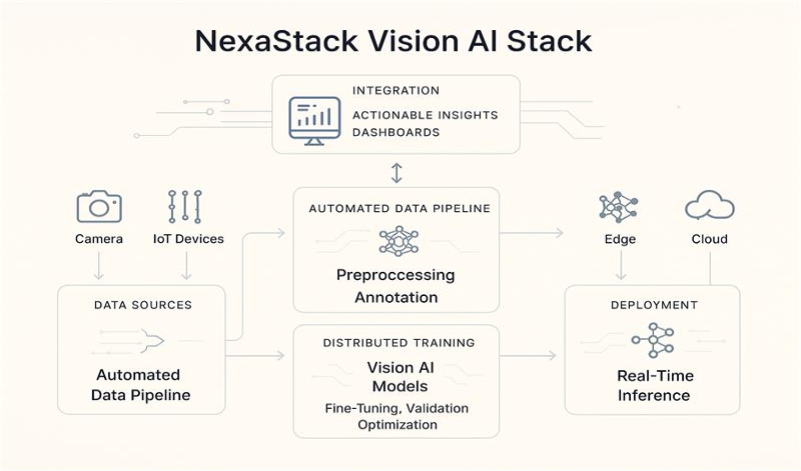
A Vision AI stack represents the end-to-end ecosystem that enables image and video-based machine learning. It typically includes multiple layers working in harmony — data, models, and infrastructure.
- Data Layer
The foundation of every Vision AI system. This includes:
-
Data ingestion (from cameras, IoT sensors, cloud buckets)
-
Preprocessing (resizing, denoising, normalisation)
-
Storage and cataloguing
-
Annotation and metadata management
- Model Layer
This is where learning happens. Vision AI models — from CNNs to Vision Transformers — are trained and evaluated here. It includes:
-
Model architecture selection
-
Training and validation
-
Experiment tracking and versioning
-
Infrastructure Layer
The backbone that supports compute-intensive AI tasks. This involves:
-
Distributed training clusters (Kubernetes, Ray, or Horovod)
-
GPU/TPU orchestration
-
Edge-cloud synchronisation for hybrid deployments
NexaStack connects these layers seamlessly through a modular, composable AI fabric, allowing enterprises to evolve their Vision AI systems as workloads grow.
Core Components: Data, Models, and Infrastructure
Data
NexaStack’s data pipeline framework enables enterprises to ingest, preprocess, and label massive datasets without manual effort.
It supports:
-
Multi-format inputs (images, videos, LiDAR, thermal, depth maps)
-
Automatic schema inference and metadata tagging
-
Integration with AWS S3, GCP Storage, Azure Blob, and on-prem systems
AI-assisted labelling tools accelerate dataset creation using semi-supervised annotation and active learning loops — drastically reducing human workload while improving accuracy.
Models
The platform comes pre-integrated with leading frameworks:
-
TensorFlow and PyTorch for deep vision models
-
ONNX Runtime for model portability
-
NVIDIA Triton for scalable inference
NexaStack supports transfer learning, fine-tuning, and model distillation, enabling rapid iteration and optimisation of vision models for diverse applications — from defect detection to emotion recognition.
Infrastructure
Built on Kubernetes-native architecture, NexaStack dynamically provisions compute and storage resources based on workload demand.
-
Supports hybrid deployment (on-prem + cloud)
-
Auto-scales GPU clusters
-
Provides high-availability storage with data redundancy
This ensures that Vision AI workloads remain performant, reliable, and cost-efficient.
Challenges in Scaling Vision AI Workloads
Scaling Vision AI isn’t just about adding more GPUs or storage. The true complexity lies in orchestrating a continuous flow of data, training, and inference, while maintaining quality and compliance.
Common challenges include:
-
Data Volume Explosion: High-definition video data grows exponentially, straining ETL pipelines.
-
Complex Training Environments: Multi-node GPU synchronisation requires robust orchestration.
-
Model Drift: Changes in lighting, background, or camera quality degrade accuracy over time.
-
Operational Silos: Lack of integration between data engineering, AI, and DevOps teams delays innovation.
-
Regulatory Oversight: Enterprises must ensure AI decisions remain explainable and traceable.
NexaStack’s AI observability and automation engine mitigates these by enforcing consistency and transparency across the stack — from dataset lineage to deployment monitoring.
Data Pipeline for Vision AI 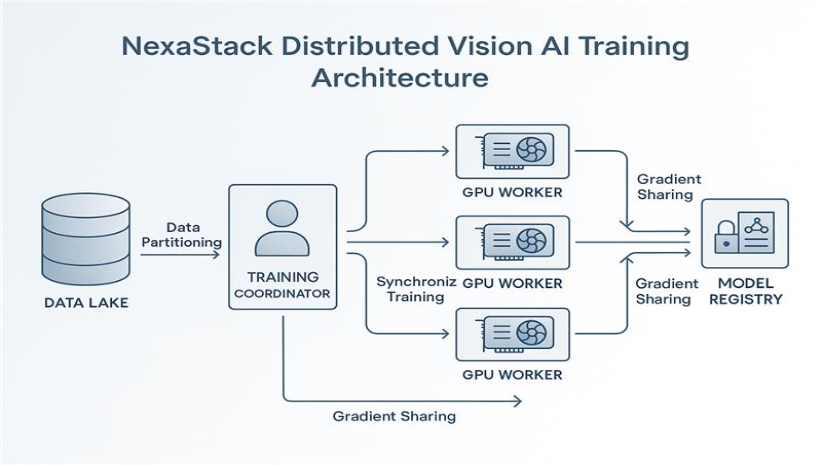
Data Ingestion and Preprocessing at Scale
NexaStack enables organisations to connect data sources — cameras, sensors, drones, or cloud repositories — into a unified data pipeline. Using parallelised data ingestion and preprocessing nodes, it can handle terabytes of image data with minimal latency. The system automatically detects corrupt files, duplicates, and anomalies, ensuring high data fidelity.
Labelling and Annotation Automation
Labelling is traditionally time-consuming and error-prone. NexaStack employs AI-assisted labelling, where pre-trained models perform first-pass annotations, and humans only review uncertain cases. This hybrid loop achieves up to 70% faster labelling with higher precision.
Handling Multimodal Data Efficiently
NexaStack’s pipeline is multimodal by design. It can fuse:
-
Visual streams (RGB, thermal)
-
Textual descriptions
-
Sensor data (depth, accelerometer, LiDAR)
-
Audio cues (in surveillance or robotics)
This multimodal fusion creates richer contextual understanding — essential for tasks like scene recognition or predictive maintenance.
Model Development and Training
Vision Model Architectures and Frameworks
NexaStack offers a model zoo with ready-to-use architectures:
-
ResNet, EfficientNet, and ConvNeXt for classification
-
YOLOv8, Detectron2, and SSD for object detection
-
UNet, Mask R-CNN, and DeepLabV3+ for segmentation
-
Swin Transformer and CLIP for multimodal understanding
Developers can deploy pre-trained models or train custom architectures using NexaStack’s high-performance environment optimised for GPUs and TPUs.
Distributed Training with NexaStack
For enterprises dealing with petabyte-scale data, NexaStack supports distributed data parallel (DDP) and model parallel (MP) training using Kubernetes, Ray, and Horovod.
It includes:
-
Elastic job scheduling
-
Automated checkpointing
-
Fault-tolerant recovery
-
Spot instance optimisation for cost savings
Training runs are automatically logged in NexaStack’s Experiment Tracker, ensuring reproducibility and version control.
Continuous Improvement with Feedback Loops
Once deployed, NexaStack continuously collects inference metrics — such as confidence scores, error rates, and latency — feeding them back into the training pipeline. This closed-loop system enables auto-retraining and model promotion, ensuring models evolve with new data trends and maintain high performance.
Inference and Deployment
Real-time vs. Batch Inference Pipelines
NexaStack distinguishes between real-time and batch workloads:
-
Real-time inference: For surveillance, robotics, and smart manufacturing systems where millisecond latency is crucial.
-
Batch inference: For large-scale analysis, such as reviewing thousands of medical scans or retail footage overnight.
The platform intelligently routes workloads based on SLA requirements.
Edge vs. Cloud Deployment Strategies
NexaStack’s hybrid deployment engine supports edge AI, cloud AI, and hybrid configurations:
-
Edge: Low latency, localised decision-making, reduced bandwidth costs.
-
Cloud: Centralised compute for heavy inference and analytics.
-
Hybrid: Balances cost and performance using adaptive scheduling.
Edge deployment uses lightweight container runtimes (like K3S or Docker Swarm), while cloud deployments leverage Kubernetes clusters and GPU pools for large-scale inference.
Integration with Enterprise Systems
Vision AI becomes powerful only when integrated into business workflows. NexaStack provides RESTful APIs, event streams, and webhook triggers that enable seamless integration with enterprise applications — ERP, MES, CRM, or IoT platforms.
This ensures insights generated by Vision AI can trigger automated business actions, such as halting defective production lines, alerting staff, or updating customer profiles in real time.

Observability, Monitoring, and Governance
Tracking Model Performance and Drift
Every Vision AI system must evolve continuously. NexaStack’s AI Observability Layer tracks:
-
Model accuracy and false-positive trends
-
Latency and throughput
-
Dataset version lineage
-
Feature importance and explainability metrics
Ensuring Compliance and Audit Readiness
NexaStack includes AI governance modules that log every decision, dataset, and model version. Enterprises can produce detailed audit trails for regulatory requirements in healthcare, finance, or public sectors. All components follow Zero-Trust Identity frameworks, ensuring only authorised entities can access models, data, or inference results.
End-to-End Visibility Across the Stack
NexaStack provides unified visibility across the entire Vision AI pipeline — from data ingestion to real-time inference — through intuitive dashboards and system health monitors. This visibility enables IT, data science, and compliance teams to collaborate efficiently.
Industry Use Cases of Scalable Vision AI
-
Manufacturing: Defect Detection and Quality Control
NexaStack automates visual inspection workflows using high-resolution cameras and edge inference engines. AI models identify surface defects, misalignments, or missing components in milliseconds — reducing manual inspection costs by up to 80%. -
Retail & Smart Cities: Surveillance and Customer Analytics
Retailers leverage NexaStack for customer heatmaps, queue detection, and shelf analytics. Smart cities deploy NexaStack-powered systems for traffic analysis, crowd management, and public safety monitoring — ensuring scalability from a few cameras to thousands of streams.

Future of Vision AI with NexaStack
Role of RLaaS in Adaptive Vision Systems
NexaStack’s Reinforcement Learning as a Service (RLaaS) introduces adaptive intelligence into Vision AI systems. Models can learn from operational outcomes — for instance, adjusting inspection thresholds based on changing environmental conditions — making Vision AI self-improving over time.
Multi-Agent Orchestration for Complex Environments
Future Vision AI systems will consist of multiple specialised agents — detection agents, tracking agents, analytics agents — that must collaborate seamlessly. NexaStack’s multi-agent orchestration ensures secure, decentralised communication among these AI agents, enabling coordinated intelligence at scale.
Path Toward Autonomous Vision AI Operations
The next frontier is autonomous Vision AI operations, where models self-monitor, retrain, and redeploy without human intervention. NexaStack is already enabling this evolution through Zero-Trust multi-agent identity frameworks, ensuring security even in fully autonomous AI environments.
Conclusion
Key Takeaways for Enterprises
-
Vision AI is critical for modern enterprises seeking operational efficiency and innovation.
-
Scaling Vision AI requires unifying data, models, and infrastructure under one robust platform.
-
NexaStack provides the automation, security, and observability essential for enterprise-scale deployment.
How NexaStack Accelerates Vision AI Adoption
With NexaStack, enterprises can turn visual data into actionable intelligence at scale. The platform’s end-to-end capabilities — from data ingestion to autonomous inference — simplify the Vision AI lifecycle while ensuring performance, compliance, and trust.
As businesses embrace Industry 5.0 and AI-driven automation, NexaStack stands at the forefront — delivering the scalability, reliability, and intelligence needed to power the next generation of Vision AI systems.