The rapid rise of distributed AI systems, where multiple agents and models operate across clouds, teams, and geographies, has created a new challenge: how do you govern, secure, and control AI at scale?
Traditional IT infrastructures—while strong for VMs, containers, and microservices—fall short when applied to AI models and agents. Enterprises now need a dedicated governance and control layer designed specifically for distributed AI. Enter the MCP Server (Model Control Plane).
This blog explores how MCP Servers provide the governance, access control, and isolation required to make distributed AI both secure and enterprise-ready. We’ll cover definitions, architecture, real-world use cases, and a forward-looking roadmap for CIOs and AI leaders.
Why Distributed AI Control Requires New Infrastructure
AI is no longer a centralized resource confined to a single data center or cloud. Today, models operate in a wide variety of environments—on-premises servers, public and private clouds, hybrid setups, and increasingly at the edge on devices like IoT sensors, mobile platforms, and specialized AI hardware. Alongside this diversification, multi-agent systems are becoming the standard.
In these systems, multiple autonomous AI agents work together, each handling specialized tasks, sharing insights, and making coordinated decisions in real time. While this distributed intelligence unlocks unprecedented capabilities, it also introduces significant challenges for enterprises attempting to manage and scale AI responsibly.
Without a unified control layer, organizations quickly encounter serious friction points:
-
Governance gaps: It becomes nearly impossible to track which models are being used, by whom, and for what purpose. This lack of transparency can result in compliance issues, inefficient audits, and difficulty enforcing policies across departments or teams.
-
Security risks: Distributed agents may inadvertently access sensitive data, or models might be deployed without proper isolation. Without centralized guardrails, even minor misconfigurations can lead to data leaks, regulatory violations, or exposure of proprietary algorithms.
-
Operational inefficiency: Teams often end up duplicating work, retraining models unnecessarily, or creating redundant pipelines. The absence of centralized oversight means organizations cannot fully leverage shared resources, leading to wasted compute, fragmented knowledge, and slower innovation cycles.
In essence, AI has become the new compute layer of modern enterprises. Just as Kubernetes emerged to orchestrate containerized workloads and provide consistency across diverse infrastructure, a Model Control Plane (MCP) Server is emerging to orchestrate AI. It provides the governance, security, and operational consistency enterprises need to deploy AI at scale safely and efficiently, transforming distributed intelligence from a potential liability into a strategic advantage.
The Role of an MCP (Model Control Plane) Server
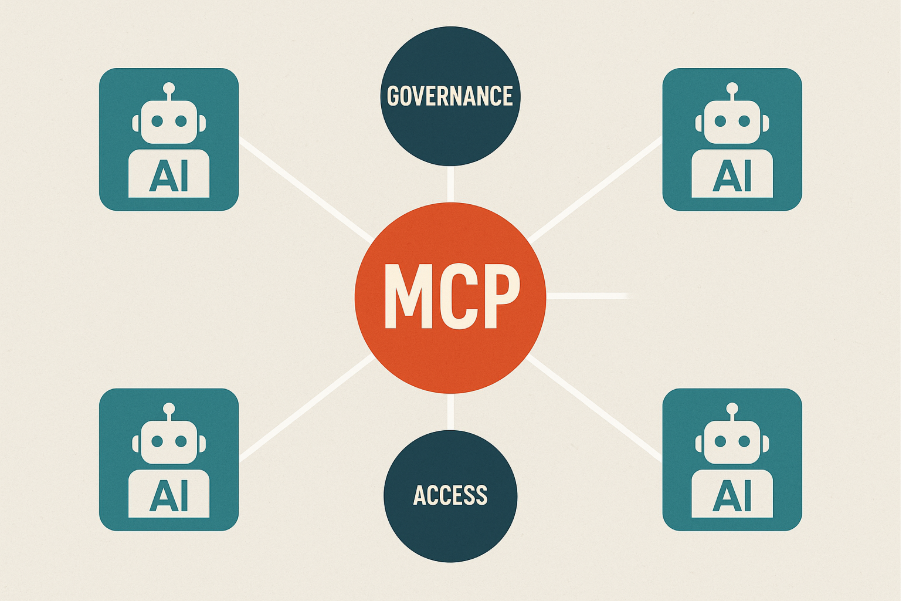
At its core, the MCP Server serves as the central authority for orchestrating and governing distributed AI systems. Imagine it as the air traffic controller of an AI ecosystem—coordinating multiple autonomous agents, models, and data streams to ensure everything operates safely, efficiently, and according to established policies. Without such oversight, distributed AI can quickly become chaotic, with duplicated efforts, security blind spots, and governance gaps.
The MCP Server provides a range of critical functions that keep AI operations under control:
-
Governance enforcement: It applies and monitors policies across all environments, ensuring that models are deployed and used in compliance with organizational rules, regulatory standards, and ethical guidelines. This visibility enables teams to track usage, performance, and adherence to policies in real-time.
-
Access management: MCP regulates who or what can interact with models, APIs, and data endpoints. Centralizing authentication and authorization prevents unauthorized access and maintains fine-grained control over sensitive assets.
-
Isolation and security: Multi-tenant environments and collaborative AI projects demand strict isolation to protect data and model integrity. MCP ensures that projects, teams, and workloads remain securely partitioned, preventing accidental or malicious cross-access.
-
Operational consistency: Just as the Kubernetes control plane abstracts the complexity of container orchestration, the MCP Server abstracts the complexity of AI deployment. It standardizes workflows, automates routine tasks, and ensures distributed AI systems run predictably across diverse infrastructure—on-premises, cloud, or edge.
In short, the MCP is to AI what the Kubernetes control plane is to containers: the central brain that governs distributed execution, provides clarity, and enforces discipline, enabling organizations to scale AI safely, efficiently, and confidently.

What is an MCP Server?
Definition and Core Functions
-
A Model Control Plane (MCP) Server is the central control layer for managing AI models and autonomous agents across distributed environments. It functions as the governance and orchestration hub, ensuring that AI systems operate securely, efficiently, and in compliance with organizational policies. Core capabilities include:
-
Policy enforcement: Governs which models or agents can access specific data or perform tasks, ensuring usage aligns with organizational rules and regulatory requirements.
-
Authentication and authorization: Manages identity and permissions for agents, models, and APIs, preventing unauthorized access and maintaining secure interactions.
-
Monitoring, logging, and compliance tracking: Provides visibility into AI workflows, including agent actions, model decisions, and data usage, enabling audits and continuous compliance verification.
How It Differs from Traditional Control Planes
While traditional control planes—like Kubernetes for containers or service meshes for networking—focus on compute and network orchestration, the MCP Server is purpose-built for AI systems. Its focus is on intelligent entities rather than infrastructure:
-
Models instead of containers: Manages lifecycle, deployment, and access for AI models, not just the compute that runs them.
-
Agents instead of microservices: Coordinates autonomous AI agents performing specialized tasks, rather than general-purpose services.
-
Data flows instead of network traffic: Orchestrates AI-driven interactions and ensures that data moves securely and appropriately between models and agents.
Importance in Multi-Agent and Multi-Model Systems
In environments where multiple models and agents collaborate on complex tasks, the MCP becomes essential:
-
Permission enforcement: Ensures no agent exceeds its allowed capabilities or accesses restricted data.
-
Isolation with orchestration: Maintains model and agent isolation for security and compliance, while still enabling coordinated workflows.
-
Comprehensive auditability: Tracks every action, decision, and data access, providing full transparency for governance and compliance audits.
In essence, the MCP Server transforms distributed AI from a fragmented and risky setup into a manageable, secure, and auditable ecosystem, enabling enterprises to scale AI with confidence.
Governance in Distributed AI with MCP
Centralized Policy Enforcement
MCP provides a single source of truth for policies—covering who can access models, how data can be processed, and what guardrails exist.
Auditability, Compliance, and Transparency
-
Every request, inference, or decision can be logged and traced.
-
Regulators or auditors can see clear evidence of responsible AI usage.
Guardrails for Responsible AI Operations
Beyond compliance, MCP enforces ethical constraints, ensuring AI systems don’t generate harmful, biased, or non-compliant outputs.

Access Control Mechanisms
Role-Based and Attribute-Based Access Controls (RBAC/ABAC)
-
RBAC: Permissions based on role (e.g., Data Scientist, Auditor).
-
ABAC: Permissions based on attributes (e.g., data sensitivity, region, time of access).
Identity and Permission Management
MCP integrates with enterprise identity systems (e.g., LDAP, SSO, OIDC) to enforce consistent identity across AI systems.
Securing APIs and Endpoints
Since most AI agents and models expose APIs, MCP enforces token-based authentication, rate-limiting, and encryption to secure communication.
Isolation and Security in MCP Servers
Tenant Isolation for Multi-Team Environments
Each team or department can operate independently, without risk of data leakage or policy overlap.
Data, Model, and Agent Segregation
MCP enforces strict segregation of data pipelines, models, and agent execution environments.
Preventing Cross-Contamination and Unauthorized Access
-
No agent can access data outside its scope.
-
No model can be invoked by unauthorized services.
MCP Architecture for Distributed AI Control
Control Plane vs. Data Plane Separation
-
Control Plane: Governance, access control, monitoring.
-
Data Plane: Model inference, agent execution, and data processing.
Integration with Orchestration Frameworks
MCP plugs into Kubernetes, Airflow, or Spark to enforce policies at runtime.
Monitoring, Logging, and Observability
Observability is critical:
-
Logs for audits
-
Metrics for performance
-
Traces for debugging
Use Cases of MCP in Enterprise AI
Finance: Ensuring Compliance in Model Usage
-
Prevent unauthorized access to sensitive financial models.
-
Log all inferences for audit readiness.
Manufacturing & Operations: Safe Coordination of AI Agents
-
Coordinate autonomous agents on factory floors.
-
Enforce safety constraints to prevent accidents or policy violations.
Challenges and Considerations
-
Scalability: Managing policies across multi-cloud, hybrid, and edge environments.
-
Flexibility vs. Governance: Striking the right balance between innovation and control.
-
Regulatory and Ethical Concerns: Navigating evolving regulations while keeping AI ethical.
Future of MCP Servers
The evolution of AI is driving a corresponding evolution in how we manage and govern it. MCP Servers, already central to distributed AI management, are poised to become far more intelligent and autonomous in the coming years. Key trends shaping their future include:
-
AI-Native Governance Frameworks: Traditional governance models are designed around users, networks, and containers. MCP Servers of the future will embed AI-specific policy understanding, capable of evaluating model behavior, prompts, outputs, and potential risks unique to AI workflows. This ensures governance is not just reactive but proactive, anticipating misuse, bias, or compliance violations before they occur.
-
Integration with RLaaS (Reinforcement Learning as a Service): As enterprises increasingly adopt reinforcement learning to optimize AI behaviors, MCP Servers will manage and govern these training loops, ensuring that learning agents adhere to ethical guidelines, resource constraints, and organizational policies while continuously improving.
-
Autonomous Enterprise AI Control: The ultimate vision for MCP Servers is a self-governing control layer, capable of making policy-aware operational decisions automatically. From scaling model deployments to dynamically restricting agent actions based on risk assessments, the MCP will evolve into a semi-autonomous system that balances performance, security, and compliance with minimal human intervention.
In short, MCP Servers are moving beyond orchestration and oversight—they are becoming the intelligent backbone of enterprise AI, enabling organizations to deploy, manage, and scale AI responsibly in increasingly complex, multi-agent, and multi-model environments.

Conclusion
Distributed AI is here to stay—but without governance, access control, and isolation, enterprises risk chaos. The MCP Server emerges as the critical missing piece, offering centralized governance, secure access, and safe isolation for AI agents and models.
Key Takeaways for CIOs and AI Leaders:
-
MCP Servers provide the AI equivalent of Kubernetes control planes.
-
They enforce policies, access, and security in distributed AI ecosystems.
-
Adoption will be key for enterprises aiming for scalable, compliant, and responsible AI operations.
Strategic Roadmap:
-
Start small—govern a subset of models.
-
Integrate MCP into your orchestration stack.
-
Scale policies across multi-cloud and multi-agent systems.
The future belongs to enterprises that can govern AI responsibly while scaling innovation—and MCP Servers will be at the heart of that transformation.