As enterprises scale their AI initiatives, one problem keeps reappearing: fragmentation. Data teams, ML engineers, and DevOps each operate in silos, using separate tools for training, deployment, and governance. The result is inefficiency, security gaps, and long R&D cycles.
To overcome this, organizations are adopting integrated AI control frameworks that connect Model Control Plane (MCP) systems with Reinforcement Learning as a Service (RLaaS) and LLMOps platforms. This integration delivers the orchestration, observability, and governance needed to accelerate R&D workflows from experimentation to production.
Why Enterprises Need Unified AI Control and Orchestration
Modern AI pipelines involve multiple components—data ingestion, training, fine-tuning, deployment, and monitoring. Without unified control, each stage becomes a black box, complicating compliance and reproducibility.
Unified orchestration through an MCP ensures:
-
Policy enforcement across model lifecycles
-
Secure multi-tenant execution of workloads
-
Centralized auditability for all AI activities
-
Consistent performance tuning across RL and LLM workloads
This level of integration is no longer optional. It’s foundational to scaling enterprise AI responsibly and efficiently.
The Role of MCP, RLaaS, and LLMOps in R&D Acceleration
Each component plays a distinct but complementary role in the R&D pipeline:
-
MCP governs AI resources, access, and orchestration.
-
RLaaS enables continuous learning and performance optimization.
-
LLMOps ensures scalable lifecycle management for large language models.
When these layers are connected, enterprises gain adaptive, compliant, and autonomous AI systems capable of continuous innovation.
What is an MCP (Model Control Plane) Server?
Core Functions and Architecture
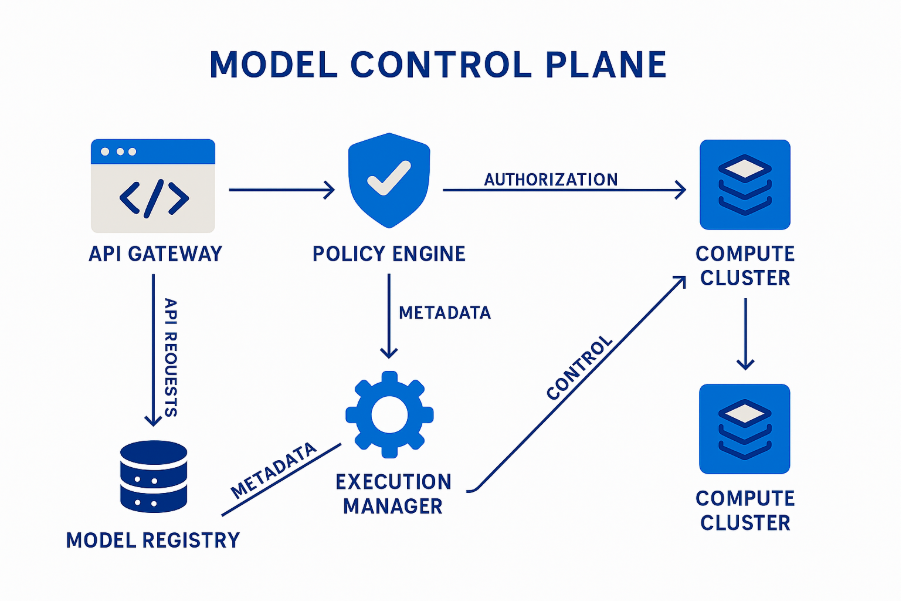
A Model Control Plane acts as the central nervous system of the AI infrastructure. It manages registration, policy enforcement, deployment orchestration, and telemetry for all model types—LLMs, RL agents, or classical ML.
Typical architecture includes:
-
API Gateway: For external integrations and role-based access.
-
Policy Engine: Defines and enforces model governance rules.
-
Model Registry: Tracks model lineage, versions, and metadata.
-
Execution Manager: Schedules and monitors workloads across compute nodes.
Governance, Access, and Isolation for AI Workloads
In multi-tenant environments, governance is non-negotiable. The MCP isolates workloads, manages encryption keys, and enforces zero-trust policies for every model operation. Integration with OIDC and RBAC systems ensures that only authorized agents or users can trigger training or deployment actions.
Overview of RLaaS (Reinforcement Learning as a Service)
Continuous Optimization Through Feedback Loops
RLaaS provides infrastructure for deploying reinforcement learning agents that continuously improve via feedback loops. Unlike static ML models, RL agents adapt in real time based on rewards and environment signals.
Enterprise-grade RLaaS typically includes:
-
Environment simulation or digital twin integration
-
Replay buffers and distributed training clusters
-
Policy versioning and rollback mechanisms
-
Integration with observability systems for reward tracking
Enabling Adaptive and Autonomous AI Agents
With RLaaS, enterprises can deploy autonomous agents that self-optimize operational parameters—whether it’s energy consumption in a factory or credit risk thresholds in finance. This adaptability drastically shortens the feedback loop between research and production outcomes.
LLMOps in the Enterprise
Managing the Lifecycle of Large Language Models
LLMOps applies MLOps principles to the unique challenges of large language models—massive compute footprints, frequent retraining, and dynamic behavior. It focuses on:
-
Model packaging and version control
-
Prompt engineering and evaluation workflows
-
Dataset lineage and fine-tuning reproducibility
Deployment, Monitoring, and Drift Detection at Scale
Post-deployment, LLMOps ensures continuous performance monitoring. Key metrics include hallucination rate, token latency, and semantic drift. Integrated drift detection pipelines trigger revalidation or fine-tuning jobs when performance deviates from expected baselines.
Why Integration Matters for R&D Workflows
Breaking Silos Between Teams and Tools
Most enterprises operate with separate data, ML, and DevOps teams. MCP integration bridges these silos through a unified control plane where every model, experiment, and deployment is visible and traceable.
Improving Collaboration Across Data Science, DevOps, and Compliance
By combining MCP with LLMOps and RLaaS, compliance officers can trace model lineage, data scientists can run experiments safely, and DevOps teams can automate rollouts—all within one governed framework.
Accelerating Experimentation-to-Deployment Cycles
Unified orchestration enables fast iteration. Policies automate security reviews, model validation, and deployment gating—reducing manual interventions and time-to-market for R&D outputs.
Integrating MCP with RLaaS
Policy-Driven Orchestration of RL Pipelines
Through policy-as-code, MCP can define conditions under which RL training or evaluation jobs are executed. This ensures compliance even when RLaaS workloads span hybrid or multi-cloud environments.
Coordinating Multi-Agent Learning Environments
MCP manages coordination between multiple RL agents running in distributed environments. This prevents resource contention and allows controlled experiments with shared environments or synthetic datasets.
Ensuring Compliance and Reliability
Every RL pipeline triggered via MCP is logged with metadata—policy ID, agent version, dataset lineage—ensuring complete traceability and reproducibility for audits.
Integrating MCP with LLMOps
Centralized Governance for LLM Pipelines
MCP brings uniform governance to LLM pipelines—training, fine-tuning, deployment, and inference. It ensures model routing, caching, and access control are consistent across environments.
Model Versioning, Routing, and Observability
Using MCP’s registry and policy engine, LLMOps platforms can automatically route traffic between model versions based on policy rules, A/B testing setups, or performance thresholds.
Automating Compliance and Security Checks
Every deployment pipeline runs through automated policy validation—verifying encryption, data access permissions, and prompt safety before production rollout.
Combined MCP + RLaaS + LLMOps Architecture
End-to-End Workflow Orchestration for R&D
When integrated, MCP becomes the central orchestrator, RLaaS handles adaptive optimization, and LLMOps ensures lifecycle control. Together, they create a self-regulating AI environment.
Data, Model, and Agent Lifecycle Management
Data flows from curated datasets to fine-tuned models; RL agents refine outputs through continuous feedback. MCP governs every stage—data provenance, model lineage, and policy enforcement.
Example Pipeline: From Experimentation to Production
-
Data scientist submits an RL training job via MCP API.
-
RLaaS provisions isolated training environments.
-
Trained policy is validated and registered in MCP.
-
LLMOps deploys the model, monitors performance, and feeds telemetry back to RLaaS.
-
MCP enforces compliance and logs lineage across all systems.
This closed-loop pipeline ensures continuous optimization with governance intact.
Use Cases in R&D Workflows
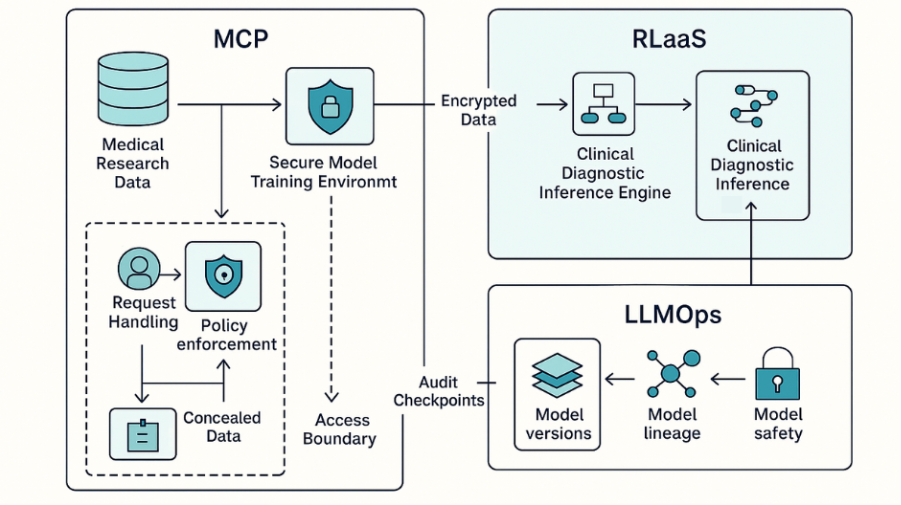
Finance: Adaptive Risk Modeling and Compliance Testing
Financial institutions can deploy RL agents to optimize trading strategies while using MCP to enforce compliance. LLMOps ensures audit-ready transparency in model behavior and outputs.
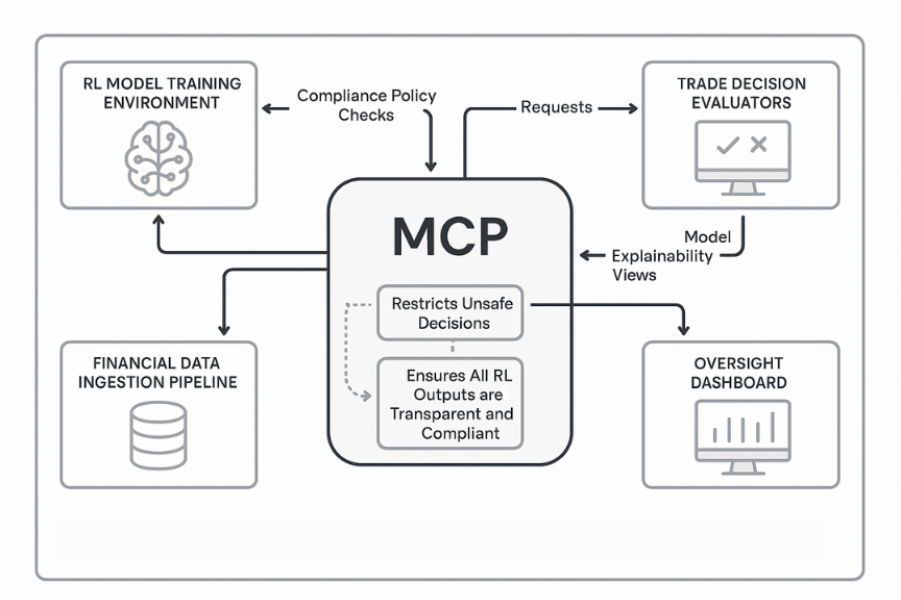
Manufacturing: Process Optimization and Digital Twins
Factories can link RLaaS with digital twins for process control. MCP ensures safe experimentation boundaries, while LLMOps provides explainability dashboards for operators.
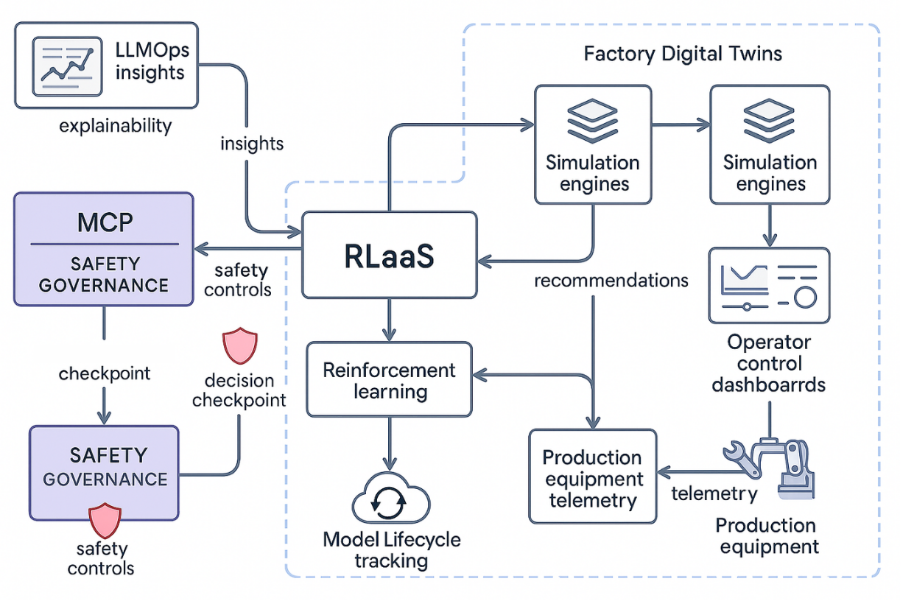
Challenges and Considerations
-
Infrastructure Complexity and Compute Demands
Running RL and LLM workloads simultaneously demands high compute capacity. Kubernetes-based orchestration under MCP helps, but enterprises must plan for elastic scaling and GPU resource isolation.
-
Balancing Autonomy with Human Oversight
Autonomous agents must operate under defined guardrails. MCP policies enforce human-in-the-loop checkpoints to maintain accountability and prevent model drift from introducing risk.
-
Security, Privacy, and Regulatory Compliance
With AI increasingly under regulatory scrutiny, MCP-driven governance ensures that data usage, model updates, and inference requests remain auditable and compliant with frameworks like GDPR and HIPAA.
Future of Integrated AI Control
-
Autonomous R&D Pipelines Powered by Multi-Agent Systems
Future R&D workflows will involve multiple AI agents collaborating—some optimizing models, others validating results. MCP will act as the coordination fabric, ensuring orderly interactions and shared governance.
-
RLaaS and LLMOps Convergence in Enterprise AI Factories
The lines between RL and LLMOps are already blurring. RL techniques are being applied to prompt tuning and reward modeling, while LLMOps platforms integrate continuous feedback loops. The result: enterprise AI factories that improve automatically.
-
Path Toward Self-Optimizing Enterprise AI Environments
With MCP as the brain, RLaaS as the adaptive muscle, and LLMOps as the operational backbone, enterprises can achieve self-optimizing R&D environments—where AI continuously refines itself under governed autonomy.
Conclusion
Key Takeaways for AI Leaders and R&D Teams
-
MCP integration is essential for managing complexity across AI workloads.
-
RLaaS brings adaptivity and continuous improvement through reinforcement learning.
-
LLMOps ensures control over large language models in production.
-
Combined, they create a governed, scalable, and autonomous AI infrastructure.
Why MCP Integration is Foundational for the Future of Enterprise AI
As enterprises shift toward AI-driven R&D, the ability to manage, monitor, and govern adaptive models at scale determines who leads and who lags. Integrating MCP with RLaaS and LLMOps isn’t just a technical strategy—it’s the operational foundation of next-generation enterprise AI.