Executive Summary
Manufacturing enterprises are rapidly adopting remote monitoring and telematics to gain real-time visibility into machines, production lines, fleets, and energy systems. However, traditional IoT platforms struggle with fragmented data, delayed insights, limited automation, and regulatory constraints—especially in regulated and geo-sensitive environments.
Nexastack, the Agentic Infrastructure Platform for Reasoning AI, enables manufacturers to deploy Agentic AI-powered remote monitoring and telematics across private clouds, sovereign environments, on-premises, and at the edge. By orchestrating AI agents that reason over telemetry data, Nexastack transforms raw signals into autonomous decisions—reducing downtime, optimizing performance, and ensuring compliance at scale.
Business Challenge in Manufacturing Telematics
Modern manufacturing environments generate massive volumes of telemetry data from:
-
Industrial machines and CNC equipment
-
Robotics and automated production lines
-
Industrial vehicles and material handling systems
-
Energy, HVAC, and utilities infrastructure
-
Edge sensors and IIoT devices

Despite this data abundance, manufacturers face critical challenges:
1. Reactive Monitoring Instead of Predictive Intelligence
Most systems rely on threshold-based alerts, detecting failures only after performance degradation has already occurred.
2. Siloed Telemetry Data
Machine data, fleet telematics, energy metrics, and operational logs remain fragmented across vendors, plants, and regions.
3. Limited Automation and Human Dependency
Operational teams must manually analyze dashboards, correlate signals, and decide corrective actions—slowing response times.
4. Compliance and Data Sovereignty Risks
Public cloud–based monitoring platforms often violate data residency, IP protection, and regulatory requirements, particularly in manufacturing hubs across Europe, the GCC, and APAC.
5. Scalability Across Plants and Regions
Scaling remote monitoring across hundreds of factories and edge locations requires consistent governance, security, and orchestration.
Why Traditional Telematics Platforms Fall Short
Conventional remote monitoring and telematics solutions focus on data collection and visualization, not reasoning or autonomous action. They lack:
-
Contextual memory across machines and events
-
Cross-system decision orchestration
-
Policy-driven automation
-
Edge-to-cloud intelligence coordination
-
Sovereign AI deployment controls
This creates operational blind spots and limits business impact.
Nexastack Approach: Agentic AI for Remote Monitoring and Telematics
Nexastack introduces an Agentic AI-driven architecture, where intelligent agents continuously reason over telemetry data and autonomously coordinate actions across manufacturing systems.
Nexastack Core Capabilities
-
Private Cloud AI & Sovereign AI deployment
-
Agentic AI orchestration across edge, plant, and cloud
-
Contextual memory for machines, assets, and events
-
Secure inference and policy-driven governance
-
A2A (Agent-to-Agent) communication for real-time decisions
This makes Nexastack the operating system for reasoning AI in manufacturing environments.
Architecture: How Nexastack Powers Remote Monitoring
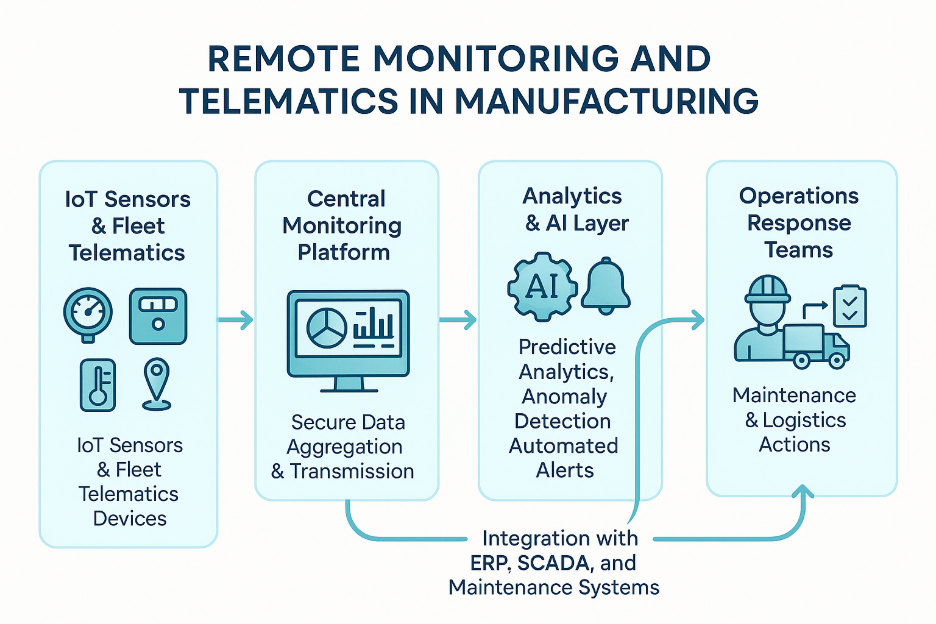
1. Telemetry Ingestion at Scale
Nexastack ingests high-frequency data from:
-
PLCs, SCADA, and MES systems
-
Fleet telematics devices (GPS, fuel, usage)
-
Industrial sensors (vibration, temperature, pressure)
-
Robotics controllers and digital twins
Data is processed locally at the edge or within private cloud environments to meet latency and sovereignty requirements.
2. Agentic AI Layer for Reasoning
Instead of static dashboards, Nexastack deploys specialized AI agents, including:
-
Monitoring Agents – Continuously analyze telemetry patterns
-
Anomaly Detection Agents – Identify deviations beyond static thresholds
-
Predictive Maintenance Agents – Forecast failures and remaining useful life
-
Optimization Agents – Tune machine parameters and energy consumption
-
Compliance Agents – Enforce operational and regulatory policies
These agents collaborate through agent-to-agent orchestration, sharing context and decisions in real time.
3. Contextual Memory and Digital Traceability
Nexastack maintains a context-first memory layer, storing:
-
Historical machine behavior
-
Maintenance events and interventions
-
Operator actions and outcomes
-
Environmental and production context
This allows AI agents to reason over time, not just react to isolated signals.
4. Autonomous Action and Closed-Loop Control
Based on agent reasoning, Nexastack can autonomously:
-
Trigger maintenance workflows
-
Adjust machine operating parameters
-
Reroute fleet assets or production loads
-
Notify operators with prescriptive actions
-
Integrate with ERP, CMMS, and EAM systems
All actions are governed by enterprise-defined policies.

Deployment Model: Private Cloud and Sovereign AI by Design
Nexastack is architected for regulated and IP-sensitive manufacturing environments:
-
Private Cloud AI for enterprise-scale operations
-
Sovereign AI to ensure regional data residency
-
On-prem and edge inference for low-latency control
-
Air-gapped or restricted networks are required
This ensures manufacturers retain full control over telemetry data, AI models, and decision logic.
Use Case Scenarios in Manufacturing
1. Predictive Maintenance for Critical Equipment: AI agents detect early vibration and thermal anomalies, predict failure windows, and auto-schedule maintenance—reducing unplanned downtime.
2. Fleet Telematics and Asset Optimization: Agentic AI optimizes routing, fuel usage, and equipment utilization for industrial vehicles and logistics fleets.
3. Energy and Utilities Monitoring: AI agents continuously optimize energy consumption, detect inefficiencies, and ensure sustainability targets are met.
4. Robotics and Automation Monitoring: Agents monitor robot health, cycle times, and failure patterns—autonomously recalibrating systems when anomalies arise.
5. Remote Plant Operations: Operations teams gain real-time, AI-driven insights across global plants without manual correlation or constant supervision.

Business Outcomes and Measurable Impact
Manufacturers using Nexastack-powered remote monitoring and telematics achieve:
-
30–45% reduction in unplanned downtime
-
25–35% improvement in asset utilization
-
20–30% lower maintenance costs
-
Faster mean-time-to-detect (MTTD) and respond (MTTR)
-
Improved compliance with regional data regulations
-
Scalable monitoring across plants, regions, and edge locations
Why Nexastack Is Different
| Capability | Traditional Telematics | Nexastack Agentic AI |
|---|---|---|
| Monitoring | Reactive dashboards | Autonomous reasoning |
| Intelligence | Rule-based alerts | Context-aware AI agents |
| Deployment | Public cloud–centric | Private & Sovereign AI |
| Automation | Manual workflows | Closed-loop agentic actions |
| Scalability | Tool sprawl | Unified agentic platform |
| Compliance | Limited control | Policy-driven governance |
Conclusion: The Future of Manufacturing Telematics Is Agentic
Remote monitoring and telematics are no longer just about visibility—they are about autonomous intelligence and action. Nexastack enables manufacturers to move from reactive monitoring to self-reasoning, self-optimizing operations.
By combining Agentic AI, Private Cloud AI, Sovereign AI, and agent-to-agent orchestration, Nexastack delivers the execution backbone required for next-generation manufacturing.
Nexastack is the operating system for reasoning AI—powering intelligent, compliant, and autonomous manufacturing at scale.
Frequently Asked Questions (FAQs)
Quick FAQs on remote monitoring and telematics in manufacturing.
What is remote monitoring in manufacturing?
It tracks machine health and performance in real time.
How does telematics help manufacturers?
It collects equipment and usage data for analysis.
What problems does it solve?
It reduces downtime and improves maintenance planning.
Can it scale across multiple plants?
Yes — data is centralized across sites.