Executive Summary
A large manufacturing enterprise faced rising defect rates, inconsistent product quality, and high inspection costs due to manual quality checks. As production volumes increased, defects were often detected late, leading to rework, scrap, and customer complaints.
By deploying computer vision–based quality analytics powered by Nexastack’s agentic AI infrastructure, the company automated real-time quality inspection across production lines. AI agents analyse images from cameras and sensors to detect defects, misalignments, and missing components, automatically diverting faulty units and triggering corrective workflows.
Results achieved:
-
~50% reduction in inspection errors
-
~30% reduction in manual inspection costs
-
Improved compliance, traceability, and product quality consistency

Business Context: Why This Matters
In modern manufacturing, quality inspection must keep pace with:
-
High-speed production lines
-
Increasing product variants
-
Strict regulatory and compliance requirements
Manual inspection and sampling-based checks are no longer sufficient for ensuring quality. Manufacturers need always-on, real-time quality assurance that scales across lines and plants without increasing cost or risk.
Customer Challenges
Business Challenges
-
High defect escape rates due to missed visual anomalies
-
Labor-intensive inspections require large quality teams
-
Inconsistent quality outcomes caused by human fatigue and subjectivity
-
Delayed defect detection, increasing scrap and rework costs
-
Difficulty scaling inspection across multiple lines and factories
Technical Challenges
-
Variability in product appearance (shape, color, texture)
-
Need for low-latency AI inference on high-speed lines
-
Integration with existing MES and ERP systems
-
Managing large volumes of image and sensor data
-
Ensuring explainability and auditability for compliance
Solution Overview: Agentic Computer Vision for Quality Analytics 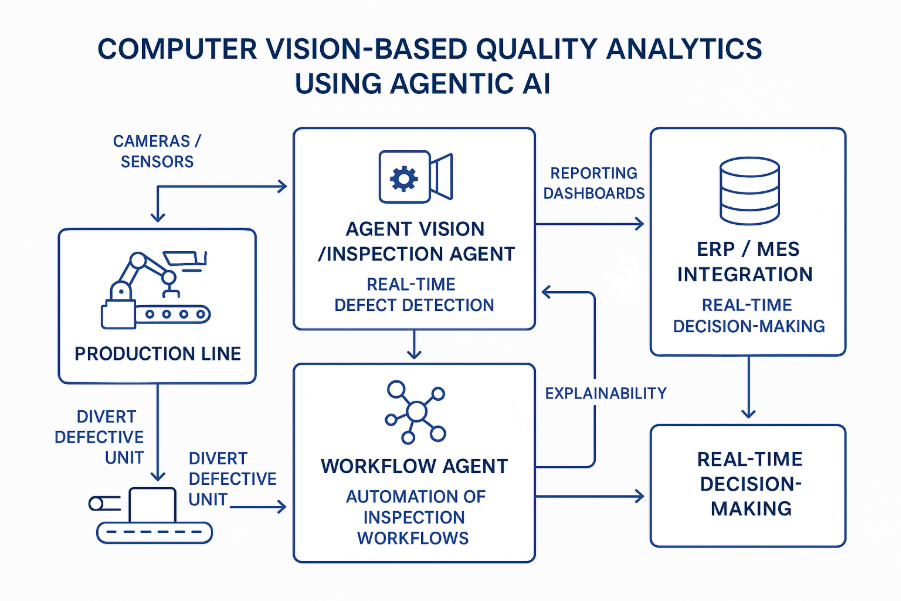
Using Nexastack’s agentic AI platform, the manufacturer implemented an edge-to-cloud quality inspection system where multiple AI agents collaborate autonomously. The solution inspects every unit in real time, not just samples, enabling proactive defect prevention instead of reactive correction.

How the Solution Works (Step-by-Step)
- Real-Time Visual Inspection
Vision agents capture high-resolution images from cameras installed along production lines and apply AI models to detect:
-
Misaligned labels
-
Missing or damaged components
-
Surface defects and anomalies
- Automated Quality Decisions
When defects are detected:
-
Faulty units are automatically diverted or quarantined
-
Visual evidence is attached to each inspection event
-
Alerts are sent to production and quality teams
-
Analytics and Root Cause Identification
Analytics agents aggregate inspection data across:
-
Shifts
-
Production lines
-
Plants
Dashboards reveal defect trends, recurring issues, and root causes.
- Continuous Learning and Optimization
Confirmed defects feed back into model training pipelines, allowing the system to:
-
Improve detection accuracy
-
Adapt to new defect patterns
-
Support new products and packaging formats
Results at a Glance
|
Area |
Impact |
|
Inspection Accuracy |
~50% fewer inspection errors |
|
Labor Costs |
~30% reduction in manual inspection effort |
|
Quality Consistency |
Improved across lines and plants |
|
Compliance |
Enhanced traceability and audit readiness |
|
Scalability |
Easily extended to new lines and sites |
Recommended AI Agents
-
Vision / Inspection Agent – Real-time defect detection using computer vision
-
Analytics Agent – Trend analysis, root cause insights, reporting
-
Workflow Agent – Automated diversion, alerts, MES/ERP updates
-
Trust & Governance Agent (Optional) – Explainability, audit logs, compliance tracking

Impact Across Model, Data, and Workflow
Model
-
Higher defect detection accuracy
-
Reduced false positives and negatives
-
Continuous improvement via retraining
Data
-
Unified ingestion of images, sensor data, and production metadata
-
Historical and real-time datasets enable predictive quality analytics
Workflow
-
Fully automated detect → divert → report → learn loop
-
Reduced operational bottlenecks and manual intervention
Target Industries
-
Manufacturing (electronics, consumer goods)
-
Automotive & Aerospace
-
Food & Beverage
-
Pharmaceuticals & Medical Devices
-
High-Tech & Semiconductors
Why Nexastack
Nexastack provides the agentic infrastructure layer required to run computer vision quality analytics reliably at enterprise scale:
-
Secure private cloud and edge AI execution
-
Agent-to-agent orchestration for closed-loop quality workflows
-
Contextual memory for defect history and trends
-
Built-in governance, explainability, and compliance
Nexastack acts as the operating system for Reasoning AI, enabling autonomous, scalable, and compliant quality inspection systems.
Best Practices & Learnings
-
Proper camera placement and lighting are critical
-
Diverse, well-labeled datasets improve initial accuracy
-
Human-in-the-loop feedback accelerates model maturity
-
Edge processing minimizes latency and production impact
Future Roadmap
-
Expand vision inspection to additional production lines
-
Integrate predictive maintenance with quality analytics
-
Use digital twins to simulate and prevent defect scenarios
-
Extend vision AI for regulatory compliance monitoring

Conclusion
By adopting computer vision–based quality analytics on Nexastack’s agentic AI platform, the manufacturer transformed quality inspection from a manual bottleneck into an autonomous and scalable capability. The solution delivers consistent product quality, reduced costs, real-time visibility, and continuous improvement—aligning directly with Industry 4.0 and smart factory objectives.
Frequently Asked Questions (FAQs)
Advanced FAQs on computer vision–based quality analytics in manufacturing.
How does computer vision enable real-time quality analytics on production lines?
By analyzing high-frequency image streams to detect defects, deviations, and anomalies as products move through the line.
What manufacturing quality problems are best solved with vision analytics?
Surface defects, dimensional errors, assembly mismatches, and process drift.
How does vision-based quality analytics scale across multiple plants?
Through standardized models, centralized analytics, and distributed edge inference.
How does computer vision improve OEE and yield?
By reducing missed defects, minimizing rework, and enabling faster corrective actions.