Executive Summary
Manufacturing organizations are operating in an environment of rising energy costs, increasing regulatory scrutiny, and growing pressure to meet sustainability and ESG targets. Energy-intensive operations, distributed plants, and complex production lines make it difficult to maintain real-time visibility into energy consumption and inefficiencies. Traditional energy management approaches rely on periodic audits, static dashboards, and manual interventions—methods that are no longer sufficient for modern manufacturing environments.
NexaStack’s AI-powered energy management solution for Manufacturing enables organizations to continuously monitor, analyze, and optimize energy usage across plants, production lines, and industrial equipment. Built on ElxirData’s industrial data foundation, the solution combines IoT-driven energy data ingestion, private cloud AI inference, and agentic AI automation to deliver real-time energy intelligence.
By transforming raw energy telemetry into actionable insights, manufacturers can reduce energy waste, lower operational costs, and advance ESG-aligned energy optimization initiatives—without disrupting production or compromising data security.
Industry Context: Energy as a Strategic Manufacturing Constraint
Energy is no longer a fixed overhead cost in manufacturing. It has become a dynamic operational variable that directly impacts margins, sustainability commitments, and operational resilience. Volatile energy pricing, decarbonization mandates, and supply chain pressures necessitate that manufacturers adopt industrial energy optimization strategies that operate continuously rather than reactively.
In smart factory environments, energy consumption must be correlated with production output, equipment performance, and maintenance activity. Without real-time energy monitoring for manufacturing, inefficiencies remain hidden, and optimization opportunities are missed. This shift is driving demand for AI-powered energy management platforms capable of operating at an industrial scale.
FAQ 1 : What is an AI-powered Energy Management Solution for manufacturing?
Answer: An AI-powered Energy Management Solution uses IoT and artificial intelligence to monitor and optimize energy usage in real time across manufacturing operations, helping reduce costs, improve efficiency, and support sustainability goals.
Manufacturing Energy Management Challenges
Manufacturing enterprises face several persistent challenges in managing energy efficiently. Many plants lack real-time visibility into industrial energy consumption, relying instead on delayed reports that obscure abnormal usage patterns. Energy inefficiencies caused by equipment degradation, process drift, or operational changes often go undetected for extended periods.
Energy data is frequently siloed across meters, building management systems, and operational technology environments. This fragmentation prevents manufacturers from correlating energy usage with production KPIs, such as throughput, downtime, or overall equipment effectiveness (OEE).
Additionally, sustainability and compliance teams struggle to generate accurate, auditable ESG energy reporting, as energy data lacks consistency, governance, and traceability across sites.

Business Objectives and Outcomes
To remain competitive and compliant, manufacturing leaders are prioritizing AI-driven energy optimization initiatives that deliver measurable outcomes. Key objectives include:
-
Continuous optimization of energy usage across assets and production lines
-
Proactive detection of abnormal energy consumption and inefficiencies
-
Integration of energy intelligence with MES, ERP, and sustainability systems
-
Reduction of operational energy costs without impacting output
-
Alignment with Industry 4.0 energy transformation strategies
By embedding agentic AI for energy management, organizations move from reactive monitoring to autonomous, intelligence-driven optimization.
Limitations of Traditional Energy Management Systems
Legacy energy management systems are designed for reporting rather than optimization. These platforms depend on fragmented metering infrastructure, periodic audits, and static dashboards that offer limited operational insight. While they provide historical visibility, they lack predictive energy analytics and do not support automated decision-making.
Traditional systems are poorly integrated with manufacturing operations, preventing closed-loop optimization. As manufacturing environments become more complex, these limitations make it impossible to achieve scalable industrial energy optimization using legacy approaches alone.
Technical and Integration Challenges in Manufacturing Environments
Deploying AI-based energy management for manufacturing introduces several technical challenges. Industrial environments consist of heterogeneous IoT sensors, PLCs, smart meters, and legacy systems that must be integrated reliably. Energy data must be synchronized across real-time and historical streams while maintaining low latency for operational decisions.
Manufacturers must also ensure secure data flow across OT and IT boundaries. Energy data is operationally sensitive and must comply with governance, access control, and regulatory requirements. NexaStack addresses these challenges through sovereign AI execution, secure private cloud infrastructure, and policy-driven data governance.
Solution Architecture Overview
ElxirData: Industrial Energy Data Foundation
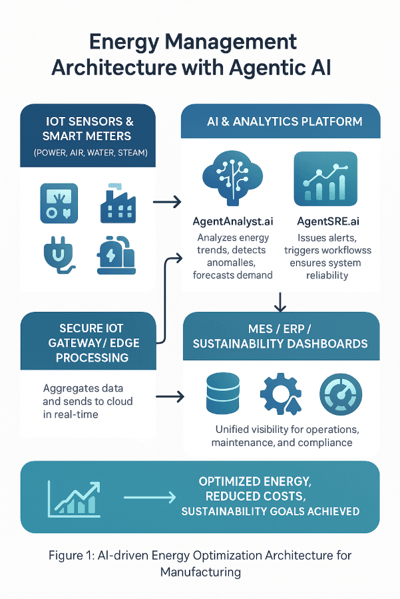
ElxirData forms the foundational layer of the solution, ingesting, normalizing, and governing energy and operational data from across the manufacturing environment. This includes IoT sensors, smart meters, PLCs, MES platforms, and ERP systems.
By creating a unified, analytics-ready data layer, ElxirData enables accurate energy analytics for manufacturing and ensures data consistency across sites. Governed data pipelines support both real-time processing and historical analysis, forming the backbone for AI-driven optimization.
NexaStack: Agentic AI for Energy Optimization
NexaStack operates on top of ElxirData, applying agentic AI and autonomous AI agents to continuously analyze energy consumption patterns. AI models learn baseline energy behavior for equipment and processes, detect anomalies, and forecast inefficiencies before they escalate.
AI agents for energy management orchestrate alerts, recommendations, and corrective actions—either autonomously or with human oversight. Executed on private cloud AI infrastructure, NexaStack ensures secure, high-performance optimization while supporting sovereign AI requirements for regulated manufacturing environments.
The platform integrates seamlessly with MES, ERP, and maintenance systems, enabling closed-loop energy optimization workflows that align energy usage with operational goals.
End-to-End Energy Intelligence Workflow
Energy optimization begins with real-time data capture from industrial IoT sensors and smart meters deployed across manufacturing operations. ElxirData securely ingests this telemetry, normalizes it, and applies governance policies to ensure data quality and traceability.
NexaStack’s AI models analyze energy consumption patterns continuously, identifying deviations from expected behavior. When anomalies or inefficiencies are detected, agentic workflows initiate alerts, recommendations, or automated corrective actions. These actions feed back into the system, enabling continuous learning and optimization.
This closed-loop approach transforms energy management into a self-improving system that adapts to changing operational conditions.
FAQ: What measurable results can manufacturers expect?
Answer: Manufacturers often see double-digit energy savings, improved sustainability reporting, and faster operational response through AI-driven energy optimization.
Measurable Business Impact
Manufacturers implementing AI-powered energy management achieve tangible improvements across multiple dimensions. Organizations typically see meaningful reductions in overall energy consumption, improved response times to abnormal usage, and enhanced visibility into energy drivers across operations.
Automation reduces the manual effort required for monitoring and reporting, while governed data pipelines improve the accuracy of ESG energy reporting. Over time, energy optimization contributes to lower operational costs, improved sustainability performance, and increased operational resilience.
Strategic Value for Industry 4.0 and Smart Manufacturing
In Industry 4.0 environments, energy optimization is a critical enabler of autonomous manufacturing. Smart factory energy optimization integrates IoT, AI, and automation to deliver adaptive, data-driven operations. By embedding energy intelligence into production workflows, manufacturers can reduce waste, improve efficiency, and respond dynamically to operational changes.
Agentic AI for manufacturing energy management aligns sustainability objectives with operational performance, ensuring that energy efficiency becomes a competitive advantage rather than a compliance burden.

Why ElxirData and NexaStack
Together, ElxirData and NexaStack deliver a comprehensive industrial energy management platform—from real-time data ingestion to AI-driven optimization and autonomous execution. The combined architecture is purpose-built for manufacturing environments, supporting scale, security, and governance.
By leveraging private cloud AI, sovereign data control, and agentic AI orchestration, manufacturers gain end-to-end energy intelligence that supports both operational excellence and long-term sustainability goals.