.png)
Physical AI Deployment Gap: From Demos to Deployment
Explore the Physical AI Deployment Gap and why robotics demos fail in production. Learn the architectural challenges blocking real-world deployment.
Physical AI vs Vision AI vs Robotics: Understanding the Differences
Physical AI vs Vision AI vs Robotics are often confused. You can learn how they differ and which capabilities your enterprise actually needs.
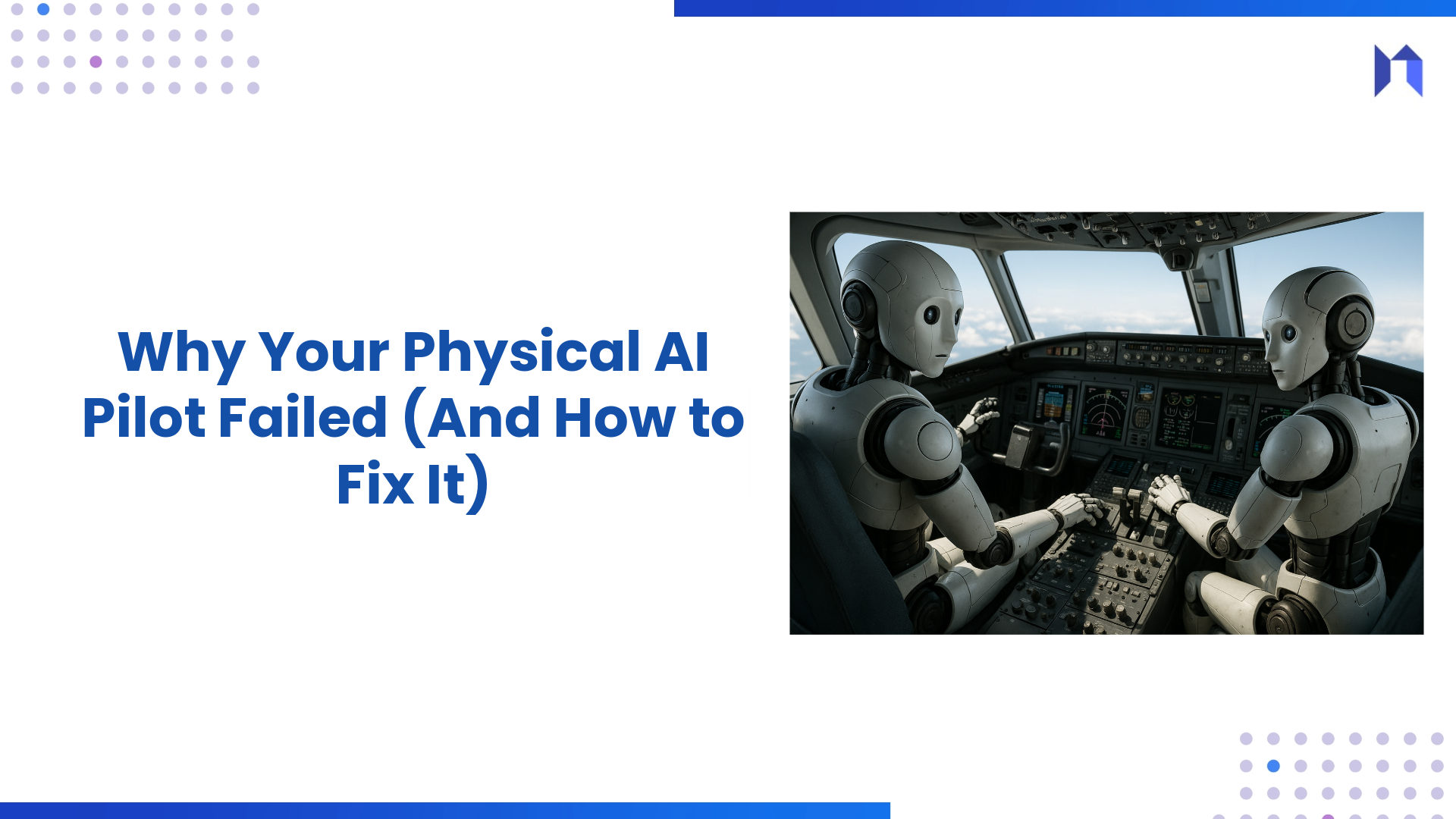
Why Your Physical AI Pilot Failed (And How to Fix It)
Most Physical AI pilot failed due to deployment gaps—learn the real causes and how to design pilots that scale successfully.
Reliability Engineering for Physical AI: Beyond Mean Success Rates
Explore reliability engineering for Physical AI, focusing on performance beyond mean success rates for optimal outcomes.
Featured Voice



Featured Series
LLMOps
Highly perceptive, accurate, and interactive visual AI agents to make better decisions using richer insights generated

Physical AI Deployment Gap: From Demos to Deployment
Explore the Physical AI Deployment Gap and why robotics demos fail in production. Learn the architectural challenges blocking real-world deployment.
Physical AI vs Vision AI vs Robotics: Understanding the Differences
Physical AI vs Vision AI vs Robotics are often confused. You can learn how they differ and which capabilities your enterprise actually needs.
Why Your Physical AI Pilot Failed (And How to Fix It)
Most Physical AI pilot failed due to deployment gaps—learn the real causes and how to design pilots that scale successfully.
Reliability Engineering for Physical AI: Beyond Mean Success Rates
Explore reliability engineering for Physical AI, focusing on performance beyond mean success rates for optimal outcomes.
The Integration Problem: Why Physical AI Must Connect to Everything
Learn why the integration problem is crucial for Physical AI deployment and how it drives real-world success.
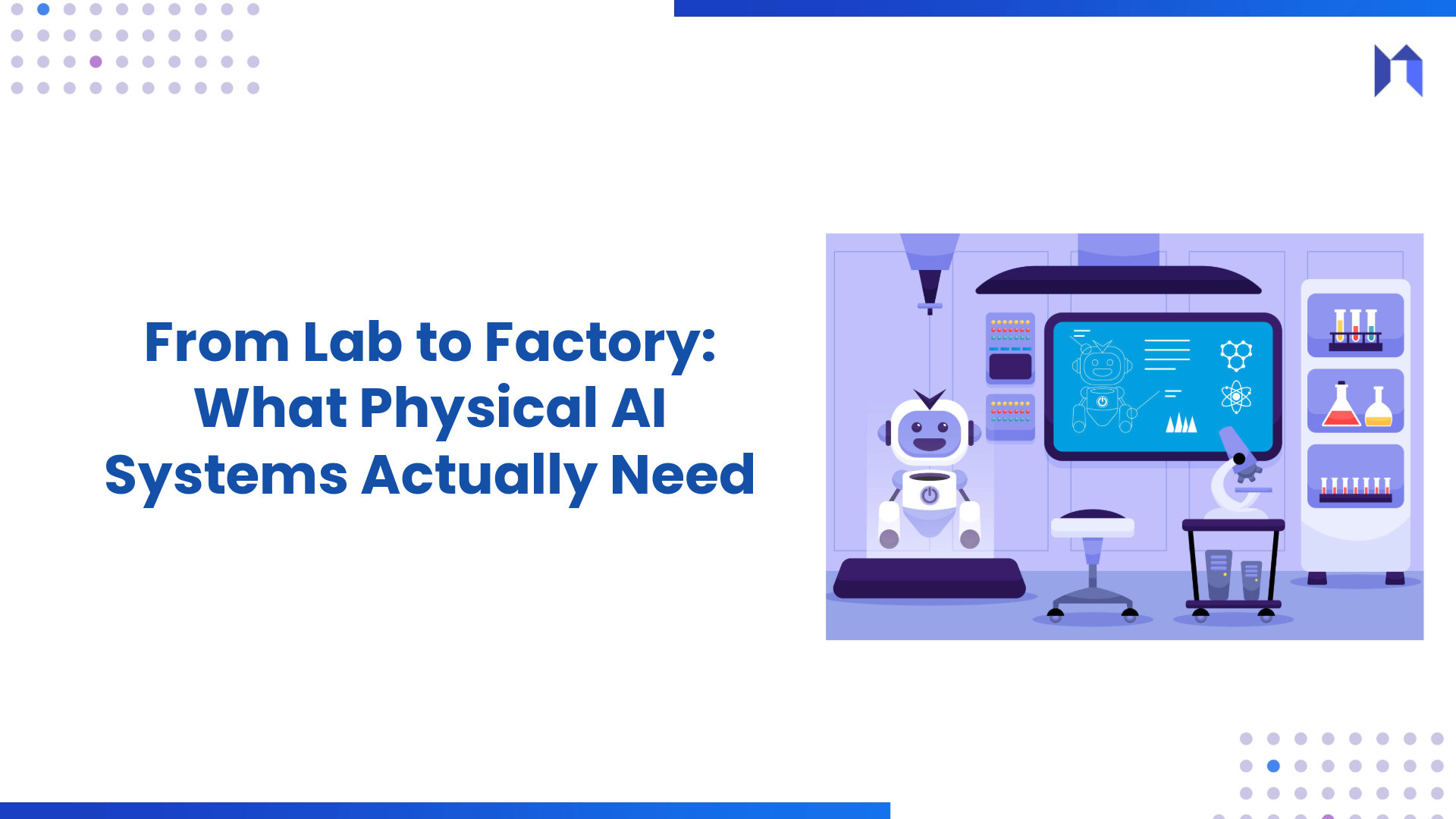
From Lab to Factory: What Physical AI Systems Actually Need
Learn how to ensure physical AI systems meet production requirements for real-world deployment success from lab to factory.
Why 95% Success Rate Means Failure in Physical AI
A 95% success rate sounds impressive — until you realize it means 50+ failures per day in production.
Private Cloud AI Inference: Cost, Control & Compliance
Private Cloud AI Inference enables predictable cost, control & compliance-ready AI deployment with NexaStack for enterprises.
Scaling AI Across the Enterprise: A Platform-First Approach
Scaling AI Across the Enterprise A Platform-First Approach enables secure governed and scalable AI adoption across global enterprises.
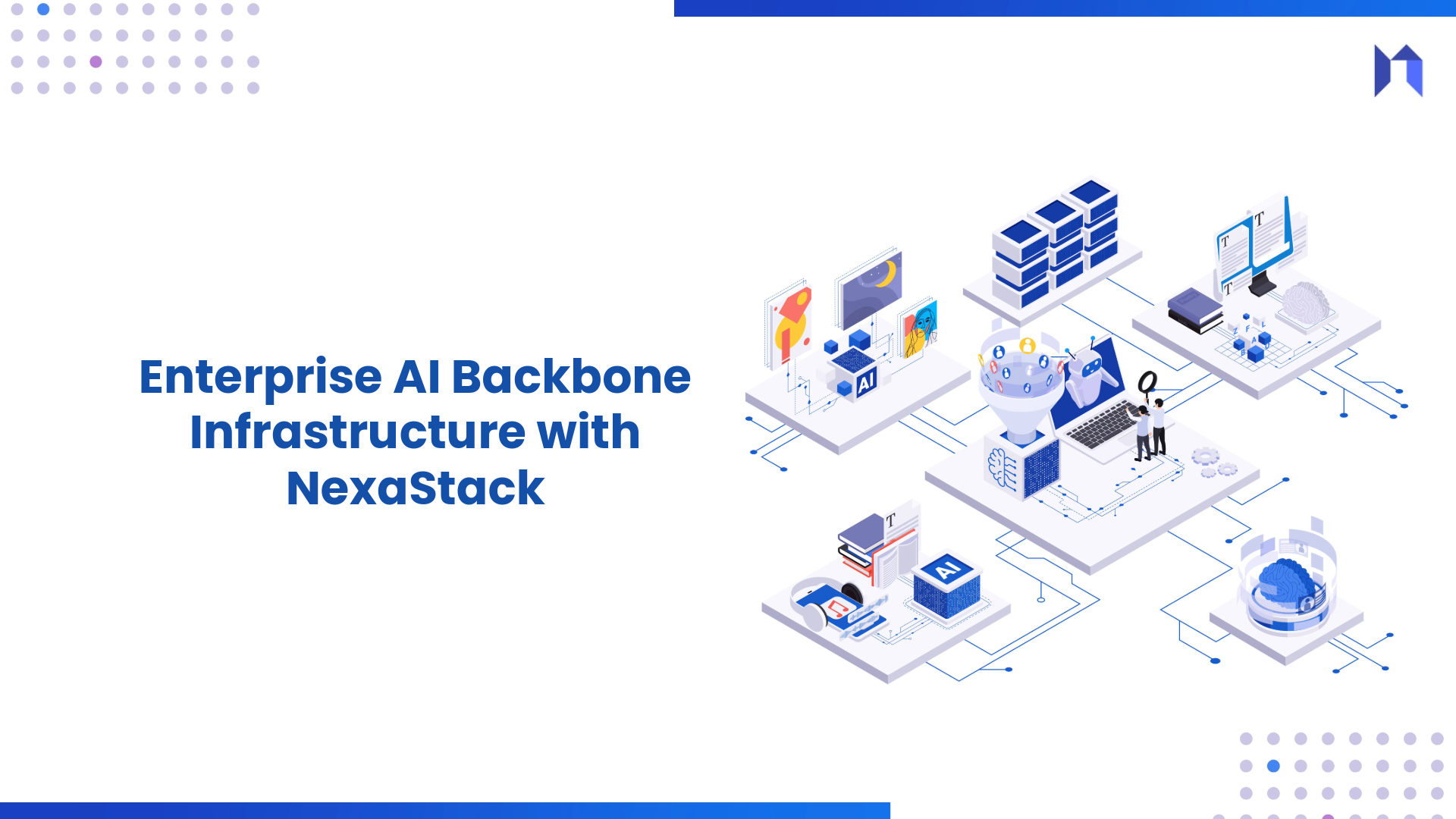
Enterprise AI Backbone Infrastructure with NexaStack
Enterprise AI backbone infrastructure with NexaStack enables secure, scalable, agentic AI operations across private, hybrid, and sovereign ...
Foundation Models: Risk, Hallucinations & Explainability
Foundation models - Risk, hallucinations & explainability impact enterprise AI trust, governance, compliance, and safe deployment at scale.
Model Cards and AI Fact Sheets: Building Governance-Ready AI
Model cards and AI fact sheets enable governance-ready AI through transparency, compliance alignment, risk management, and deployment.
Agentic AI and GRC: Challenges in Multi-Agent Autonomous Systems
Agentic AI governance challenges in multi-agent autonomous systems, covering GRC, security, and responsible enterprise AI adoption.
AI Factory-as-a-Service for Managed Private Compute
AI factory-as-a-service for managed private compute enables secure, scalable private cloud AI infrastructure for enterprise agentic workloads.
Driving Business Value with GenAI: A Strategic Adoption Playbook
Driving business value with GenAI enables enterprises to scale AI adoption, optimize decisions, and deliver measurable operational outcomes.
Why Model Registries Matter in Enterprise LLMOps?
Model registries matter in enterprise LLMOps ensures governance, versioning, compliance, reproducibility, and secure deployment of AI models.
Emerging LLM Techniques for Industry-Grade Applications
Explore LLM techniques enabling Private cloud AI, sovereign AI, Agentic AI, and AI agent deployment at scale.

Design Patterns for Scalable Multi-Agent AI Infrastructure
Design patterns for scalable multi-agent AI infrastructure enabling agentic AI, AI agent orchestration on private cloud AI.

How NexaStack Powers Coordination in Multi-Agent Environments
NexaStack enables secure coordination, orchestration, and real-time reasoning across scalable multi-agent environments for enterprise systems.
On-Premises AI Platform for Regulated Environments
On-Premises AI platform for regulated environments ensures secure, compliant, high-performance AI deployment for sensitive enterprise workloads.

Vision AI at the Edge: Inference Pipelines with RLaaS
Vision AI at the edge: inference pipelines with RLaaS enable real-time learning, secure processing, and scalable autonomous vision systems.

MCP Server for Distributed AI Control
MCP server for distributed AI control delivers secure governance, reliable agent coordination, and scalable autonomous operations for enterprises.
Evaluating and Comparing LLM Techniques for On-Premise Deployments
Evaluating and comparing llm techniques for on-premises deployments helps enterprises optimize secure, scalable AI performance across environments.
RLaaS vs Traditional MLaaS: A Strategic Comparison for Modern AI Teams
Compare RLaaS with traditional MLaaS to understand differences in automation, adaptability, scalability, and real-time decision-making capabilities.
Integrating MCP with RLaaS and LLMOps for R&D Workflows
Integrating MCP with RLaaS and LLMOps streamlines R&D workflows, improving experimentation, automation, scalability, and AI-driven innovation.
Automating the AI Model Lifecycle in Enterprises
Automate the AI model lifecycle with secure, scalable workflows that streamline deployment, monitoring, optimization, and governance for enterprises.
Why Smart Enterprises Choose Private Cloud AI Over Public Cloud?
Smart enterprises adopt Private Cloud AI for security, sovereignty, compliance, performance, and full control over public clouds.
Scalable Vision AI Stack with NexaStack
Scalable Vision AI Stack by NexaStack enabling secure inference, multimodal agents, and high-performance computer vision workloads.
Composable Compute Infrastructure for Agentic AI
Composable compute infrastructure accelerates agentic AI with faster performance, reduced bottlenecks, and scalable private cloud efficiency.
Private AI Clusters for Regulated Industries
Build secure Private AI clusters for regulated industries to ensure compliance, data control, sovereignty, governance, and reliable enterprise ...
Designing Low-Latency Pipelines for Real-Time Inference at the Edge
Low-latency pipelines enabling real-time decisioning with private cloud AI, sovereign AI, and agentic AI capabilities.
Open Telemetry & AI Agents – Building Observability from the Ground Up
Open Telemetry enhances AI agent observability by delivering unified tracing, metrics, and logs for reliable, compliant, production-grade agentic ...
Leveraging Private Cloud Compute for Secure and Scalable AI Workloads
Secure private cloud compute for scalable AI workloads with sovereign control, high performance, and strong data protection.
On-Prem AI Agents for Manufacturing, Finance & Healthcare
On-prem AI agents enabling secure, compliant, high-performance automation for manufacturing, finance, and healthcare with sovereign control.
Governing AI Systems: How Agentic GRC Enables Responsible AI Operation
Governing AI systems: How agentic GRC enables responsible AI operation through governance, compliance, risk management, and accountability.
5 Key Observability Metrics for Deploying a Private AI Assistant
Discover key observability metrics for optimizing and monitoring the performance of a private AI assistant.
Agentic GRC: From Reactive to Continuous Cybersecurity Assurance
Discover how Agentic GRC transforms cybersecurity by shifting from reactive defense to continuous compliance and cybersecurity assurance.
Agentic GRC for Health & Safety: AI-Driven Compliance & Accountability
Ensure continuous compliance and workplace safety with Agentic GRC — AI-driven accountability, risk monitoring, and autonomous governance automation.
Agent GRC for Health and Safety: Continuous Compliance AI Agents
Agent GRC for Health and Safety enables continuous compliance AI agents ensuring proactive monitoring, governance, and risk control.
The Evolution of GRC: From Compliance to Agentic Governance
Explore the evolution of GRC from compliance-driven models to Agentic Governance, enabling autonomous, intelligent, and adaptive control of the ...
How Agentic GRC Transforms IT Operations into Control Systems
Agentic GRC automates compliance and turns IT operations into intelligent, secure, and self-regulating control systems.
Model Risk Management in Financial Institutions
Model risk management in financial institutions ensures compliance, accuracy, governance, and reliability of AI and analytical models.
Reliable LLM Pipelines with NexaStack and Private Cloud Inference
Build reliable LLM pipelines with NexaStack’s private cloud inference for secure, scalable, and compliant AI model deployment.
Continuous Compliance for LLMs: CI/CD Pipelines with GRC
Ensure continuous compliance for LLMs with integrated CI/CD pipelines, automating GRC monitoring, validation, and governance across AI workflows.
Architecting Multi-Agent AI Systems Using RLaaS and AgentOps
Build intelligent Multi-Agent AI Systems using RLaaS and AgentOps for scalable learning, automation, and coordinated decision-making.
AI Orchestration Platforms for Autonomous Enterprises
AI orchestration platforms for autonomous enterprises enable context-first automation, governance, compliance, and intelligent agent collaboration.
From Prompt to Pipeline: Full-Stack AI Orchestration for Teams
From prompt to pipeline: Full-stack ai orchestration for Teams ensures scalable, secure, trustworthy enterprise-grade AI deployment.
Elastic AI Infrastructure: Pay-as-You-Grow Models for Agentic AI
Elastic ai infrastructure: pay-as-you-grow models for agentic ai deliver scalable, flexible, and cost-efficient enterprise automation.
When to Choose Private Cloud for AI Inference: A CISO’s Checklist
Accelerate intelligent applications using Private Cloud for AI Inference with enterprise-grade security, compliance and optimised performance.
Implementing Zero-Trust Architecture for AI Systems
Secure AI with Zero-Trust Architecture for AI Systems ensuring compliance, resilience, data protection, and trusted enterprise adoption.
Agent Governance at Scale: Policy-as-Code Approaches in Action
Agent Governance at Scale Policy-as-Code Approaches in Action ensures compliance automation transparency and governance for AI systems.
Data Residency & Sovereignty with Private Cloud AI Platforms
Ensure compliance and control with data residency & sovereignty with private cloud AI platforms for secure, scalable enterprise AI.
Deploying RL Agents in Private Cloud for Real-Time Decision Systems
Deploying RL Agents in Private Cloud for real-time decision systems, enabling secure, scalable, and intelligent enterprise automation.
Building a Kubernetes-Native AI Platform for the Enterprise
Kubernetes-Native AI Platform for the Enterprise delivers scalable, portable, and secure AI orchestration across cloud and hybrid environments.
Training RL Agents on Private Cloud: A Secure RLaaS Blueprint
Training RL agents on a private cloud enables secure, scalable, and efficient reinforcement learning, which improves performance and enterprise ...
Sovereign AI: Private Clouds with National Oversight
Sovereign AI private clouds with national oversight ensure a secure, compliant, and scalable national AI infrastructure for enterprises.
What Is RLaaS? Reinforcement Learning at Scale for Enterprise
Reinforcement learning at scale for enterprise with RLaaS enables secure, scalable, efficient AI adoption, optimisation, and automation.
Private Cloud RAG: Secure and Fast Retrieval-Augmented Generation
Private cloud RAG: secure and fast retrieval-augmented generation enabling enterprises with compliant, scalable, low-latency AI solutions.
What Is InferenceOps?
InferenceOps empowers enterprises with scalable, reliable, and efficient AI inference pipelines ensuring optimized model deployment and monitoring.
Zero Trust for AI: Securing Pipelines with Model Risk Management
Zero trust for AI: securing pipelines with model risk management, ensuring compliance, security governance, and minimising AI risks.
GRC in Energy AI: Optimising Power Grids with Regulated AI Models
GRC in energy AI enables optimising power grids with regulated AI models ensuring compliance efficiency sustainability and resilience.
Assessing Your Enterprise’s LLMOps Maturity: A Strategic Self-Audit
Assessing your enterprise’s LLMOps maturity with a strategic self-audit to optimize AI lifecycle management and scalability.
Securing Smart Buildings with AI: Risk Controls & Compliance
Securing smart buildings with AI: Risk controls & compliance solutions ensure safety, regulatory adherence, automation, and operational resilience.
AI Governance in Manufacturing: Model Risk in Predictive Maintenance
AI governance in manufacturing: model risk in predictive maintenance ensures reliability, compliance, transparency, and sustainable operations with ...
Synthetic Data in Model Risk Management
Synthetic data in model risk management enhances testing, reduces bias, improves compliance, and ensures resilient, trustworthy AI systems.
Making AI Portable: Run LLMs Anywhere with Cloud-Neutral Design
Making AI Portable Run LMs Anywhere with Cloud Neutral Design enables flexible scalable and cloud agnostic AI deployment.
Agentic AI for Predictive Maintenance: Prevent Downtime & Cut Costs
Boost efficiency with Agentic AI for Predictive Maintenance to prevent downtime, optimise operations, and significantly cut maintenance costs.
Responsible AI in Telecom: Fraud Detection & Network Optimisation
Discover how Responsible AI in Telecom enhances fraud detection and network optimization with ethical, transparent, and efficient solutions.
How to Build RL-Driven Systems?
RL-Driven Systems leverage reinforcement learning for adaptive decision-making, optimising performance and efficiency across enterprise AI ...
How a Unified Control Plane Simplifies AI Operations?
Unified Control Plane simplifies AI operations by centralising management, streamlining workflows and enhancing enterprise AI orchestration.
Assembly Line Quality with Agentic AI-Powered Real-Time Detection
Enhance assembly line quality with Agentic AI-powered real-time detection for faster defect identification and improved manufacturing efficiency.
How to Build Agentic AI for Industrial Systems?
Learn how to build Agentic AI for industrial systems with intelligent agents, automation, orchestration, and real-time insights.
AI and GRC in Logistics: Model Transparency in Supply Chain AI
Ensure AI transparency GRC in Logistics and practices for secure, auditable, and explainable supply chains.
The New Face of Model Risk: Managing AI and LLMs at Scale
Explore the new face of model risk managing AI and LLMs at scale with context-driven, autonomous risk operations.
AI Governance at the Infrastructure Layer
AI Governance at the infrastructure layer ensures secure, compliant, and efficient management of AI workloads across enterprise infrastructure.
Lifecycle Management for AI Models
Lifecycle management for ai models ensures efficient deployment, monitoring, optimization, and retirement of AI models across production environments.
OpenLLM: Production-Ready Language Models
OpenLLM Production-Ready Language Models for efficient deployment scaling and monitoring of LLMs in real-world enterprise environments.
Designing the Enterprise AI OS: Strategy, Tools & ROI
Designing the enterprise ai os: strategy, tools & roi for building intelligent systems that drive automation, efficiency, and measurable business ...

Combating Model Drift with Proactive Infrastructure Design
Combating model drift with proactive infrastructure design ensures stable AI performance and resilience across dynamic enterprise environments.
Intelligent AI Workload Orchestration: From Chaos to Control
Discover intelligent ai workload orchestration to optimise resource utilisation, improve performance, and streamline AI operations seamlessly.
Integration as Competitive Advantage
Discover how leveraging integration as a competitive advantage drives agility, innovation, and growth in today’s digital enterprise landscape.
How to Unify, Secure, and Scale Your Infrastructure
Unify, secure, and scale your infrastructure with modern strategies for integration, security, and seamless cloud scalability.
Kubernetes for AI: Simplified Deployment
Kubernetes for AI Simplified Deployment enables scalable efficient and automated orchestration of machine learning models in production.
Why Agentic AI Is the Future of Infrastructure?
Agentic AI is the future of infrastructure, enabling autonomous, intelligent, and adaptive management across cloud and enterprise systems.
ML Production Excellence: Optimized Workflows
Achieve ML Production Excellence with optimized workflows for faster deployment, automation, scalability, and reliable performance.
Video Generation with NexaStack: Business Beyond Marketing
Video Generation with NexaStack enables intelligent, scalable video content creation for enterprise functions beyond traditional marketing use.
AI Compliance Automation for Regulated Infrastructure
Ensure AI compliance automation for regulated infrastructure with scalable, auditable, and secure governance.
How NexaStack Enables a High-Performance AI Factory for Enterprises
Discover how NexaStack enables a high-performance AI factory for enterprises through automation, monitoring, orchestration, and optimization.
Function Calling with Open Source LLMs
Learn function calling with open source LLMs to integrate structured outputs into AI workflows efficiently and accurately.
Orchestrating AI Agents for Business Impact
Orchestrating AI Agents for business impact helps businesses automate workflows, improve efficiency, and drive intelligent digital transformation.
Self-Learning Agents with Reinforcement Learning
Self-learning agents with Reinforcement Learning improve autonomous decision-making by optimising actions through continuous environment-based ...
Large-Scale Language Model Deployment
Large-scale language model deployment for secure, scalable AI infrastructure with optimized performance and enterprise-ready deployment strategies.
Accelerating Innovation with AI Coding Assistants with NexaStack
Accelerating Innovation with AI Coding Assistants using NexaStack for enhanced developer productivity, automation, and secure enterprise development.
Building Deploying a Sentence Embedding Service with Nexastack
Build and deploying a sentence embedding service with NexaStack for scalable, secure, and efficient NLP model deployment.
Llama 2 in Action: Transformation Blueprint with NexaStack
Deploy Llama 2 in action with NexaStack for secure, scalable, and automated enterprise AI transformation and deployment.
Advanced AI Forecasting - Power of AI Forecasting
Discover the power of AI forecasting to enhance predictive accuracy, streamline decisions, and optimize business outcomes.
Intelligent Query Systems: The Decision Edge
Discover how Intelligent Query Systems provide the decision edge with real-time insights, automation, and strategic intelligence.
Exploring the World of Open-Source Text-to-Speech Models
Exploring the world of open-source text-to-speech models for scalable, custom voice solutions.
From AI Experiments to Enterprise Scale: Running LLMs in the Cloud
From AI experiments to enterprise scale: running LLMs in the cloud with optimized performance, flexibility, and scalability.
Image Recognition as Business Accelerator
Discover how image recognition as a business accelerator transforms industries through automation, visual data analysis, and AI innovation.
Control and Innovation: The AI Balance
Explore how organizations achieve control and innovation the AI balance through governance compliance risk management and strategy.
Embedding Models: The Strategic Advantage
Embedding Models The Strategic Advantage offers businesses deep contextual insights driving smarter AI decisions and personalized automation.
Inference Server Integration: Performance Strategy
Inference server integration: Performance strategy focuses on optimising model deployment for scalability, low latency, and efficient performance.
Deploying an OCR Model with EasyOCR and NexaStack
Deploying an OCR model with easyocr and nexaStack enables efficient text extraction, integration, and real-time model performance monitoring.
Knowledge Retrieval Excellence with RAG
Knowledge retrieval excellence with RAG enables accurate, context-aware responses by combining real-time retrieval with generative AI.
Scaling Open-Source Models: The Market Bridge
Scaling open-source models: The market bridge explores strategies to operationalise open-source AI models for enterprise-grade deployment.
LangChain in Production: Enterprise Scale
LangChain in Production at Enterprise Scale enables building deploying and managing enterprise AI applications with confidence and efficiency.
Rapid Model Deployment: Time-to-Value Strategy
Accelerate AI success with Rapid Model Deployment using a structured Time-to-Value Strategy for faster implementation and results.
Building a Digital Twin of Your AI Factory Using NexaStack
Build a digital twin of your AI factory using NexaStack for scalable, secure, and intelligent AI infrastructure operations.
Air-Gapped Model Inference for High-Security Enterprises
Enable secure, offline AI with air-gapped model inference for high-security enterprises using NexaStack's trusted infrastructure platform.
AI Infrastructure Buying Guide to Start Your AI Lab in 2025
AI Infrastructure Buying Guide to Start Your AI Lab with optimal tools, hardware, cloud setup, and cost strategies.
Deploying Llama 3.2 Vision with OpenLLM: A Step-by-Step Guide
Discover how deploying Llama 3.2 Vision with OpenLLM streamlines AI integration, enhances efficiency, and ensures scalable performance.
Implementing Stable Diffusion 2.0 Services with Nexastack Strategics
Implementing stable diffusion 2.0 services with Nexastack strategics for scalable, secure, and optimised generative AI deployment.
BYOC Strategy: The Trifecta Advantage
Discover how the BYOC Strategy Trifecta Advantage empowers enterprises with flexibility security and control in modern AI deployments.
Fine-Tune AI Inference for Better Performance with Nexastack
Fine-Tune AI Inference for Better Performance with NexaStack using optimized deployment, low latency, scalable AI, and efficient inference solutions.
Model Testing for Use-Cases Before Infrastructure Setup
Learn why model testing for use cases before infrastructure setup is essential to reducing risk, cost, and deployment errors.
Cloud-Agnostic AI Inference: Integrating Hyperscalers & Private Cloud
Explore cloud-agnostic AI inference: Integrating Hyperscalers & Private Cloud for scalable, flexible, and vendor-neutral AI deployments.
OpenLLM Decision Framework for Enterprises
A strategic guide for organizations adopting open-source large language models using the OpenLLM foundations decision framework.
Model Deployment Architecture: The Strategic View
Model deployment architecture enables scalable and secure deployment monitoring and lifecycle management of machine learning models across ...
Self-Hosted AI Models - Implementing Enterprise-Grade Self-Hosted AI
Learn how to implement enterprise-grade self-hosted AI models for secure, scalable, and compliant AI deployment solutions.
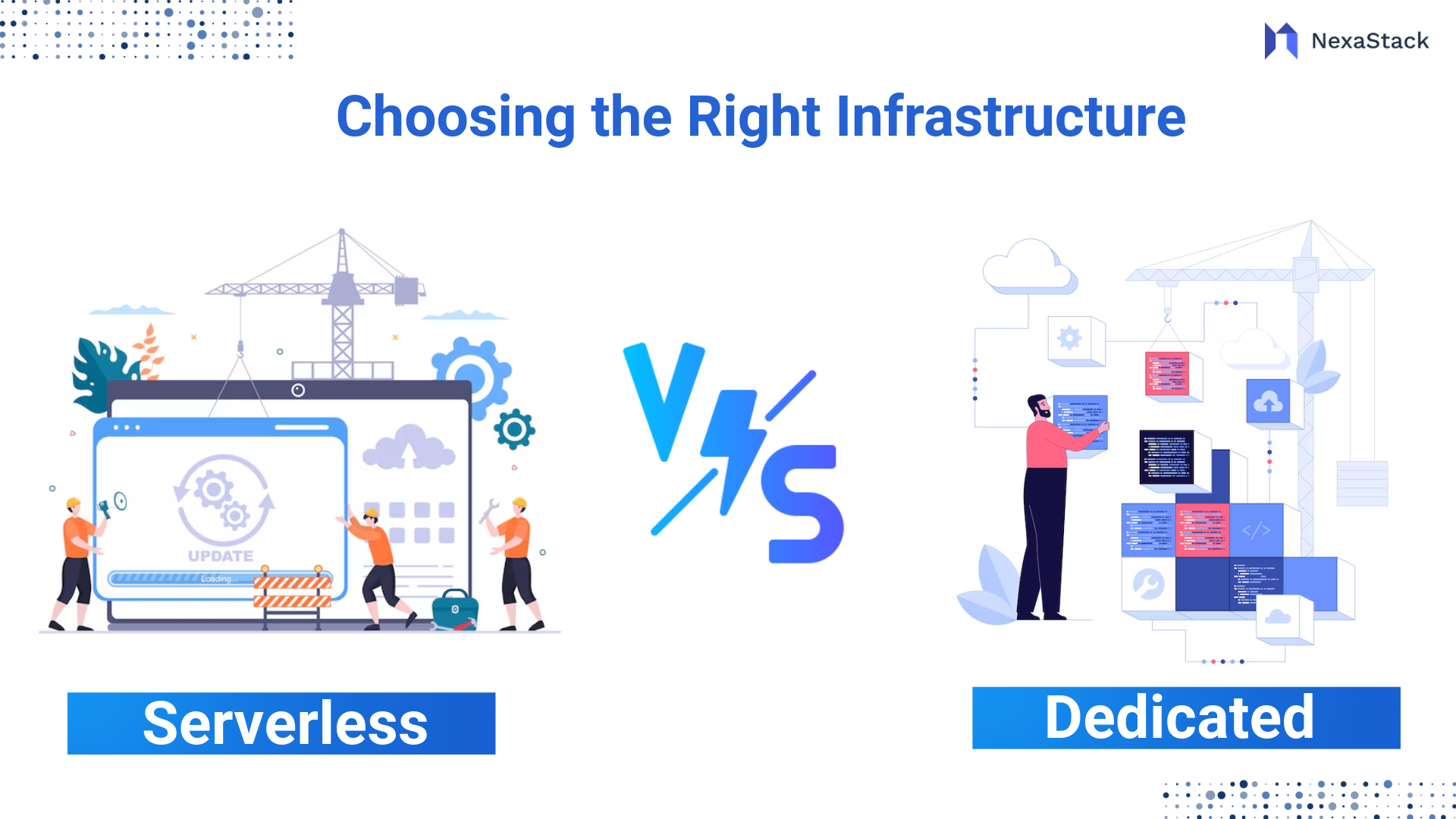
Serverless vs Dedicated Infrastructure: Definitions and Architectures
Compare serverless vs dedicated infrastructure to understand scalability, cost, control, and performance for modern cloud architecture decisions.
DevOps Principles Alignment with Agents Development and Deployment
Explore devOps principles alignment with agents development and deployment for scalable, secure, and automated AI agent lifecycle management.
Beyond Traditional Frameworks: The Evolution of LLM Serving
Explore Beyond Traditional Frameworks The Evolution of LLM Serving to understand scalable adaptive and efficient large model deployment.
Deploying a Private AI Assistant with Nexastack
Learn the key steps for deploying a Private AI Assistant securely, ensuring data privacy, scalability, and compliance.
Run LLAMA Self Hosted - Optimizing LLAMA Model Deployment
Run LLAMA Self Hosted for optimized deployment of LLAMA model, ensuring efficient performance, scalability, and reduced operational overhead.
ML Monitoring: Protecting AI Investments
Ensure reliable performance, detect anomalies, and safeguard models with ML monitoring, protecting AI Investments across AI lifecycle stages.
Running DeepSeek Self-Hosted: The DeepSeek Implementation Framework
Running DeepSeek Self-Hosted The DeepSeek Implementation Framework for secure, scalable, private AI deployment and seamless enterprise integration.

Multimodal AI as Competitive Differentiator
Discover how multimodal ai as competitive differentiator drives innovation, real-time intelligence, and personalized experiences across industries.

Develop & Deploy Model Context Protocol to Plug Legacy Enterprise Data
Develop & deploy model context protocol to plug legacy enterprise data and enable seamless integration, modernization, and unified data access.
Private Coding Assistant for Small, Medium and Large Development Teams
Private coding assistant for small, medium and large development teams enhances productivity, collaboration, and code quality across all team sizes.
OneDiffusion: Unified Image Strategy
OneDiffusion Unified Image Strategy enables on-premises AI image generation with real-time inference and edge AI deployment capabilities.
AI Agent Framework: Strategic Implementation
Explore AI Agent Framework for scalable, autonomous systems with real-time inference, on-device intelligence, and responsible AI strategies.
GRPC for Model Serving: Business Advantage
GRPC for model serving: business advantage enables faster, efficient, and scalable AI model deployment with reduced latency and overhead.
Stable Diffusion Services: Control and Cost
Discover Stable Diffusion Services with enhanced control and cost-efficiency for scalable, secure, and customizable AI image generation.
Image Generation with Self-Hosted LLAMA Models
Explore image generation with self-hosted LLAMA models for secure, scalable, and customizable AI-powered visual content creation.

Agentic Inference: The Decision Advantage
Explore how Agentic Inference delivers the decision advantage through autonomous reasoning, adaptive planning, and intelligent agent actions.
Agentic SOC Platform –In Depth Investigations and Autonomous Security
Agentic SOC Platform enables in-depth investigations, autonomous threat detection, and proactive security operations.
Understanding Retrieval-Augmented Generation
Discover how Retrieval-Augmented Generation enhances AI by combining knowledge retrieval with generative models for accurate responses.
Real-Time ML Inference: Competitive Edge
Discover how Real-Time ML Inference provides a competitive edge by enabling instant insights, faster decisions, and automation.
Structured Decoding with vLLM: Techniques and Applications
Explore structured decoding with vLLM to enhance controlled text generation, accuracy, and structured output in large language models.
Compound AI Systems: Orchestrating Excellence
Discover how Compound AI Systems integrates multiple intelligent agents to deliver scalable, adaptive, and efficient AI-driven solutions.
Optimizing TensorRT-LLM: Best Practices for Efficient Model Serving
Optimizing TensorRT-LLM for efficient model serving with best practices for fast AI inference and real-time performance.
Building A Multi-Agent System with Akira AI and NexaStack
Explore building a Multi-Agent System with Akira AI and NexaStack for intelligent automation, collaboration, and enhanced decision-making.
Deploying Code Llama in Production with OpenLLM
Learn how to deploying Code Llama in production with Openllm for scalable, efficient, and secure inference operations.
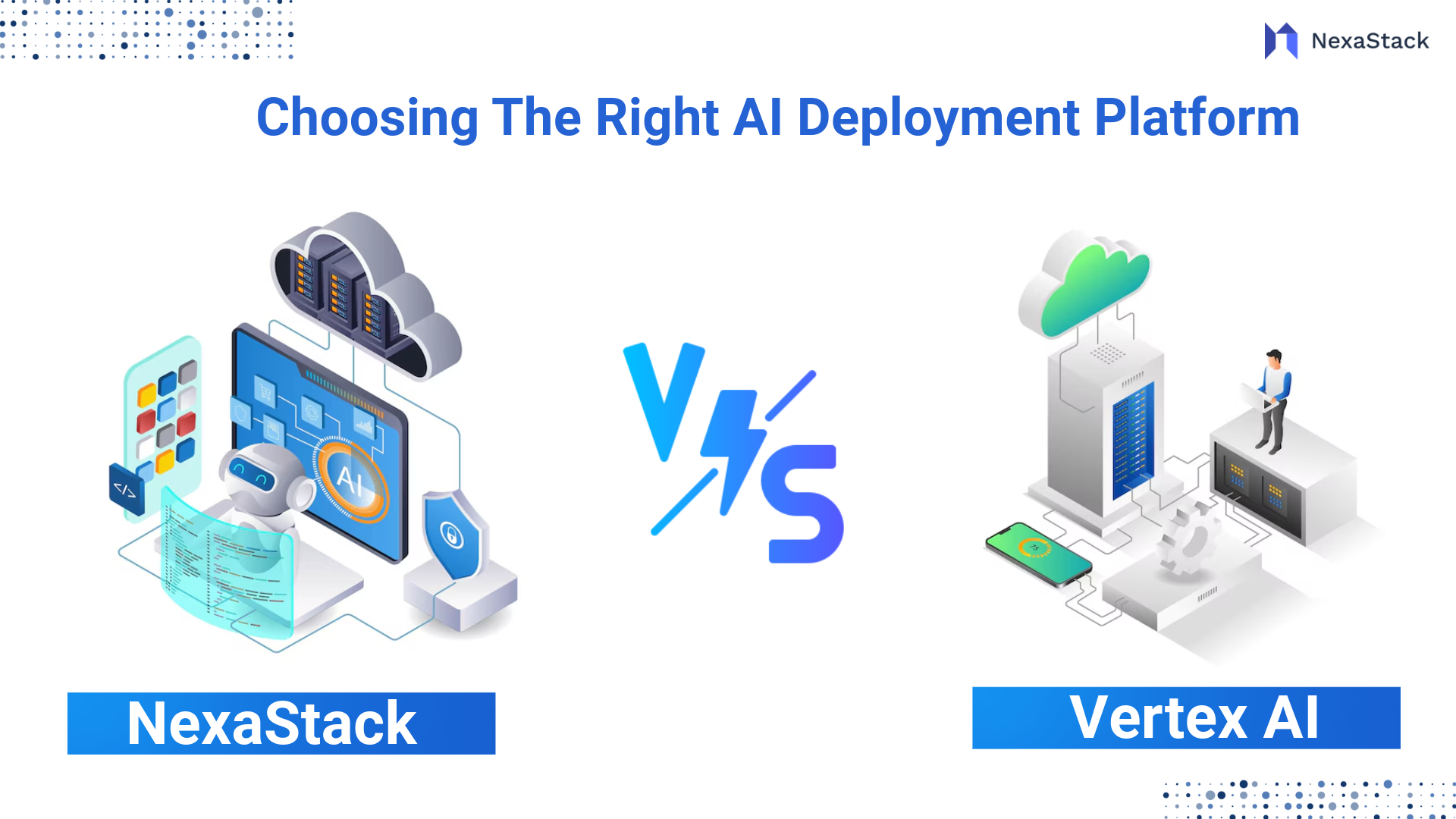
NexaStack vs Vertex AI: Choosing the Right AI Deployment Platform
Compare NexaStack vs Vertex AI to evaluate AI development platforms for scalability, automation, and enterprise-ready solutions.
Secure and Private DeepSeek Deployment
Secure and Private deepSeek deployment with enterprise-grade encryption, isolated environments, access control, and compliance for trusted AI.
ColPali: Capabilities and Enterprise Applications
Explore ColPali capabilities and enterprise applications, enhancing automation and productivity through collaborative and personalised AI agents.
Deploying AI21's Jamba 1.5 Mini with NexaStack
Deploying AI21's Jamba 1.5 Mini with fast efficient multilingual LLM for enterprise-grade AI applications and scalability.
Accelerate Agentic AI Application Development with NexaStack
Discover Agentic AI application development with NexaStack to streamline intelligent agent workflows, automation, and deployment capabilities.
Editors' Picks
Get more Latest Blogs
Physical AI Deployment Gap: From Demos to Deployment
Explore the Physical AI Deployment Gap and why robotics demos fail in production. Learn the ...
Physical AI vs Vision AI vs Robotics: Understanding the Differences
Physical AI vs Vision AI vs Robotics are often confused. You can learn how they differ and which ...
Why Your Physical AI Pilot Failed (And How to Fix It)
Most Physical AI pilot failed due to deployment gaps—learn the real causes and how to design pilots ...
Reliability Engineering for Physical AI: Beyond Mean Success Rates
Explore reliability engineering for Physical AI, focusing on performance beyond mean success rates ...
The Integration Problem: Why Physical AI Must Connect to Everything
Learn why the integration problem is crucial for Physical AI deployment and how it drives ...
From Lab to Factory: What Physical AI Systems Actually Need
Learn how to ensure physical AI systems meet production requirements for real-world deployment ...
Featured Series
Agentic AI
Intelligent visual AI agents that perceive, analyze, and act with precision for smarter decision-making
Physical AI Deployment Gap: From Demos to Deployment
Explore the Physical AI Deployment Gap and why robotics demos fail in production. Learn the architectural challenges blocking real-world deployment.
Physical AI vs Vision AI vs Robotics: Understanding the Differences
Physical AI vs Vision AI vs Robotics are often confused. You can learn how they differ and which capabilities your enterprise actually needs.
Why Your Physical AI Pilot Failed (And How to Fix It)
Most Physical AI pilot failed due to deployment gaps—learn the real causes and how to design pilots that scale successfully.
Reliability Engineering for Physical AI: Beyond Mean Success Rates
Explore reliability engineering for Physical AI, focusing on performance beyond mean success rates for optimal outcomes.
The Integration Problem: Why Physical AI Must Connect to Everything
Learn why the integration problem is crucial for Physical AI deployment and how it drives real-world success.
From Lab to Factory: What Physical AI Systems Actually Need
Learn how to ensure physical AI systems meet production requirements for real-world deployment success from lab to factory.
Why 95% Success Rate Means Failure in Physical AI
A 95% success rate sounds impressive — until you realize it means 50+ failures per day in production.
Private Cloud AI Inference: Cost, Control & Compliance
Private Cloud AI Inference enables predictable cost, control & compliance-ready AI deployment with NexaStack for enterprises.
Scaling AI Across the Enterprise: A Platform-First Approach
Scaling AI Across the Enterprise A Platform-First Approach enables secure governed and scalable AI adoption across global enterprises.
Enterprise AI Backbone Infrastructure with NexaStack
Enterprise AI backbone infrastructure with NexaStack enables secure, scalable, agentic AI operations across private, hybrid, and sovereign ...
Foundation Models: Risk, Hallucinations & Explainability
Foundation models - Risk, hallucinations & explainability impact enterprise AI trust, governance, compliance, and safe deployment at scale.
Model Cards and AI Fact Sheets: Building Governance-Ready AI
Model cards and AI fact sheets enable governance-ready AI through transparency, compliance alignment, risk management, and deployment.
Agentic AI and GRC: Challenges in Multi-Agent Autonomous Systems
Agentic AI governance challenges in multi-agent autonomous systems, covering GRC, security, and responsible enterprise AI adoption.
AI Factory-as-a-Service for Managed Private Compute
AI factory-as-a-service for managed private compute enables secure, scalable private cloud AI infrastructure for enterprise agentic workloads.
Driving Business Value with GenAI: A Strategic Adoption Playbook
Driving business value with GenAI enables enterprises to scale AI adoption, optimize decisions, and deliver measurable operational outcomes.
Why Model Registries Matter in Enterprise LLMOps?
Model registries matter in enterprise LLMOps ensures governance, versioning, compliance, reproducibility, and secure deployment of AI models.
Emerging LLM Techniques for Industry-Grade Applications
Explore LLM techniques enabling Private cloud AI, sovereign AI, Agentic AI, and AI agent deployment at scale.
Design Patterns for Scalable Multi-Agent AI Infrastructure
Design patterns for scalable multi-agent AI infrastructure enabling agentic AI, AI agent orchestration on private cloud AI.
How NexaStack Powers Coordination in Multi-Agent Environments
NexaStack enables secure coordination, orchestration, and real-time reasoning across scalable multi-agent environments for enterprise systems.
On-Premises AI Platform for Regulated Environments
On-Premises AI platform for regulated environments ensures secure, compliant, high-performance AI deployment for sensitive enterprise workloads.
Vision AI at the Edge: Inference Pipelines with RLaaS
Vision AI at the edge: inference pipelines with RLaaS enable real-time learning, secure processing, and scalable autonomous vision systems.
MCP Server for Distributed AI Control
MCP server for distributed AI control delivers secure governance, reliable agent coordination, and scalable autonomous operations for enterprises.
Evaluating and Comparing LLM Techniques for On-Premise Deployments
Evaluating and comparing llm techniques for on-premises deployments helps enterprises optimize secure, scalable AI performance across environments.
RLaaS vs Traditional MLaaS: A Strategic Comparison for Modern AI Teams
Compare RLaaS with traditional MLaaS to understand differences in automation, adaptability, scalability, and real-time decision-making capabilities.
Integrating MCP with RLaaS and LLMOps for R&D Workflows
Integrating MCP with RLaaS and LLMOps streamlines R&D workflows, improving experimentation, automation, scalability, and AI-driven innovation.
Automating the AI Model Lifecycle in Enterprises
Automate the AI model lifecycle with secure, scalable workflows that streamline deployment, monitoring, optimization, and governance for enterprises.
Why Smart Enterprises Choose Private Cloud AI Over Public Cloud?
Smart enterprises adopt Private Cloud AI for security, sovereignty, compliance, performance, and full control over public clouds.
Scalable Vision AI Stack with NexaStack
Scalable Vision AI Stack by NexaStack enabling secure inference, multimodal agents, and high-performance computer vision workloads.
Composable Compute Infrastructure for Agentic AI
Composable compute infrastructure accelerates agentic AI with faster performance, reduced bottlenecks, and scalable private cloud efficiency.
Private AI Clusters for Regulated Industries
Build secure Private AI clusters for regulated industries to ensure compliance, data control, sovereignty, governance, and reliable enterprise ...
Designing Low-Latency Pipelines for Real-Time Inference at the Edge
Low-latency pipelines enabling real-time decisioning with private cloud AI, sovereign AI, and agentic AI capabilities.
Open Telemetry & AI Agents – Building Observability from the Ground Up
Open Telemetry enhances AI agent observability by delivering unified tracing, metrics, and logs for reliable, compliant, production-grade agentic ...
Leveraging Private Cloud Compute for Secure and Scalable AI Workloads
Secure private cloud compute for scalable AI workloads with sovereign control, high performance, and strong data protection.
On-Prem AI Agents for Manufacturing, Finance & Healthcare
On-prem AI agents enabling secure, compliant, high-performance automation for manufacturing, finance, and healthcare with sovereign control.
Governing AI Systems: How Agentic GRC Enables Responsible AI Operation
Governing AI systems: How agentic GRC enables responsible AI operation through governance, compliance, risk management, and accountability.
5 Key Observability Metrics for Deploying a Private AI Assistant
Discover key observability metrics for optimizing and monitoring the performance of a private AI assistant.
Agentic GRC: From Reactive to Continuous Cybersecurity Assurance
Discover how Agentic GRC transforms cybersecurity by shifting from reactive defense to continuous compliance and cybersecurity assurance.
Agentic GRC for Health & Safety: AI-Driven Compliance & Accountability
Ensure continuous compliance and workplace safety with Agentic GRC — AI-driven accountability, risk monitoring, and autonomous governance automation.
Agent GRC for Health and Safety: Continuous Compliance AI Agents
Agent GRC for Health and Safety enables continuous compliance AI agents ensuring proactive monitoring, governance, and risk control.
The Evolution of GRC: From Compliance to Agentic Governance
Explore the evolution of GRC from compliance-driven models to Agentic Governance, enabling autonomous, intelligent, and adaptive control of the ...
How Agentic GRC Transforms IT Operations into Control Systems
Agentic GRC automates compliance and turns IT operations into intelligent, secure, and self-regulating control systems.
Model Risk Management in Financial Institutions
Model risk management in financial institutions ensures compliance, accuracy, governance, and reliability of AI and analytical models.
Reliable LLM Pipelines with NexaStack and Private Cloud Inference
Build reliable LLM pipelines with NexaStack’s private cloud inference for secure, scalable, and compliant AI model deployment.
Continuous Compliance for LLMs: CI/CD Pipelines with GRC
Ensure continuous compliance for LLMs with integrated CI/CD pipelines, automating GRC monitoring, validation, and governance across AI workflows.
Architecting Multi-Agent AI Systems Using RLaaS and AgentOps
Build intelligent Multi-Agent AI Systems using RLaaS and AgentOps for scalable learning, automation, and coordinated decision-making.
AI Orchestration Platforms for Autonomous Enterprises
AI orchestration platforms for autonomous enterprises enable context-first automation, governance, compliance, and intelligent agent collaboration.
From Prompt to Pipeline: Full-Stack AI Orchestration for Teams
From prompt to pipeline: Full-stack ai orchestration for Teams ensures scalable, secure, trustworthy enterprise-grade AI deployment.
Elastic AI Infrastructure: Pay-as-You-Grow Models for Agentic AI
Elastic ai infrastructure: pay-as-you-grow models for agentic ai deliver scalable, flexible, and cost-efficient enterprise automation.
When to Choose Private Cloud for AI Inference: A CISO’s Checklist
Accelerate intelligent applications using Private Cloud for AI Inference with enterprise-grade security, compliance and optimised performance.
Implementing Zero-Trust Architecture for AI Systems
Secure AI with Zero-Trust Architecture for AI Systems ensuring compliance, resilience, data protection, and trusted enterprise adoption.
Agent Governance at Scale: Policy-as-Code Approaches in Action
Agent Governance at Scale Policy-as-Code Approaches in Action ensures compliance automation transparency and governance for AI systems.
Data Residency & Sovereignty with Private Cloud AI Platforms
Ensure compliance and control with data residency & sovereignty with private cloud AI platforms for secure, scalable enterprise AI.
Deploying RL Agents in Private Cloud for Real-Time Decision Systems
Deploying RL Agents in Private Cloud for real-time decision systems, enabling secure, scalable, and intelligent enterprise automation.
Building a Kubernetes-Native AI Platform for the Enterprise
Kubernetes-Native AI Platform for the Enterprise delivers scalable, portable, and secure AI orchestration across cloud and hybrid environments.
Training RL Agents on Private Cloud: A Secure RLaaS Blueprint
Training RL agents on a private cloud enables secure, scalable, and efficient reinforcement learning, which improves performance and enterprise ...
Sovereign AI: Private Clouds with National Oversight
Sovereign AI private clouds with national oversight ensure a secure, compliant, and scalable national AI infrastructure for enterprises.
What Is RLaaS? Reinforcement Learning at Scale for Enterprise
Reinforcement learning at scale for enterprise with RLaaS enables secure, scalable, efficient AI adoption, optimisation, and automation.
Private Cloud RAG: Secure and Fast Retrieval-Augmented Generation
Private cloud RAG: secure and fast retrieval-augmented generation enabling enterprises with compliant, scalable, low-latency AI solutions.
What Is InferenceOps?
InferenceOps empowers enterprises with scalable, reliable, and efficient AI inference pipelines ensuring optimized model deployment and monitoring.
Zero Trust for AI: Securing Pipelines with Model Risk Management
Zero trust for AI: securing pipelines with model risk management, ensuring compliance, security governance, and minimising AI risks.
GRC in Energy AI: Optimising Power Grids with Regulated AI Models
GRC in energy AI enables optimising power grids with regulated AI models ensuring compliance efficiency sustainability and resilience.
Assessing Your Enterprise’s LLMOps Maturity: A Strategic Self-Audit
Assessing your enterprise’s LLMOps maturity with a strategic self-audit to optimize AI lifecycle management and scalability.
Securing Smart Buildings with AI: Risk Controls & Compliance
Securing smart buildings with AI: Risk controls & compliance solutions ensure safety, regulatory adherence, automation, and operational resilience.
AI Governance in Manufacturing: Model Risk in Predictive Maintenance
AI governance in manufacturing: model risk in predictive maintenance ensures reliability, compliance, transparency, and sustainable operations with ...
Synthetic Data in Model Risk Management
Synthetic data in model risk management enhances testing, reduces bias, improves compliance, and ensures resilient, trustworthy AI systems.
Making AI Portable: Run LLMs Anywhere with Cloud-Neutral Design
Making AI Portable Run LMs Anywhere with Cloud Neutral Design enables flexible scalable and cloud agnostic AI deployment.
Agentic AI for Predictive Maintenance: Prevent Downtime & Cut Costs
Boost efficiency with Agentic AI for Predictive Maintenance to prevent downtime, optimise operations, and significantly cut maintenance costs.
Responsible AI in Telecom: Fraud Detection & Network Optimisation
Discover how Responsible AI in Telecom enhances fraud detection and network optimization with ethical, transparent, and efficient solutions.
How to Build RL-Driven Systems?
RL-Driven Systems leverage reinforcement learning for adaptive decision-making, optimising performance and efficiency across enterprise AI ...
How a Unified Control Plane Simplifies AI Operations?
Unified Control Plane simplifies AI operations by centralising management, streamlining workflows and enhancing enterprise AI orchestration.
Assembly Line Quality with Agentic AI-Powered Real-Time Detection
Enhance assembly line quality with Agentic AI-powered real-time detection for faster defect identification and improved manufacturing efficiency.
How to Build Agentic AI for Industrial Systems?
Learn how to build Agentic AI for industrial systems with intelligent agents, automation, orchestration, and real-time insights.
AI and GRC in Logistics: Model Transparency in Supply Chain AI
Ensure AI transparency GRC in Logistics and practices for secure, auditable, and explainable supply chains.
The New Face of Model Risk: Managing AI and LLMs at Scale
Explore the new face of model risk managing AI and LLMs at scale with context-driven, autonomous risk operations.
AI Governance at the Infrastructure Layer
AI Governance at the infrastructure layer ensures secure, compliant, and efficient management of AI workloads across enterprise infrastructure.
Lifecycle Management for AI Models
Lifecycle management for ai models ensures efficient deployment, monitoring, optimization, and retirement of AI models across production environments.
OpenLLM: Production-Ready Language Models
OpenLLM Production-Ready Language Models for efficient deployment scaling and monitoring of LLMs in real-world enterprise environments.
Designing the Enterprise AI OS: Strategy, Tools & ROI
Designing the enterprise ai os: strategy, tools & roi for building intelligent systems that drive automation, efficiency, and measurable business ...
Combating Model Drift with Proactive Infrastructure Design
Combating model drift with proactive infrastructure design ensures stable AI performance and resilience across dynamic enterprise environments.
Intelligent AI Workload Orchestration: From Chaos to Control
Discover intelligent ai workload orchestration to optimise resource utilisation, improve performance, and streamline AI operations seamlessly.
Integration as Competitive Advantage
Discover how leveraging integration as a competitive advantage drives agility, innovation, and growth in today’s digital enterprise landscape.
How to Unify, Secure, and Scale Your Infrastructure
Unify, secure, and scale your infrastructure with modern strategies for integration, security, and seamless cloud scalability.
Kubernetes for AI: Simplified Deployment
Kubernetes for AI Simplified Deployment enables scalable efficient and automated orchestration of machine learning models in production.
Why Agentic AI Is the Future of Infrastructure?
Agentic AI is the future of infrastructure, enabling autonomous, intelligent, and adaptive management across cloud and enterprise systems.
ML Production Excellence: Optimized Workflows
Achieve ML Production Excellence with optimized workflows for faster deployment, automation, scalability, and reliable performance.
Video Generation with NexaStack: Business Beyond Marketing
Video Generation with NexaStack enables intelligent, scalable video content creation for enterprise functions beyond traditional marketing use.
AI Compliance Automation for Regulated Infrastructure
Ensure AI compliance automation for regulated infrastructure with scalable, auditable, and secure governance.
How NexaStack Enables a High-Performance AI Factory for Enterprises
Discover how NexaStack enables a high-performance AI factory for enterprises through automation, monitoring, orchestration, and optimization.
Function Calling with Open Source LLMs
Learn function calling with open source LLMs to integrate structured outputs into AI workflows efficiently and accurately.
Orchestrating AI Agents for Business Impact
Orchestrating AI Agents for business impact helps businesses automate workflows, improve efficiency, and drive intelligent digital transformation.
Self-Learning Agents with Reinforcement Learning
Self-learning agents with Reinforcement Learning improve autonomous decision-making by optimising actions through continuous environment-based ...
Large-Scale Language Model Deployment
Large-scale language model deployment for secure, scalable AI infrastructure with optimized performance and enterprise-ready deployment strategies.
Accelerating Innovation with AI Coding Assistants with NexaStack
Accelerating Innovation with AI Coding Assistants using NexaStack for enhanced developer productivity, automation, and secure enterprise development.
Building Deploying a Sentence Embedding Service with Nexastack
Build and deploying a sentence embedding service with NexaStack for scalable, secure, and efficient NLP model deployment.
Llama 2 in Action: Transformation Blueprint with NexaStack
Deploy Llama 2 in action with NexaStack for secure, scalable, and automated enterprise AI transformation and deployment.
Advanced AI Forecasting - Power of AI Forecasting
Discover the power of AI forecasting to enhance predictive accuracy, streamline decisions, and optimize business outcomes.
Intelligent Query Systems: The Decision Edge
Discover how Intelligent Query Systems provide the decision edge with real-time insights, automation, and strategic intelligence.
Exploring the World of Open-Source Text-to-Speech Models
Exploring the world of open-source text-to-speech models for scalable, custom voice solutions.
From AI Experiments to Enterprise Scale: Running LLMs in the Cloud
From AI experiments to enterprise scale: running LLMs in the cloud with optimized performance, flexibility, and scalability.
Image Recognition as Business Accelerator
Discover how image recognition as a business accelerator transforms industries through automation, visual data analysis, and AI innovation.
Control and Innovation: The AI Balance
Explore how organizations achieve control and innovation the AI balance through governance compliance risk management and strategy.
Embedding Models: The Strategic Advantage
Embedding Models The Strategic Advantage offers businesses deep contextual insights driving smarter AI decisions and personalized automation.
Inference Server Integration: Performance Strategy
Inference server integration: Performance strategy focuses on optimising model deployment for scalability, low latency, and efficient performance.
Deploying an OCR Model with EasyOCR and NexaStack
Deploying an OCR model with easyocr and nexaStack enables efficient text extraction, integration, and real-time model performance monitoring.
Knowledge Retrieval Excellence with RAG
Knowledge retrieval excellence with RAG enables accurate, context-aware responses by combining real-time retrieval with generative AI.
Scaling Open-Source Models: The Market Bridge
Scaling open-source models: The market bridge explores strategies to operationalise open-source AI models for enterprise-grade deployment.
LangChain in Production: Enterprise Scale
LangChain in Production at Enterprise Scale enables building deploying and managing enterprise AI applications with confidence and efficiency.
Rapid Model Deployment: Time-to-Value Strategy
Accelerate AI success with Rapid Model Deployment using a structured Time-to-Value Strategy for faster implementation and results.
Building a Digital Twin of Your AI Factory Using NexaStack
Build a digital twin of your AI factory using NexaStack for scalable, secure, and intelligent AI infrastructure operations.
Air-Gapped Model Inference for High-Security Enterprises
Enable secure, offline AI with air-gapped model inference for high-security enterprises using NexaStack's trusted infrastructure platform.
AI Infrastructure Buying Guide to Start Your AI Lab in 2025
AI Infrastructure Buying Guide to Start Your AI Lab with optimal tools, hardware, cloud setup, and cost strategies.
Deploying Llama 3.2 Vision with OpenLLM: A Step-by-Step Guide
Discover how deploying Llama 3.2 Vision with OpenLLM streamlines AI integration, enhances efficiency, and ensures scalable performance.
Implementing Stable Diffusion 2.0 Services with Nexastack Strategics
Implementing stable diffusion 2.0 services with Nexastack strategics for scalable, secure, and optimised generative AI deployment.
BYOC Strategy: The Trifecta Advantage
Discover how the BYOC Strategy Trifecta Advantage empowers enterprises with flexibility security and control in modern AI deployments.
Fine-Tune AI Inference for Better Performance with Nexastack
Fine-Tune AI Inference for Better Performance with NexaStack using optimized deployment, low latency, scalable AI, and efficient inference solutions.
Model Testing for Use-Cases Before Infrastructure Setup
Learn why model testing for use cases before infrastructure setup is essential to reducing risk, cost, and deployment errors.
Cloud-Agnostic AI Inference: Integrating Hyperscalers & Private Cloud
Explore cloud-agnostic AI inference: Integrating Hyperscalers & Private Cloud for scalable, flexible, and vendor-neutral AI deployments.
OpenLLM Decision Framework for Enterprises
A strategic guide for organizations adopting open-source large language models using the OpenLLM foundations decision framework.
Model Deployment Architecture: The Strategic View
Model deployment architecture enables scalable and secure deployment monitoring and lifecycle management of machine learning models across ...
Self-Hosted AI Models - Implementing Enterprise-Grade Self-Hosted AI
Learn how to implement enterprise-grade self-hosted AI models for secure, scalable, and compliant AI deployment solutions.
Serverless vs Dedicated Infrastructure: Definitions and Architectures
Compare serverless vs dedicated infrastructure to understand scalability, cost, control, and performance for modern cloud architecture decisions.
DevOps Principles Alignment with Agents Development and Deployment
Explore devOps principles alignment with agents development and deployment for scalable, secure, and automated AI agent lifecycle management.
Beyond Traditional Frameworks: The Evolution of LLM Serving
Explore Beyond Traditional Frameworks The Evolution of LLM Serving to understand scalable adaptive and efficient large model deployment.
Deploying a Private AI Assistant with Nexastack
Learn the key steps for deploying a Private AI Assistant securely, ensuring data privacy, scalability, and compliance.
Run LLAMA Self Hosted - Optimizing LLAMA Model Deployment
Run LLAMA Self Hosted for optimized deployment of LLAMA model, ensuring efficient performance, scalability, and reduced operational overhead.
ML Monitoring: Protecting AI Investments
Ensure reliable performance, detect anomalies, and safeguard models with ML monitoring, protecting AI Investments across AI lifecycle stages.
Running DeepSeek Self-Hosted: The DeepSeek Implementation Framework
Running DeepSeek Self-Hosted The DeepSeek Implementation Framework for secure, scalable, private AI deployment and seamless enterprise integration.
Multimodal AI as Competitive Differentiator
Discover how multimodal ai as competitive differentiator drives innovation, real-time intelligence, and personalized experiences across industries.
Develop & Deploy Model Context Protocol to Plug Legacy Enterprise Data
Develop & deploy model context protocol to plug legacy enterprise data and enable seamless integration, modernization, and unified data access.
Private Coding Assistant for Small, Medium and Large Development Teams
Private coding assistant for small, medium and large development teams enhances productivity, collaboration, and code quality across all team sizes.
OneDiffusion: Unified Image Strategy
OneDiffusion Unified Image Strategy enables on-premises AI image generation with real-time inference and edge AI deployment capabilities.
AI Agent Framework: Strategic Implementation
Explore AI Agent Framework for scalable, autonomous systems with real-time inference, on-device intelligence, and responsible AI strategies.
GRPC for Model Serving: Business Advantage
GRPC for model serving: business advantage enables faster, efficient, and scalable AI model deployment with reduced latency and overhead.
Stable Diffusion Services: Control and Cost
Discover Stable Diffusion Services with enhanced control and cost-efficiency for scalable, secure, and customizable AI image generation.
Image Generation with Self-Hosted LLAMA Models
Explore image generation with self-hosted LLAMA models for secure, scalable, and customizable AI-powered visual content creation.
Agentic Inference: The Decision Advantage
Explore how Agentic Inference delivers the decision advantage through autonomous reasoning, adaptive planning, and intelligent agent actions.
Agentic SOC Platform –In Depth Investigations and Autonomous Security
Agentic SOC Platform enables in-depth investigations, autonomous threat detection, and proactive security operations.
Understanding Retrieval-Augmented Generation
Discover how Retrieval-Augmented Generation enhances AI by combining knowledge retrieval with generative models for accurate responses.
Real-Time ML Inference: Competitive Edge
Discover how Real-Time ML Inference provides a competitive edge by enabling instant insights, faster decisions, and automation.
Structured Decoding with vLLM: Techniques and Applications
Explore structured decoding with vLLM to enhance controlled text generation, accuracy, and structured output in large language models.
Compound AI Systems: Orchestrating Excellence
Discover how Compound AI Systems integrates multiple intelligent agents to deliver scalable, adaptive, and efficient AI-driven solutions.
Optimizing TensorRT-LLM: Best Practices for Efficient Model Serving
Optimizing TensorRT-LLM for efficient model serving with best practices for fast AI inference and real-time performance.
Building A Multi-Agent System with Akira AI and NexaStack
Explore building a Multi-Agent System with Akira AI and NexaStack for intelligent automation, collaboration, and enhanced decision-making.
Deploying Code Llama in Production with OpenLLM
Learn how to deploying Code Llama in production with Openllm for scalable, efficient, and secure inference operations.
NexaStack vs Vertex AI: Choosing the Right AI Deployment Platform
Compare NexaStack vs Vertex AI to evaluate AI development platforms for scalability, automation, and enterprise-ready solutions.
Secure and Private DeepSeek Deployment
Secure and Private deepSeek deployment with enterprise-grade encryption, isolated environments, access control, and compliance for trusted AI.
ColPali: Capabilities and Enterprise Applications
Explore ColPali capabilities and enterprise applications, enhancing automation and productivity through collaborative and personalised AI agents.
Deploying AI21's Jamba 1.5 Mini with NexaStack
Deploying AI21's Jamba 1.5 Mini with fast efficient multilingual LLM for enterprise-grade AI applications and scalability.
Accelerate Agentic AI Application Development with NexaStack
Discover Agentic AI application development with NexaStack to streamline intelligent agent workflows, automation, and deployment capabilities.