What Is Physical AI Reliability Engineering?
Traditional reliability engineering was built for deterministic systems. You analyze failure modes, calculate probabilities, design redundancies, and test extensively. The system behaves predictably because it follows programmed logic.
A learned policy doesn't have failure modes you can enumerate. Its behavior emerges from training data, not explicit rules. You can't formally verify a neural network with billions of parameters. Testing can show the presence of failures, not their absence.
Yet Physical AI systems must achieve production-grade reliability — 99.9%+ success rates in environments they’ve never seen, maintained by technicians who didn’t build them, running continuously for months and years.
This requires a new approach: reliability engineering practices designed specifically for learned systems.
Key Takeaways
- Traditional reliability engineering fails for Physical AI because learned systems lack enumerable failure modes, deterministic behavior, and formally verifiable properties—assumptions that underpin conventional FMEA, fault tree analysis, and static verification methods.
- Physical AI reliability requires a five-layer stack: Hybrid architectures (bound failure modes), graceful degradation (handle uncertainty), runtime safety (enforce constraints), observability (enable diagnosis), and continuous improvement (learn from deployment data).
- The goal isn't eliminating failures—impossible for learned systems in open-world environments—but making failures recoverable, detectable, and bounded through systematic engineering practices.
- Production reliability isn't achieved at launch—it's built iteratively through deployment data flywheels: deploy → collect data → analyze failures → improve models → redeploy.
- CDOs and Analytics Leaders must measure reliability differently: Traditional uptime metrics are insufficient; learned systems require confidence calibration accuracy, escalation rates, failure recovery time, and model improvement velocity—metrics that track both system behavior and learning effectiveness.
- Hybrid architectures are non-negotiable for production deployment—pure learned policies cannot guarantee safety; programmed guards and fallbacks provide verifiable safety boundaries that learned components alone cannot deliver.
What is the primary challenge in Physical AI reliability?
Physical AI faces the challenge of not having predictable failure modes and relies on learned behaviors, which are uncertain and cannot be easily verified or tested.
Why Does Traditional Reliability Engineering Fall Short for Physical AI?
Traditional reliability engineering assumes properties that learned systems fundamentally don't have:
1. Enumerable Failure Modes
| Traditional Systems | Learned Systems (Physical AI) |
|---|---|
| Approach: List all ways the system can fail, analyze each, design mitigations (FMEA, fault trees) | Reality: Failures emerge from interactions between model, environment, and task—impossible to enumerate because they depend on distributions never seen during training |
| Assumption: Failure modes are knowable and finite | Reality: Failure modes are emergent and unbounded |
| Example: "Motor fails" → Add redundant motor | Example: "Model misclassifies object under unusual lighting" → Cannot enumerate all unusual lighting conditions |
Why traditional approaches fail: You cannot create an FMEA for "all possible input distributions the model hasn't seen." Failure modes emerge from the long tail of real-world variation.
2. Deterministic Behavior
| Traditional Systems | Learned Systems (Physical AI) |
|---|---|
| Behavior: Given the same inputs, produces the same outputs (deterministic, analyzable, predictable) | Behavior: Depends on learned representations that aren't interpretable; small input changes can produce large output changes; behavior in novel situations is uncertain |
| Verification: Analyze code logic to predict behavior | Verification: Cannot predict behavior from model weights |
| Example: "If sensor > threshold, trigger alarm" → Behavior is known | Example: "Neural network detects anomaly" → Behavior depends on training data distribution |
Why traditional approaches fail: Determinism enables formal analysis and prediction. Learned systems sacrifice determinism for generalization—you gain flexibility but lose predictability.
3. Formal Verification
| Traditional Systems | Learned Systems (Physical AI) |
|---|---|
| Approach: Mathematically prove system satisfies safety properties (model checking, theorem proving) | Reality: Formal verification of neural networks is computationally intractable for production-scale models (billions of parameters) |
| Guarantee: Can prove "System never violates constraint X" | Limitation: Cannot prove "7B parameter model never fails in unsafe ways" |
| Example: Verify state machine never enters forbidden state | Example: Cannot verify all possible neural network outputs are safe |
Why traditional approaches fail: Formal verification scales poorly beyond simple systems. Production Physical AI models (billions of parameters, complex architectures) exceed tractable verification bounds.
4. Static Analysis
| Traditional Systems | Learned Systems (Physical AI) |
|---|---|
| Approach: Analyze system design before deployment to identify weaknesses (code review, architectural analysis) | Reality: The "design" is weights learned from data; static analysis of weights doesn't reveal behavioral properties |
| Method: Review code, architecture diagrams, logic flows | Method: Cannot inspect model weights and predict behavior in edge cases |
| Value: Catch design flaws before deployment | Limitation: Model inspection doesn't predict edge case behavior |
"Unlike traditional systems, Physical AI systems do not have easily predictable failure modes. Their behavior emerges from training data, not explicit rules."
What Is the Reliability Engineering Stack for Physical AI?
Reliable Physical AI requires a layered approach. Each layer adds reliability properties that the layer below cannot provide alone.
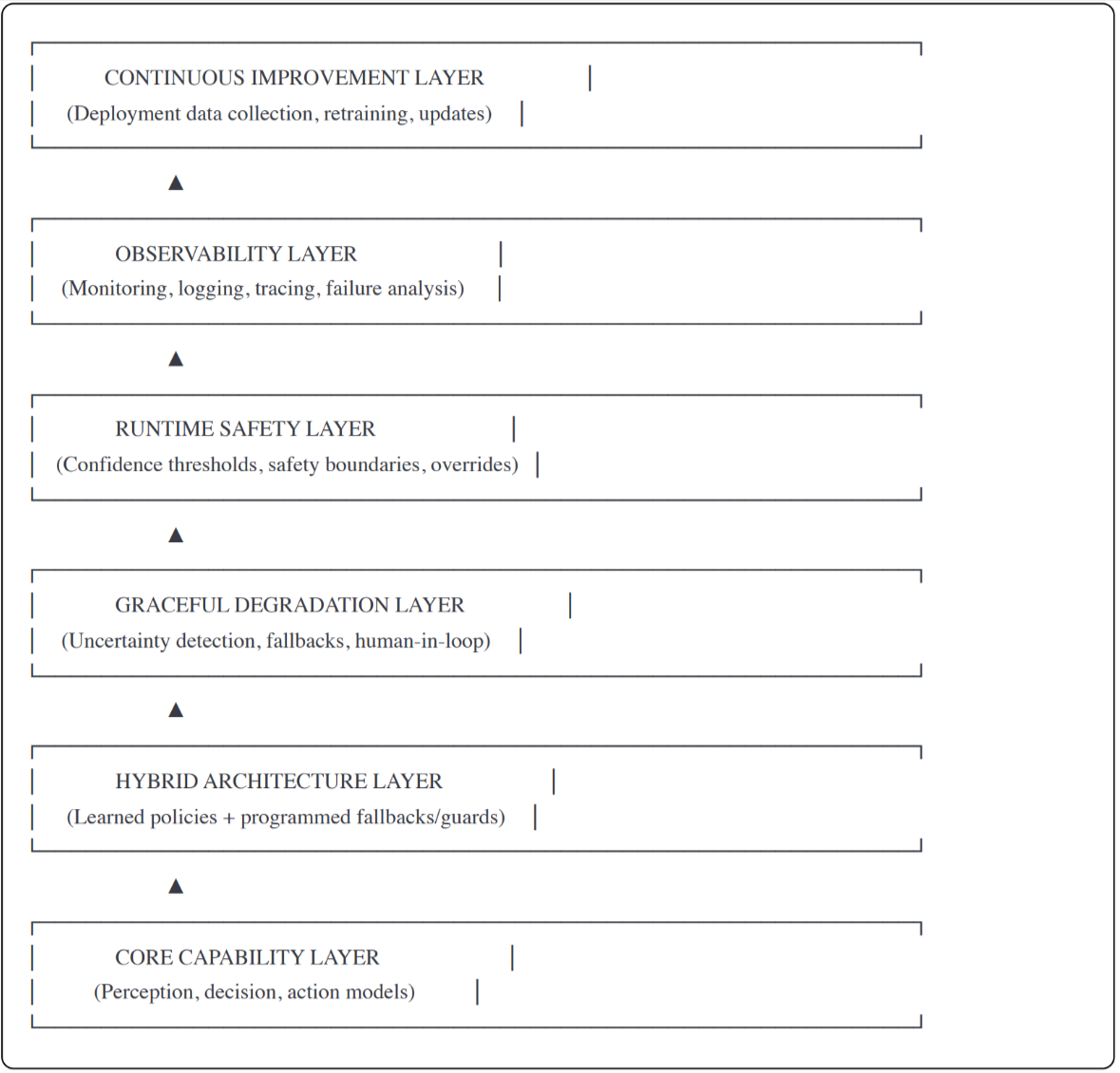
Layer 1: Hybrid Architectures
Principle: Combine learned policies (flexible, general) with programmed components (reliable, predictable) to bound failure modes.
Why Hybrids Work
Learned policies excel at handling variation and generalization. Programmed logic excels at enforcing constraints and handling known edge cases.
By combining them, you get:
-
Flexibility of learned systems for typical cases
-
Reliability of programmed systems for edge cases and safety
-
Bounded failure modes — learned components can fail, but within safe limits
How does graceful degradation work in Physical AI?
Graceful degradation ensures that when a system encounters uncertainty or a failure, it does not fail silently but instead requests assistance or falls back to a safer behavior.
Implementation Patterns
Pattern 1: Learned Core with Programmed Guards

The learned policy handles the task. Programmed guards check outputs against safety constraints and override if necessary.
Pattern 2: Programmed Router with Learned Specialists

A programmed router directs inputs to appropriate handlers. Known cases go to programmed logic. Novel cases go to learned policies.
Pattern 3: Hierarchical Control

Learned systems handle high-level reasoning where flexibility matters. Programmed systems handle low-level control where determinism matters.
Design Guidelines
-
Identify safety-critical functions: These should have programmed components or guards.
-
Define failure boundaries: What's the worst outcome if the learned component fails?
-
Design for graceful handoff: Smooth transitions between learned and programmed modes.
Layer 2: Graceful Degradation
Principle: When the system encounters unfamiliar situations, it should request help rather than fail silently.
Uncertainty Detection
Learned systems must recognize when they’re in unfamiliar territory:
1. Input Anomaly Detection
-
Is this input unlike training data?
-
Are sensor readings within expected ranges?
-
Is the environment configuration familiar?
2. Confidence Estimation
-
How confident is the model in its prediction?
-
Is confidence calibrated (does 80% confidence mean 80% accuracy)?
-
Are there competing hypotheses with similar confidence?
3. Behavioral Monitoring
-
Is the system behaving as expected?
-
Are action sequences typical or unusual?
-
Is performance degrading over time?
Degradation Strategies
When uncertainty is detected, the system has options:
-
Request human assistance: Pause and alert operator, present situation for human decision, queue for manual handling.
-
Fall back to safer behavior: Switch to more conservative policy, reduce speed/force, retreat to a known-good state.
-
Attempt with verification: Proceed with additional checks, verify the outcome before continuing, retry with a different approach if failed.
Implementation Requirements
-
Low-latency detection: Uncertainty must be detected before action, not after.
-
Clear escalation paths: Defined procedures for each degradation mode.
-
Operator training: Humans must know how to handle escalations.
-
Feedback loops: Learn from escalated cases to reduce future escalations.
Layer 3: Runtime Safety
Principle: Enforce safety constraints at runtime, regardless of what the learned policy outputs.
Safety Boundaries
Define hard limits that cannot be violated:
-
Physical limits: Maximum speeds and accelerations, force and torque limits, workspace boundaries.
-
Operational limits: Prohibited actions (e.g., never drop fragile items), required sequences (e.g., always verify before release), timing constraints (e.g., maximum cycle time).
-
Environmental limits: Human proximity responses, emergency stop integration, and environmental condition checks.
Runtime Enforcement
Safety boundaries must be enforced at runtime, not just during training:
-
Action filtering: Check every action against constraints before execution, modify or reject actions that violate limits.
-
State monitoring: Continuously verify system state against expectations, detect anomalies that might indicate unsafe conditions, and trigger protective responses when thresholds are exceeded.
-
Override mechanisms: Hardware interlocks for critical safety functions, emergency stop integration, and manual override capabilities.
Safety Verification
While you can't formally verify the learned policy, you can verify the safety layer:
-
Safety boundaries are programmed, not learned — they can be analyzed.
-
Testing can verify that boundaries are enforced correctly.
-
Monitoring can confirm that runtime enforcement is functioning.
Layer 4: Observability
Principle: You can't improve what you can't see. Comprehensive observability enables diagnosis, analysis, and improvement.
What to Observe
-
Inputs: Sensor data and quality metrics, environmental conditions, task parameters, and context.
-
Model behavior: Predictions and confidence scores, internal representations (where interpretable), decision paths, and alternatives considered.
-
Outputs: Actions commanded and executed, outcomes and success/failure, timing, and performance metrics.
-
System health: Hardware status and diagnostics, integration status and latencies, resource utilization.
Observability Infrastructure
-
Logging: Structured logs for all significant events, sufficient context for diagnosis, retention policies aligned with analysis needs.
-
Metrics: Real-time dashboards for operational monitoring, aggregated metrics for trend analysis, and alerts for anomalous conditions.
-
Tracing: End-to-end traces through the system, correlation of inputs, decisions, and outcomes, support for debugging specific incidents.
Failure Analysis
Observability enables systematic failure analysis:
-
Failure clustering: Group failures by characteristics, identify common patterns and root causes, prioritize by frequency and impact.
-
Root cause analysis: Trace from outcome back to inputs, identify contributing factors, and distinguish model failures from integration/hardware issues.
-
Trend detection: Detect gradual degradation, identify emerging failure modes, and predict maintenance needs.
Layer 5: Continuous Improvement
Principle: Production reliability isn't achieved at launch — it's built through continuous improvement from deployment data.
What is the role of hybrid architectures in Physical AI?
Hybrid architectures combine learned policies and programmed components to handle known edge cases while allowing for flexibility in handling variations in real-world data.
The Deployment Data Flywheel

Each cycle improves the system:
-
Deploy the current system version
-
Collect data from the production operation
-
Analyze failures and edge cases
-
Improve models and policies
-
Redeploy the improved version
Data Collection
Deployment data is more valuable than lab data because it matches production distribution:
What to collect:
-
All inputs (or representative samples)
-
All outcomes (success, failure, type of failure)
-
Edge cases and unusual situations
-
Human interventions and corrections
Collection requirements: Minimal impact on production performance, privacy and compliance considerations, storage, and retention management.
Improvement Mechanisms
-
Model retraining: Incorporate deployment data into training, focus on failure cases and edge cases, and validate before deployment.
-
Policy updates: Adjust parameters based on performance data, update safety boundaries based on observed failures, and refine escalation thresholds.
-
System updates: Deploy improvements without disrupting operations, validate in staging before production, rollback capability if issues emerge.
Measuring Improvement
Track reliability over time:
-
Success rate trajectory: Is reliability improving?
-
Failure mode evolution: Are old failures resolved? New ones emerging?
-
Intervention rate: Is human intervention decreasing?
-
Time to recovery: Is diagnosis and resolution getting faster?
Putting It All Together
Reliability engineering for Physical AI integrates all five layers:
| Layer | Function | Key Metrics |
|---|---|---|
| Hybrid Architecture | Bound failure modes with programmed components | Coverage of programmed guards |
| Graceful Degradation | Handle uncertainty by requesting help | Escalation rate, false positive rate |
| Runtime Safety | Enforce constraints regardless of model output | Constraint violations caught |
| Observability | Enable diagnosis and analysis | Mean time to diagnosis |
| Continuous Improvement | Improve over time | Reliability trajectory |
What Are the Implementation Priorities for Physical AI Reliability Engineering?
Phase 1: Foundation
-
Implement a hybrid architecture with safety guards
-
Deploy basic observability (logging, metrics)
-
Establish a failure analysis process
Phase 2: Robustness
-
Add graceful degradation capabilities
-
Implement runtime safety enforcement
-
Build comprehensive tracing
Phase 3: Improvement
-
Deploy data collection infrastructure
-
Establish a retraining pipeline
-
Implement continuous deployment
Final Summary: What Is the Goal of Physical AI Reliability Engineering?
Traditional reliability engineering is insufficient for Physical AI because learned systems lack enumerable failure modes, deterministic behavior, and verifiable properties.
Physical AI requires a layered approach:
-
Hybrid architectures — Bound failure modes with programmed components
-
Graceful degradation — Handle uncertainty by requesting help
-
Runtime safety — Enforce constraints regardless of model output
-
Observability — Enable diagnosis and analysis
-
Continuous improvement — Build reliability through deployment data
The goal isn't eliminating failures — that's impossible for learned systems in open-world environments. The goal is to make failures recoverable, detectable, and bounded. Production reliability isn't achieved at launch. It's built through systematic engineering practices designed for the unique properties of learned systems.
How does observability improve Physical AI systems?
Observability provides real-time monitoring and diagnostics, allowing teams to identify and fix failures quickly and continuously improve the system.