Organizations today face constant digital pressure. Cyber threats evolve rapidly, regulations shift frequently, and data is spread across cloud platforms, devices, and third-party systems. The challenge is no longer just defending networks — it’s ensuring governance, risk, and compliance (GRC) can keep up with this fast-moving environment.
Traditionally, cybersecurity teams managed threats while compliance teams handled audits and controls. That separation worked in the past, but today it leads to slow responses, blind spots, and reactive security.
This is where Agentic GRC steps in. Enabled by autonomous AI agents, Agentic GRC enables organizations to shift from reactive defense to continuous assurance. These agents monitor signals in real-time, analyze risk, make decisions, and take action — ensuring that controls, policies, and incident responses remain aligned at all times.
The result is a more innovative, adaptive governance model that updates itself as conditions change. Instead of waiting for audits or incidents, organizations stay proactively secure, compliant, and resilient.
In short, Agentic GRC turns cybersecurity into a continuous, AI-driven governance system built for today’s speed and complexity.
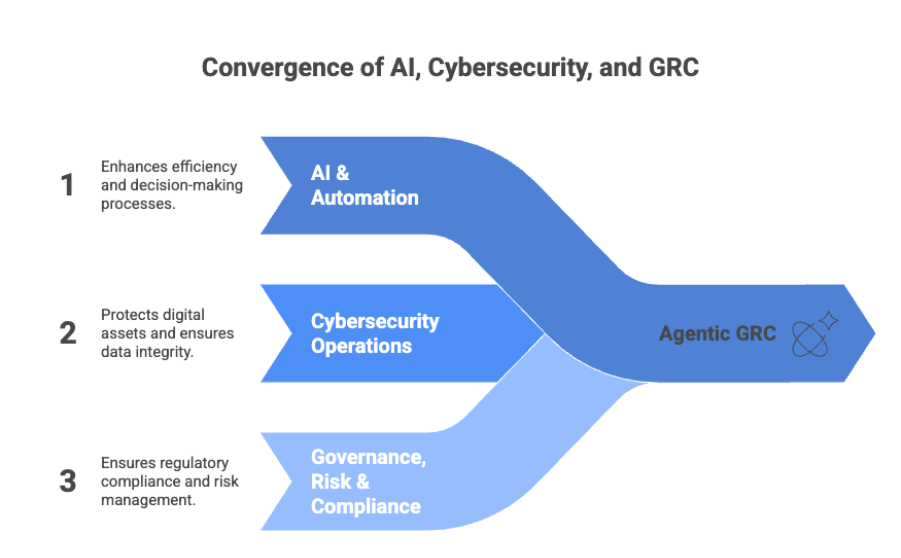
Understanding Agentic GRC in Security Operations
To understand how Agentic GRC impacts cybersecurity, it is helpful to examine how traditional GRC operates. Typically, companies conduct periodic audits, track controls in spreadsheets, and rely on humans to identify compliance gaps. That might have worked when IT environments were simpler — but in a modern enterprise with hundreds of cloud applications, endpoints, and identities, manual oversight cannot keep up.
Agentic GRC takes an entirely different approach. It uses AI agents — intelligent software components that can observe what’s happening across your systems, make sense of it, and take action based on defined governance rules.
These agents can:
-
Monitor configurations, access logs, and system behaviors continuously
-
Correlate those observations with policies and compliance standards
-
Automatically raise alerts, generate reports, or even trigger fixes when something’s off
Think of them as virtual security and compliance officers — always watching, analyzing, and enforcing policies, 24/7.
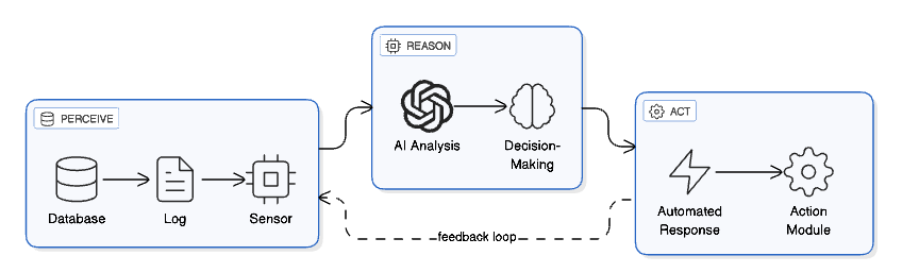
An Agentic GRC system usually operates across three layers:
-
Observation: Agents collect data from your cloud, network, and endpoint environments, watching for risks or deviations.
-
Understanding: They interpret what that data means — for example, detecting if a change in user permissions violates a control requirement in ISO 27001 or NIST CSF.
-
Action: They respond automatically or suggest remedial steps, ensuring controls are continuously validated and compliant.
The result is a smarter, self-adapting governance layer that works in tandem with your existing cybersecurity tools — not as a separate audit function, but as an integral part of security operations.
Managing Cyber Risks through Continuous Control Validation
Risk in cybersecurity is like a moving target. What’s safe today might be vulnerable tomorrow. That’s why periodic audits or annual compliance checks no longer suffice. Organizations require continuous validation — real-time assurance that controls are functioning correctly and risks are effectively managed.
Agentic GRC makes this possible through continuous control testing, real-time risk scoring, and predictive analytics.
-
Continuous Control Testing: Instead of waiting for audit cycles, AI agents can automatically test controls across all environments. For example, they might verify whether encryption is enabled on all storage systems, whether patches are up to date, or if access controls follow policy. If something fails — say, a public S3 bucket is left open — the system immediately flags it, not weeks later during an audit.
-
Dynamic Risk Scoring: Every risk isn’t equal. Agentic GRC utilizes data and context to calculate dynamic risk scores, combining threat intelligence, asset value, and control health. This helps CISOs prioritize issues that truly matter rather than drowning in alerts. For instance, if a vulnerability appears on a critical production server and there’s active exploit activity reported globally, the agent can automatically mark it as high risk and escalate.
-
Predictive Governance: Beyond just detecting problems, agents can anticipate them. By learning from past data, they can identify patterns that often lead to compliance drift — such as delayed patching or recurring misconfigurations — and alert teams before they cause incidents. With this, organizations shift from a “checklist” mindset to living governance — constantly aware, continually improving.
Aligning GRC with SOC, SIEM, and Threat Intelligence Systems
In most enterprises, there’s a disconnect between the Security Operations Center (SOC) and GRC teams. SOC analysts handle alerts, SIEM dashboards, and incidents. GRC teams focus on audits, frameworks, and reports. Both deal with security, but their worlds rarely meet.
Agentic GRC bridges this gap by connecting governance with operational systems.
Integration with SIEM and SOAR
By integrating with platforms such as Splunk, Microsoft Sentinel, or QRadar, GRC agents can retrieve event data directly from SIEM systems. If the SIEM detects suspicious activity, the agent automatically correlates it with relevant compliance controls, such as ISO 27001’s access management or NIST CSF’s “Protect” category.
When integrated with SOAR tools (like Palo Alto Cortex XSOAR or ServiceNow SecOps), agents can even automate responses. Imagine a failed login followed by privilege escalation — the agent can automatically isolate the account, update the incident ticket, and record everything for audit evidence.
Threat Intelligence Alignment
GRC agents can ingest live threat feeds from services such as MISP, Recorded Future, or internal threat intelligence sources. If a new exploit targets a software used in your environment, the system instantly checks which assets are exposed and whether controls are still compliant.
Unified Governance Dashboard
All this comes together in a unified view — one dashboard that shows your risk posture, compliance status, and threat exposure in real-time. Instead of juggling between SOC reports and compliance spreadsheets, CISOs can finally see the full picture: what threats exist, which controls are protecting them, and where governance needs tightening.
Privacy and Data Protection in Security Governance
Security isn’t just about keeping attackers out — it’s about protecting the data that defines your business. Regulations like GDPR, CCPA, and others have made privacy a boardroom concern. Agentic GRC streamlines data governance by seamlessly integrating privacy management into daily operations.
Automated Data Discovery
AI agents can continuously scan systems to find where sensitive data lives — whether it’s customer records in cloud storage, team member data in HR tools, or financial data in shared drives. They utilize natural language processing (NLP) to automatically classify various data types, including PII, PHI, financial information, and other sensitive data.
Privacy-Aware Incident Response
When incidents happen, agents can instantly assess privacy impact. Suppose a database breach affects 10,000 customer records — the system identifies that the data falls under GDPR, prepares breach notification templates, and guides compliance teams on timelines and reporting requirements.
Policy Enforcement
Agents can also prevent privacy violations in real-time. For example, suppose someone attempts to send sensitive files to an external email address or upload them to a public drive. In that case, the system can block the action immediately and record the event in compliance logs. In short, Agentic GRC makes privacy compliance automatic, not manual — keeping enterprises both secure and accountable.
Key Standards – ISO 27001, NIST CSF, GDPR Compliance
Every cybersecurity framework — from ISO 27001 to NIST CSF to GDPR — aims for one thing: the structured and consistent protection of information. However, mapping hundreds of controls and collecting evidence across various tools is tedious and prone to error. Agentic GRC simplifies this with automation and intelligence.
ISO 27001
AI agents continuously monitor controls defined in ISO 27001, such as access restrictions, incident management, and audit logging. When something drifts out of compliance, the system automatically generates evidence, notifies the control owner, and even starts corrective workflows. This replaces endless manual checks with ongoing assurance.
NIST Cybersecurity Framework
For organizations following NIST CSF, Agentic GRC helps track progress across the five core pillars: Identify, Protect, Detect, Respond, and Recover. Agents can link operational data (from SIEM, CMDB, or endpoint tools) to each function, giving a live snapshot of your maturity and risk exposure.
GDPR and Global Privacy Laws
For data protection laws like GDPR, agents can automate compliance tracking — from consent management to breach notifications. When a privacy incident occurs, the system identifies the applicable legal obligations and ensures timely reporting within the 72-hour window mandated by the GDPR.
This compliance-by-design approach saves time, reduces audit fatigue, and ensures enterprises stay compliant even as regulations evolve.
Real-World Scenarios – Incident Governance via Agents
Let’s make this more concrete with a few real-life examples of how Agentic GRC works in action.
Scenario 1: Suspicious Privilege Escalation
A GRC agent notices that a user suddenly gained admin access outside normal working hours. It cross-checks this activity against company policy and ISO 27001 controls, flags it as a potential violation, and automatically initiates a SOAR response to disable the account. At the same time, it logs every action for audit purposes — eliminating the need for manual work.
Scenario 2: Third-Party Vendor Risk
A vulnerability is discovered in a SaaS tool your company uses. The agent detects the software version in use internally, evaluates exposure, and alerts vendor management teams. It even automatically requests updated security documentation from the vendor.
Within hours, leadership has complete visibility into vendor risk and ongoing mitigation.
Scenario 3: Data Leakage Prevention
A team member attempts to upload confidential client data to an unauthorized cloud application. The agent blocks the transfer, classifies the file as sensitive, and records the event as a privacy enforcement case in accordance with GDPR guidelines. What would’ve been a potential breach turns into a controlled, auditable event — handled autonomously. These examples show how Agentic GRC doesn’t just observe governance — it enforces it, instantly and intelligently.
How NexaStack Enables Agentic GRC for Cybersecurity
To put Agentic GRC into practice, organizations need more than AI models — they require a platform that can coordinate agents, integrate with security tools, and enforce decisions in real-time. That’s where NexaStack fits in.
NexaStack acts as the operational layer for autonomous cybersecurity and compliance. It enables multiple AI agents to collaborate — monitoring risks, understanding controls, determining actions, and taking automated responses.
For example:
-
A Monitoring Agent watches signals from SIEM, EDR, cloud logs, and identity platforms.
-
A Compliance Agent maps these signals to frameworks such as ISO 27001, SOC 2, and NIST, among others.
-
A Decision Agent evaluates risk levels and recommends or triggers responses.
-
An Action Agent enforces controls — such as blocking access, updating tickets, or generating evidence for audits.
This turns GRC into a continuous loop — detect → analyze → act → document — instead of waiting for monthly reviews or annual audits.
NexaStack also works on-premises and in air-gapped environments, making it suitable for regulated industries such as BFSI, healthcare, manufacturing, and government. Because the data never leaves your environment, compliance and sovereignty stay intact.
Most importantly, NexaStack doesn’t replace your existing tools — it orchestrates them, bringing intelligence and automation on top of your current security stack.
The outcome:
Continuous assurance instead of reactive firefighting.
Faster responses, fewer manual tasks, and a security posture that adapts on its own.
Conclusion – Autonomous Cyber Assurance and Resilience
Cybersecurity now needs more than defense — it needs governance that thinks. Agentic GRC facilitates this shift by utilizing AI agents that continuously monitor, reason, and act to maintain system security and compliance. Instead of reacting to threats or audits, organizations gain real-time assurance — where compliance is continuous, controls are self-checking, and risks are managed before they escalate.
By uniting governance and security intelligence, Agentic GRC helps build resilient, adaptive enterprises ready for the AI-driven future.
Agentic GRC transforms cybersecurity from a reactive defense into a system of continuous assurance and adaptive governance.