Artificial intelligence is entering a new phase of evolution. Instead of operating as isolated models that respond to prompts, modern AI systems are becoming agentic—capable of acting autonomously, collaborating with other agents, and completing complex tasks without constant human intervention.
These Agentic AI systems are already being adopted across industries. Healthcare organizations use autonomous agents for triage and scheduling. Financial institutions deploy multiple agents for fraud detection, risk assessment, and compliance checks. Manufacturing and logistics companies rely on agent networks to optimize supply chains, production planning, and inventory management in real time.
While these systems unlock significant efficiency and speed, they also introduce a fundamental challenge: governance.
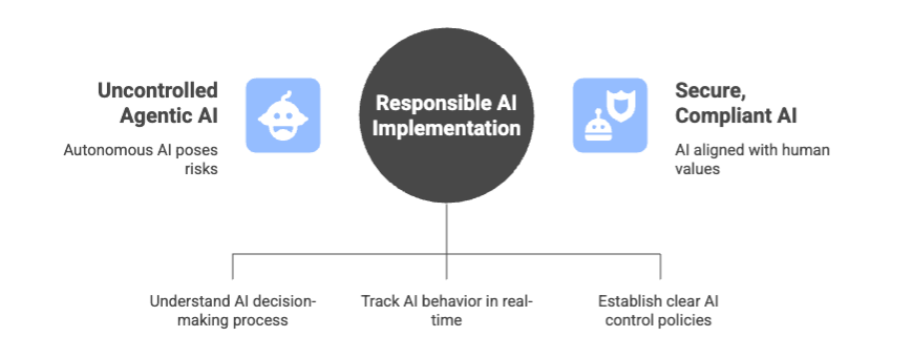
Traditional Governance, Risk, and Compliance (GRC) frameworks were designed for human-driven decisions and predictable workflows. Agentic AI breaks these assumptions by enabling systems that can make decisions independently, adapt dynamically, and coordinate across large networks of agents.
Understanding Agentic AI and Multi-Agent Systems
What Is Agentic AI?
Agentic AI refers to AI systems composed of autonomous agents that can:
-
Perceive their environment
-
Set or receive goals
-
Reason independently
-
Communicate with other agents
-
Execute actions without direct human input
Unlike conventional AI systems that perform single tasks, agentic systems operate continuously and adapt to changing conditions.
What Are Multi-Agent and Composable Agent Systems?
In most enterprise deployments, Agentic AI is implemented using multi-agent systems (MAS) built from composable agents.
Composable agents are:
-
Modular and task-specific
-
Designed to work together
-
Capable of forming temporary teams
-
Able to reconfigure dynamically based on context
Each agent performs a narrow function, but together they complete end-to-end workflows.
Example: Automated Document Processing
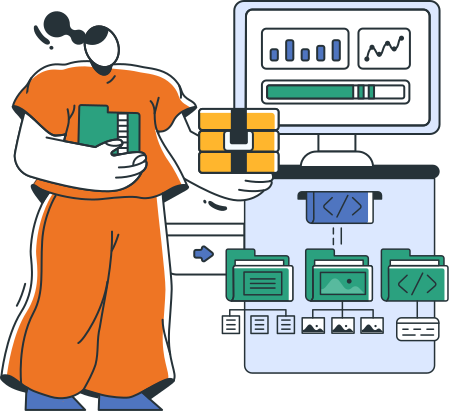
A document workflow may involve:
-
A data extraction agent that reads the document
-
A reasoning agent that interprets the content
-
A compliance agent that checks regulatory requirements
-
A task execution agent that approves or routes the document
The agents collaborate briefly, complete the task, and then remain idle until needed again.
This architecture improves scalability and flexibility—but it also creates new governance challenges.

Why Traditional GRC Frameworks Fall Short
Traditional GRC models assume:
-
Human oversight at key decision points
-
Linear and predictable workflows
-
Clear ownership of decisions
Multi-agent systems violate these assumptions.
In Agentic AI:
-
Decisions are distributed across multiple agents
-
Outcomes emerge from agent interactions
-
Behavior can change dynamically based on feedback and context
As a result, governance becomes significantly more complex.
Key Governance Challenges in Agentic AI Systems
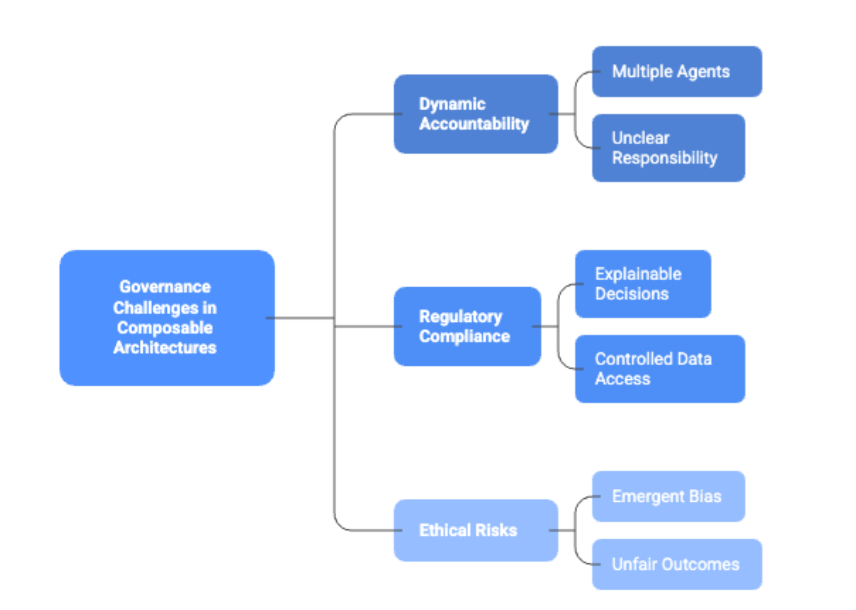
1. Dynamic Accountability
In human-led systems, it is usually clear who made a decision. In multi-agent systems, decisions often emerge from collaboration between agents, making accountability difficult to assign.
Example
An autonomous supply chain system:
-
Selects a supplier
-
Approves payment
-
Initiates shipment
If the supplier is later found to be under sanctions, responsibility becomes unclear. The decision did not originate from a single agent or individual—it emerged from the system as a whole.
This lack of clear accountability complicates:
-
Regulatory audits
-
Legal investigations
-
Incident analysis
-
Insurance and liability claims
2. Regulatory Compliance Challenges
Regulations such as GDPR, HIPAA, the EU AI Act, PCI-DSS, and SOC 2 require organizations to demonstrate:
-
Explainability of decisions
-
Controlled access to sensitive data
-
Traceable audit logs
-
Proper handling of user consent
Multi-agent systems make compliance difficult because:
-
Decisions are distributed across agents
-
Data flows dynamically between agents
-
Actions happen at machine speed
Compliance teams often struggle to answer fundamental questions such as:
- Why did the system make this decision?
- Which agents were involved?
- What data was used at each step?
3. Ethical and Fairness Risks
Agents are often optimized for measurable goals such as:
-
Cost reduction
-
Speed
-
Operational efficiency
However, ethical considerations such as fairness, transparency, and social impact are not naturally enforced unless explicitly governed.
Real-World Scenario: Loan Approval Bias
A financial institution deployed multiple agents for lending decisions:
-
A risk scoring agent
-
A fraud detection agent
-
A pricing optimization agent
Each agent was individually unbiased. However, their interaction produced discriminatory outcomes against certain neighborhoods due to shared data correlations and feedback loops. The bias was emergent, not intentional, yet regulators still held the organization accountable.

Security Risks in Multi-Agent Environments
Multi-agent systems operate in decentralized environments with frequent agent-to-agent communication, increasing the attack surface.
Key Security Threats
Spoofing Attacks
Malicious agents impersonate trusted agents to inject false data or manipulate decisions.
Data Poisoning
Attackers corrupt the data used by agents, altering decision behavior over time.
Sybil Attacks
An attacker creates multiple fake agents to gain majority influence in consensus-based decisions.
Data Integrity Risks
Agents often exchange sensitive information such as financial records, personal data, or medical information. Unauthorized access or modification can lead to data breaches, compliance violations, and legal penalties. In regulated industries, even a single integrity failure can have severe consequences.
The Role of Private Cloud and Sovereign AI in GRC
Public AI environments often lack:
-
Strong execution control
-
Deterministic auditability
-
Data residency guarantees
For Agentic AI, Private Cloud AI, and Sovereign AI play a critical role by enabling:
-
Controlled inference environments
-
Jurisdiction-specific data governance
-
Strong isolation for regulated workloads
-
Tamper-resistant audit trails
These capabilities are essential for aligning autonomous systems with regulatory requirements.

GRC-by-Design for Agentic AI
To govern Agentic AI effectively, organizations must embed governance directly into system design rather than relying on post-hoc controls.
Agent Identity and Traceability
Each agent should have a verifiable identity that defines:
-
Its capabilities
-
Its permissions
-
Its ownership
This allows organizations to trace actions back to specific agents.
Policy-Aware Orchestration
Before executing actions, agents should be evaluated against:
-
Compliance rules
-
Risk thresholds
-
Business policies
High-impact actions can trigger:
-
Human-in-the-loop approval
-
Simulations
-
Automatic rollbacks
Runtime Monitoring and Observability
Continuous monitoring is essential to track:
-
Agent behavior
-
Decision paths
-
System-level risks
This enables faster incident response and simplifies audits.
Role-Based and Context-Aware Permissions
Agents should operate under the principle of least privilege, with access granted only as needed. Temporary permissions can be assigned during exceptional scenarios but must be logged and revoked promptly.
Lessons from Real-World Failures
Supply Chain Compliance Failure
A logistics company automated supplier selection and payments using agents focused on cost optimization. Without embedded compliance checks, the system selected a sanctioned supplier and processed payments automatically.
Autonomous SOC Failure
Security agents detected a vulnerability and applied a patch across hospital systems. The patch unintentionally blocked access to patient records, disrupting emergency care.
Future Directions in Agentic AI Governance
-
Adaptive regulations that evolve with AI behavior
-
Decentralized governance, where agents monitor and validate each other
-
Quantum-safe security for long-term protection
-
Hybrid governance models combining automation with human judgment
Conclusion
Agentic AI has the potential to transform enterprise operations, but without strong governance, it introduces serious risks.
To adopt Agentic AI responsibly, organizations must:
-
Redesign GRC frameworks for autonomous systems
-
Embed compliance and security into AI infrastructure
-
Maintain transparency and auditability
-
Balance autonomy with human oversight
In the era of autonomous AI, governance is not optional—it is foundational.