Artificial Intelligence is no longer a futuristic concept; it’s running your business operations, optimizing your decisions, and even negotiating deals on your behalf. However, as AI evolves from passive tools to autonomous, goal-driven agents—what experts now call agentic AI —a new challenge is emerging: how do we keep these intelligent systems under control?
A new layer of Governance, Risk, and Compliance designed specifically for intelligent and autonomous systems. Unlike traditional governance, which audits code or reviews data after deployment, Agentic GRC works in conjunction with AI to implement a real-time monitoring model, continuously monitoring behavior, data integrity, fairness, and explainability as the system operates.
The Governance Gap in AI Systems
As enterprises adopt AI at scale, many have discovered a “governance gap”: while there are robust processes for software, data, compliance, and risk in legacy systems, those same practices often don’t translate cleanly into AI systems. According to Gartner, as many as 60% of organizations risk failure in AI initiatives due to inadequate governance frameworks.
Why does this gap exist?
-
AI systems aren’t static—they evolve, learn, adapt, and sometimes self-modify (especially when agentic).
-
Decision-making is no longer purely deterministic; “why did the model decide that?” is a valid question.
-
Models, data pipelines, feedback loops, and operational context all combine in ways that cross traditional silos (data, compliance, risk, operations).
-
The regulatory and ethical landscape for AI is still evolving and becoming increasingly complex.
In effect, organizations are deploying robust AI systems without the same confidence they have in more traditional software or business processes. Governance needs to catch up.
Why AI Operations Need Dedicated Governance Layers
AI operations differ from traditional IT operations in several critical ways:
-
Data dependence and evolution: Models rely on large volumes of data that change over time; just as significantly, models themselves can drift or degrade.
-
Decision impact: AI outcomes are increasingly influencing business decisions, customer experiences, and even societal outcomes (e.g., credit decisions, hiring practices, healthcare).
-
Emergent behavior: With agentic systems, AI can act autonomously, plan, coordinate with other agents, and trigger actions—not just respond to queries.
-
Regulatory and reputational risk: Misconduct, unintended bias, lack of transparency, or model failure can lead to serious compliance and trust issues.
-
Lifecycle complexity: From data ingestion, feature engineering, modelling, deployment, monitoring, retraining—and possibly autonomous modification—the lifecycle is complex and requires oversight at multiple points.
Because of these differences, simply applying existing IT governance or risk management frameworks is insufficient. A dedicated governance layer explicitly designed for AI operations is required.
Principles of Responsible AI – Transparency, Fairness, Accountability
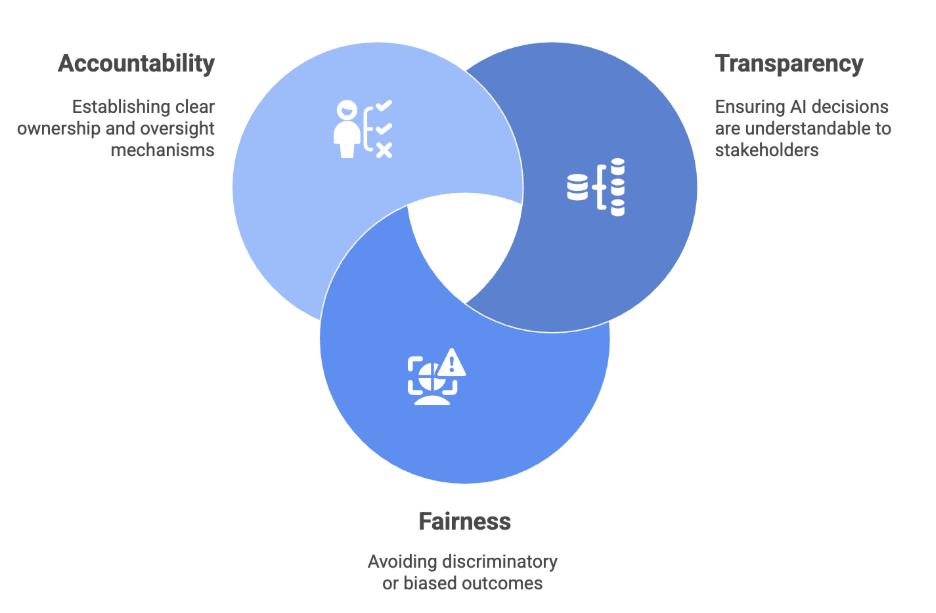
At the heart of AI governance are the principles of responsible AI. These principles provide an ethical and operational compass around which governance systems should be built. Key principles include:
Transparency
Transparency means ensuring that the “why” and “how” of AI decisions are clear and understandable to stakeholders. As organizations like Microsoft and Google emphasize, transparency is not just about publishing a model card—it’s about ensuring that stakeholders can trace data lineage, model logic, decisions, and feedback loops.
Fairness
Fairness addresses the need to avoid discriminatory or biased outcomes. Models trained on unrepresentative data can amplify historical inequalities; therefore, responsible AI frameworks are necessary for detecting, correcting, and ensuring fairness throughout the AI lifecycle.
Accountability
Accountability ensures that there are clear owners and mechanisms for oversight. Who is responsible if an AI system misbehaves? Who must answer the questions? Who will remediate? Governance frameworks emphasize clear roles, responsibilities, and audit trails to ensure transparency and accountability.
These three can serve as an organizing lens for your governance design. But note—they are necessary but not sufficient. Robust AI governance must also consider privacy, robustness, security, and continuous monitoring.
Agentic GRC for Monitoring Model Lifecycle and Data Integrity
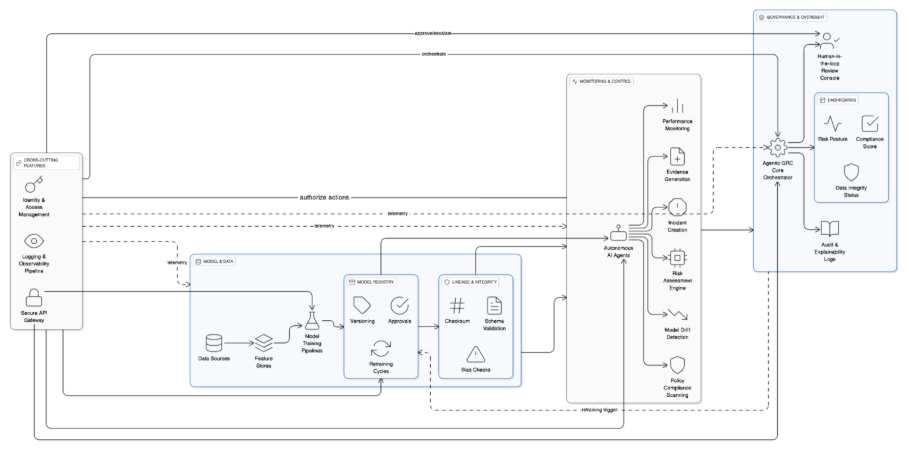
The term “agentic” refers to AI systems capable of autonomous, goal-directed behavior, including reasoning, acting, interacting, and coordinating with other systems. When such systems are deployed, governance must evolve accordingly, and that is where an Agentic GRC architecture becomes essential.
Key features of Agentic GRC
-
Automated governance workflows: Using AI and automation within the GRC framework to monitor controls, evidence generation, and policy compliance. For example, AI agents within the GRC system can proactively scan model logs, data inputs, outputs, and flag anomalies.
-
Continuous data integrity monitoring: Ensuring that input data, feature sets, and model feedback loops are validated, have lineage, and are free of corruption or bias.
-
Lifecycle tracking and versioning: Every model version, every retraining cycle, every feedback deployment must be tracked—including metadata such as who approved it, with what dataset, and what key metrics are in play.
-
Risk assessment embedded in operations: Rather than a one-time “checklist” at model launch, agentic GRC embeds risk assessment as part of the model lifecycle in deployment, drift detection, and change management.
-
Human oversight and escalations: Even when agents perform monitoring, there must be human-in-the-loop oversight for high-risk decisions and escalations for when thresholds are breached.
-
Audit trail, logging, and explainability: The system must capture the “why” behind model decisions, document tool usage by agentic systems, and maintain a log of autonomous actions.
Managing AI Risks: Bias, Drift, and Explainability
Any discussion of AI governance must confront the major risk categories, and deploying agentic AI amplifies them.
Bias and Discrimination
Data may carry historical bias, sample bias, and label bias, all of which can produce inequitable outcomes. Fairness-driven governance necessitates bias detection at multiple layers, encompassing both pre-deployment and post-deployment fairness testing, as well as remedial mechanisms when unfair outcomes are identified.
Model Drift and Data Drift
Over time, models may degrade due to changes in the underlying data distributions (data drift) or the model logic becoming outdated (model drift). Drift can lead to degraded performance, unintended consequences, or fairness violations. Continuous monitoring and re-validation are critical.
Explainability and Transparency
“Black box” models, or agentic systems that make autonomous decisions, raise questions about explainability. Stakeholders must understand how decisions are made and how they are informed. Regulators increasingly demand this.
Autonomy-specific Risks
Agentic AI introduces additional risks: emergent behavior, agent-to-agent interactions, external tool invocation, prompt injection, model tampering, and data poisoning.
Mitigation Strategies
-
Build fairness, explainability, drift-detection, and audit trails into your model pipeline.
-
Utilize continuous monitoring, establish thresholds for retraining, and configure alert triggers in GRC dashboards.
-
Embed human oversight for automated actions, especially where decisions carry significant risk.
-
Maintain documented lineage and accountability for model decisions and autonomous actions.
-
Use robust testing (including adversarial and stress tests), especially for autonomous agents.
When Agentic GRC is well-configured, it enables you to operationalize these strategies through built-in controls, dashboards, alerts, and ongoing governance workflows.

Alignment with Global Frameworks (EU AI Act, NIST AI RMF, ISO 42001)
Organizations must align with emerging global frameworks and standards—both to manage risk and build trust.
EU AI Act
The EU AI Act categorizes AI systems by risk levels and mandates obligations (e.g., transparency, human oversight, documentation). For agentic systems, this is especially relevant because their autonomy can fall into “high-risk” categories.
NIST AI Risk Management Framework (AI RMF)
The NIST framework offers a flexible, voluntary structure for assessing, mitigating, and monitoring AI risks, encompassing governance, explainability, fairness, and robustness. Enterprises are increasingly referencing it as a blueprint for success.
ISO 42001 (Hypothetical/Future standard)
While ISO 42001 (AI Management Systems) is still in development, it signals that international standards for AI governance, management, and operations are forthcoming. Aligning early with standards-based controls—and integrating Agentic GRC workflows—gives organizations a head start.
How Agentic GRC Supports Alignment
-
Documentation and versioning modules help meet regulatory documentation obligations (e.g., EU AI Act Article 11) for high-risk systems.
-
Risk management workflows within GRC align directly with NIST phases (e.g., Govern, Map, Measure, Manage, Monitor).
-
Audit trails, agent action logs, and model lineage support standard compliance and certification readiness.
-
Continuous monitoring tools built into Agentic GRC help maintain compliance over time, not just at the time of deployment.
By embedding these frameworks into your governance architecture, you proactively meet regulatory demands, build stakeholder trust, and reduce the risk of non-compliance.
Embedding a Governance-Culture for Agentic Systems
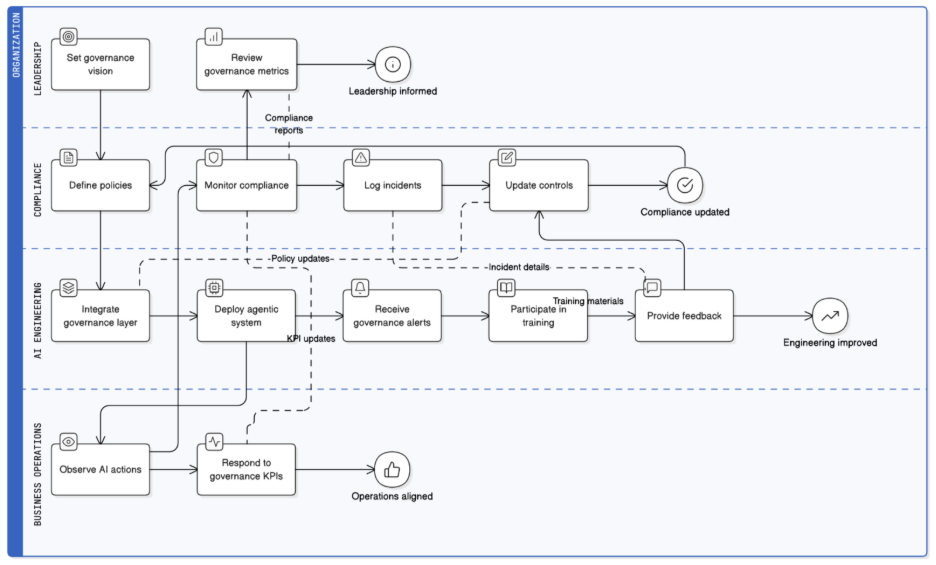
Governance isn’t a dashboard or a compliance checklist—it’s a living culture. For organizations deploying agentic AI, true responsibility begins when governance is woven into everyday decisions, team behavior, and technology workflows. This is where Nexastack’s integrated approach makes the difference: by embedding governance and monitoring directly into AI operations, it ensures that responsible practices are not optional—they’re operational.
Leadership & Ownership
Accountability must start at the top. Boards, compliance heads, and AI engineering teams require shared visibility into how autonomous systems behave and learn. With Nexastack’s unified observability layer, executives can view governance metrics—model compliance scores, bias alerts, data lineage—in a single pane of glass. This clarity turns governance from an afterthought into a leadership-level KPI.
Cross-Functional Collaboration
AI governance spans data science, security, legal, risk, and business operations. Nexastack enables cross-team orchestration through policy-driven workflows—so when one agent acts autonomously, its actions are logged, verified, and shared across compliance and technical teams in real time. This breaks silos and ensures that governance keeps pace with agility.
Training & Awareness
Agentic AI introduces new risks, including prompt injection, emergent behaviors, and unexplainable reasoning. Nexastack supports in-context governance alerts and guided training for developers and operators, ensuring that human oversight remains aware of model intent and risk. Every AI action becomes a teachable moment for continuous improvement.
Incentives & Metrics
Governance succeeds when it’s measurable. Nexastack embeds governance KPIs—such as trust index, model drift rate, and compliance adherence—into operational dashboards. Teams can see their governance score in the same way they view uptime or latency. This alignment encourages proactive governance behavior and rewards responsible engineering.
Continuous Improvement
AI evolves—and so must governance. With Nexastack’s audit intelligence and feedback loops, every incident or model deviation feeds back into policy refinement. Post-incident retrospectives automatically generate governance insights and recommended control updates. This transforms compliance into a self-learning system that evolves in tandem with the AI itself.
By fostering a governance-first mindset and enabling it through Nexastack’s platform, organizations align people, processes, and technology—creating a culture where AI acts responsibly by design, not by enforcement.

Continuous Monitoring and Model Validation
AI governance doesn’t end when a model goes live—it begins there. For agentic systems, where decisions and adaptations occur autonomously, continuous monitoring and validation are crucial for maintaining control, trust, and compliance. Nexastack makes this ongoing vigilance practical and automated.
Real-Time Operational Monitoring
Nexastack’s real-time observability engine tracks every model and agent activity—inputs, outputs, reasoning chains, performance metrics, tool invocations, and fairness indicators. Drift detectors and anomaly monitors send alerts into the governance dashboard, enabling teams to act before an issue escalates. Instead of reactive governance, organizations gain predictive control.
Model Validation & Retraining
Governance must span the entire model lifecycle. With Nexastack’s integrated validation pipelines, organizations can run pre-deployment fairness and bias tests, as well as trigger post-deployment drift checks, automatically. When a model crosses compliance thresholds, Nexastack can initiate governance workflows—from retraining requests to rollback or decommissioning—without human delay.
Audit & Reporting
Compliance audits shouldn’t be an exercise in data gathering. Nexastack automates governance reporting, generating structured documentation that includes model cards, risk summaries, lineage diagrams, and incident logs. These reports align with global frameworks, such as the EU AI Act, NIST AI RMF, and ISO 42001, providing organizations with audit readiness through minimal manual effort.
Feedback & Governance Loops
When an AI system behaves unexpectedly, Nexastack’s closed-loop governance engine captures the incident, analyzes root causes, updates policies, and retrains relevant models. Each governance loop strengthens the overall system—turning incidents into institutional learning.

From Ethical AI to Autonomous AI Governance
As organizations evolve from deploying AI models to managing autonomous, agentic systems, the governance challenge grows just as rapidly. Principles such as transparency, fairness, and accountability are essential—but they must be implemented beyond policy statements into operational practice.
With Nexastack at the core of Agentic GRC, governance becomes a living system: cultural in spirit, technical in execution, and measurable in impact. Organizations not only meet compliance requirements but also build trustworthy, self-regulated AI ecosystems where innovation and responsibility advance hand in hand.