Executive Summary
Modern regulatory frameworks such as AML, KYC, FATCA, SOX, GDPR, and ESG require enterprises to maintain continuous, explainable, and auditable compliance across all operations. Traditional compliance approaches—built on manual audits, periodic reviews, and static rule engines—struggle to scale with today’s transaction volumes and regulatory velocity. Risk & Compliance Automation with Agentic AI transforms compliance into a real-time, continuously governed system. Using NexaStack, enterprises deploy AI agents that continuously scan transactional, operational, and document data; detect anomalies; auto-generate compliance cases such as Suspicious Activity Reports (SARs); and maintain immutable audit trails.
This approach shifts compliance from reactive reporting to proactive regulatory assurance, enabling enterprises to reduce risk exposure while improving operational efficiency.
Q&A (Featured Snippet) — What is Risk & Compliance Automation?
A: Risk & Compliance Automation uses AI agents to continuously monitor enterprise data, detect regulatory risks, and generate audit-ready compliance reports automatically.
Business Challenges
Enterprises operating across regions and industries face increasing compliance complexity driven by regulatory expansion and data growth.
Key Challenges
-
Manual audits increase compliance cycle time and operational cost
-
Lack of centralized visibility across global transactions and workflows
-
Siloed departmental data creates inconsistent audit trails
-
Static legacy systems fail to adapt to evolving regulatory logic
-
High false positives overwhelm compliance teams
Addressing these challenges requires AI-powered workflow automation that unifies data, intelligence, and governance.
Q&A (Featured Snippet) — What causes high false positives in compliance systems?
A: Static rule-based systems lack contextual intelligence and cannot adapt to evolving risk patterns.
Goals and Objectives
The objective of Risk & Compliance Automation is to enable continuous, explainable, and enterprise-wide regulatory oversight.
Primary Goals
-
Deploy continuous compliance monitoring across workflows and documentation
-
Automate AML/KYC case creation, routing, and reporting
-
Enable explainable, auditable AI-driven risk intelligence
-
Reduce reliance on manual audits and minimize false positives
-
Provide real-time governance dashboards for compliance leadership
Limitations of Existing Compliance Solutions
Legacy compliance tools were not designed for modern, distributed enterprises.
Common Limitations
-
No adaptive risk modeling or learning capability
-
Heavy dependence on manual reviews and spreadsheets
-
Fragmented data across ERP, GRC, and operational systems
-
Limited correlation across transactions, documents, and events
-
Poor explainability for regulatory audits
Integrating workflow automation with governed AI execution is essential to overcome these constraints.

Technical and Integration Challenges
Enterprise-grade compliance automation must address complex technical realities.
Key Challenges
-
Consolidating structured and unstructured data (transactions, emails, logs)
-
Managing model drift as regulations and behaviors evolve
-
Enforcing zero-trust security for regulated data
-
Supporting edge, hybrid, and private cloud deployments
-
Maintaining audit integrity across distributed systems
NexaStack addresses these challenges through policy-driven AI orchestration, secure execution boundaries, and private cloud compliance controls.
Solution Overview: AI-Based Risk & Compliance Platform
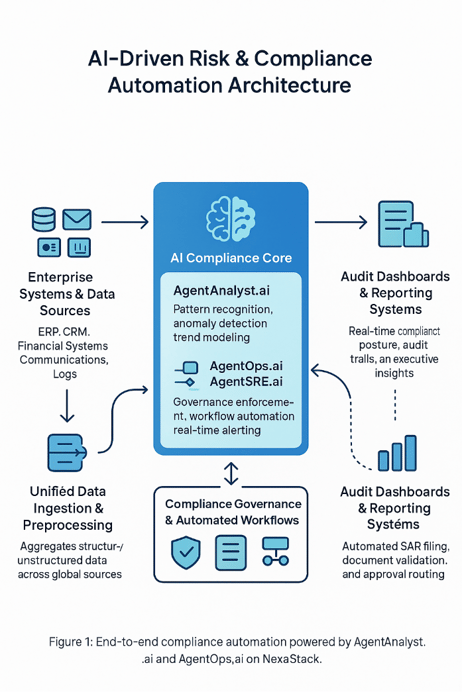
The NexaStack Risk & Compliance Platform combines Agentic AI, governance controls, and workflow orchestration into a unified compliance backbone.
Key Capabilities
-
Continuous scanning of transactions, files, and communications
-
Natural language AI for document validation and anomaly detection
-
Explainable audit metadata for every decision
-
Automated SAR and due-diligence workflows
-
Native integration with ERP, GRC, SIEM, and data platforms
Powered by: AgentAnalyst.ai and AgentOps.ai on NexaStack
Q&A (Featured Snippet) — Can the platform integrate with existing compliance tools?
A: Yes. NexaStack integrates seamlessly with ERP, GRC, and security platforms via APIs.
Solution Approach
1. Multi-Source Data Ingestion
Transactional, operational, and communication data is unified through secure APIs and event streams.
2. Adaptive AI Model Management
Reinforcement-trained models continuously adapt to:
-
New regulatory requirements
-
Emerging risk patterns
-
Historical audit outcomes
3. Autonomous Compliance Workflows
-
Automatic case creation and prioritization
-
Linked evidence, approvals, and documentation
-
Human-in-the-loop governance is required
4. Integrated Governance Dashboards
-
Real-time compliance posture visibility
-
Explainability, lineage, and policy enforcement
-
Regulator-ready audit views
Q&A (Featured Snippet)- What are autonomous compliance workflows?
A: They are AI-driven workflows that automatically detect issues, create cases, and route them for approval.
Impact Areas
| Impact Area | Description |
|---|---|
| Workflow | Automated documentation, reporting, and review pipelines |
| Model | Adaptive AI models that continuously improve detection accuracy |
| Data | Unified, traceable audit evidence across regions |
This unified model ensures data integrity, audit readiness, and regulatory consistency across jurisdictions.
Results and Business Benefits
-
70% faster compliance review cycles
-
50% reduction in false alerts
-
Enterprise-wide risk visibility across all operations
-
Lower operational overhead with near real-time audits
-
Improved regulatory confidence through explainable AI
Conclusion
Risk & Compliance Automation is no longer about periodic audits or regulatory checklists. It is about continuous assurance, explainable intelligence, and proactive governance. By combining Agentic AI orchestration, AI governance, and intelligent workflow automation, NexaStack enables enterprises to build resilient compliance systems that scale with regulation, data, and business growth—delivering trust, transparency, and regulatory readiness across every transaction.