Executive Summary
A mid-to-large manufacturing enterprise experienced frequent unplanned downtime, escalating maintenance costs, and low asset utilization resulting from reactive and time-based maintenance practices.
By adopting NexaStack’s Agentic Infrastructure Platform, the organization deployed AI agents for predictive maintenance across edge and private cloud environments. These agents continuously monitored equipment health, predicted failures in advance, and autonomously triggered maintenance workflows across CMMS and ERP systems.
The result was a shift from reactive maintenance to autonomous, condition-based maintenance, delivering measurable improvements in reliability, cost efficiency, and operational resilience.
Business Impact
-
40–50% reduction in unplanned downtime
-
25–35% reduction in maintenance costs
-
Extended asset life and higher Overall Equipment Effectiveness (OEE)
What Is Agentic AI Predictive Maintenance?
Agentic AI Predictive Maintenance utilizes autonomous AI agents to continuously monitor equipment health, predict potential failures, and execute maintenance actions without requiring manual intervention.
Unlike traditional rule-based systems, agentic AI:
-
Reasons over context and history
-
Learns continuously from outcomes
-
Coordinates actions across systems (CMMS, ERP, edge devices)
Customer Challenges
Business Challenges
-
Unplanned downtime: Sudden equipment failures disrupting production schedules
-
High corrective costs: Emergency repairs, expedited parts, and external contractors
-
Inefficient maintenance: Time-based servicing causes over-maintenance or missed failures
-
Siloed data: Sensor data, logs, and maintenance records scattered across systems
-
Multi-plant complexity: Diverse assets, legacy systems, and inconsistent processes
Technical Challenges
-
Heterogeneous sensor data (vibration, temperature, current, acoustic)
-
Edge latency and bandwidth constraints
-
Model drift impacting prediction accuracy
-
Limited explainability for maintenance engineers
-
Security and audit requirements across global plants
Why Traditional Predictive Maintenance Falls Short
| Traditional Approach | Limitation |
|---|---|
| Threshold-based alerts | High false positives |
| Manual inspections | Reactive, slow response |
| Centralized analytics | High latency |
| Static ML models | No drift handling |
| Cloud-only deployment | Data sovereignty risks |
Why NexaStack for Predictive Maintenance?
NexaStack is the operating system for agentic and reasoning AI, purpose-built to run AI agents securely across edge, private cloud, and sovereign environments.
Key Differentiators
-
Unified inference for real-time and batch predictions
-
Agentic orchestration across monitoring, forecasting, and workflows
-
Private Cloud & Sovereign AI deployment for sensitive industrial data
-
Continuous learning pipelines with drift detection
-
Explainable AI for engineering trust and audits
Solution Overview: Agentic AI Architecture
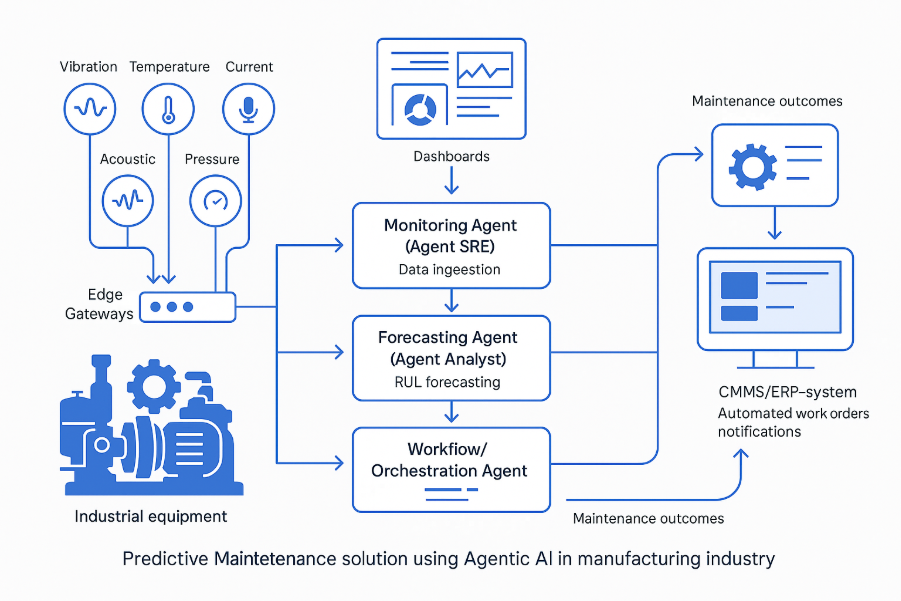
Using NexaStack, the enterprise deployed a multi-agent predictive maintenance architecture:
Core AI Agents
-
Monitoring / SRE Agent
Ingests real-time IoT telemetry at the edge and detects anomalies early -
Forecasting / Analyst Agent
Predicts degradation trends, estimates Remaining Useful Life (RUL), and recommends maintenance windows -
Workflow / Orchestration Agent
Automatically creates CMMS work orders, triggers ERP procurement, and schedules technicians -
Trust & Governance Agent
Ensures explainability, auditability, and compliance
All agents are orchestrated using NexaStack’s unified inference layer, enabling low-latency execution from edge to cloud.
How the System Works
1. Monitoring & Anomaly Detection
-
Edge-deployed agents analyze vibration, temperature, acoustic, and current signals
-
Early anomaly detection before threshold breaches
2. Failure Forecasting & RUL Estimation
-
Context-aware models incorporate load, duty cycles, and operating conditions
-
Predict failure probability with confidence intervals
3. Autonomous Workflow Execution
-
Work orders are created automatically in CMMS
-
Spare parts ordered via ERP
-
Technician schedules are optimized and pushed to mobile apps
4. Continuous Learning & Drift Management
-
Post-repair data feeds back into models
-
Drift detection triggers retraining pipelines
Impact Areas
Model
-
Reduced false positives and negatives
-
Continuous drift detection and retraining
-
Equipment-specific, domain-aware models
Data
-
Unified ingestion of IoT telemetry, logs, and maintenance records
-
Consistent data pipelines across plants
Workflow
-
End-to-end automation from detection to execution
-
Minimal manual intervention
Results & Benefits
Business Outcomes
-
Up to 50% reduction in unplanned downtime
-
35% lower maintenance and MRO costs
-
Improved production predictability
-
Extended asset life and reliability
Technical Outcomes
-
Real-time inference at the edge
-
Scalable private cloud AI deployment
-
Built-in governance and explainability
Target Industries & Assets
-
Manufacturing: CNC machines, robots, motors
-
Automotive & Aerospace: Engines, turbines, test rigs
-
Energy & Utilities: Generators, transformers
-
Oil & Gas: Pumps, compressors
-
Process Industries: Reactors, agitators
Conclusion
By leveraging NexaStack’s Agentic Infrastructure Platform, organisations can move beyond predictive analytics to agentic action—where AI agents reason, decide, and execute maintenance autonomously.
This use case demonstrates how Agentic AI + Private Cloud AI transforms predictive maintenance into a strategic advantage for Industry 4.0 and smart manufacturing.