Executive Summary
Post-incident fire damage assessment and emergency response demand rapid, precise, and scalable mapping — and drone-based reconstruction is the practical path forward. NexaStack’s Reconstruction Drone Agent eliminates slow, risky manual inspections by deploying autonomous multi-sensor drones powered by the SAIF Aviator Agent. These drones capture high-resolution imagery, LiDAR data, thermal/infrared inputs, and environmental telemetry. Using NexaStack’s AI Reasoning Stack within the Agentic AI Blueprint, the system performs AI-accelerated photogrammetry, spatial analysis, and multi-modal data fusion to produce detailed 3D fire-scene models, burn-severity assessments, and structural damage classifications.
The platform builds on NexaStack’s Unified Inference Engine to generate standardised, audit-ready outputs tightly integrated with GIS systems, insurance workflows, and incident-management pipelines. Its edge-native architecture within the NexaStack Platform ensures real-time processing, strong data governance, and secure traceability — even in disconnected or high-risk field environments. By leveraging NexaStack’s agentic AI infrastructure through the Composable Agent Framework, the solution delivers the operational speed, accuracy, and reliability required for emergency mapping, forensic fire analysis, and autonomous drone-based damage documentation.
Industry Use Cases and Relevance
Fire and Emergency Services: Post-fire forensic evidence captures for investigatory and litigation use cases, including detailed damage visualisation and risk assessment. Insurance and Risk Underwriting: Automated damage quantification and severity scoring accelerate claims adjudications and reduce fraudulent or duplicate claims.
Recovery Planning and Urban Resilience: 3D reconstructions assist planners and structural engineers in assessing hazard zones and prioritising rebuilding or mitigation efforts. Environmental and Forestry Management: Wildfire impact assessments on landscapes and ecosystems improve restoration efforts and wildfire prevention strategies.
Government and Regulatory Agencies: Ensure compliant, defensible incident documentation aligned with policy and audit requirements.
Customer and Operational Challenges
Post-incident assessment has long been defined by slow, manual processes and fragmented documentation practices. Even well-resourced teams struggle to capture reliable spatial data, maintain consistency across inspection workflows, and ensure that evidence is defensible when legal or insurance reviews begin. These limitations create operational drag at exactly the moment when clarity and speed matter most. Within this landscape, several recurring challenges continually surface:
-
Extensive manual ground inspections expose personnel to hazards amid unstable, smoke-filled environments.
-
Photographic data suffers from a lack of spatial context, complicating structural damage interpretation.
-
3D recovery modelling requires specialised skills often unavailable on-site, causing delays.
-
Data management workflows for evidence, audit trails, and secure sharing lack integration and automation.
-
Timeliness and consistency are critical as delays propagate legal, financial, and recovery impacts.
Business and Technical Pain Points
Despite growing adoption of drones and digital tools, post-incident workflows still struggle with long-standing operational gaps. Much of the ecosystem remains dependent on manual processes, inconsistent data capture, and disconnected systems that can’t support the scale or speed modern incidents demand. These foundational weaknesses show up quickly during insurance evaluations, forensic reviews, and recovery planning, creating friction for every stakeholder involved. As a result, several critical pain points continue to surface:
-
Manual, non-standardised workflows slow insurance claims and delay recovery operations.
-
Fragmented data sets hinder collaboration among assessors, insurers, and emergency planners.
-
Risk of incomplete documentation undermines forensic defensibility and compliance.
-
Lack of secure, automated pipelines restricts scalability and repeatability of post-incident mapping.
NexaStack AI-Powered Solution
The NexaStack Reconstruction Drone Agent delivers a complete, end-to-end response to the challenges of post-incident assessment. The process begins with autonomous multi-modal data capture, where fleets of AI-directed drones gather thermal, RGB, LiDAR, and multispectral imagery along both predetermined and adaptive flight paths. This ensures that every angle of the incident scene is covered with consistent, high-quality data.
Once collected, the imagery is pushed into NexaStack’s Reasoning Stack, where AI-accelerated 3D reconstruction pipelines convert raw sensor feeds into accurate, georeferenced spatial meshes. These digital models form the backbone of the analysis workflow, serving as a precise, navigable representation of the incident environment.
From there, intelligent damage and hazard classification engines take over. NexaStack’s embedded models grade burn severity, detect structural deformities, and highlight potential safety risks without requiring manual review. The platform’s multi-agent orchestration framework coordinates these tasks in parallel, managing image processing, hazard assessment, reporting, and metadata enrichment as a unified pipeline.
All outputs are compiled into automated, audit-ready reports. Each dossier follows a standardised format, embedding structured metadata, visual evidence, and encrypted records that meet forensic and regulatory standards. Throughout the process, NexaStack enforces strict federated data governance—maintaining policy-driven access controls, preserving chain-of-custody integrity, and aligning with enterprise compliance requirements.
The entire system operates on a cloud-edge hybrid architecture. Immediate computation and preliminary analysis occur at the edge for low-latency responsiveness, while deeper analytics, long-term archival, and sovereign cloud storage ensure durability, security, and organisational control. Together, these capabilities create a dependable, scalable, and defensible workflow for post-incident mapping and documentation.
Detailed Workflow Description
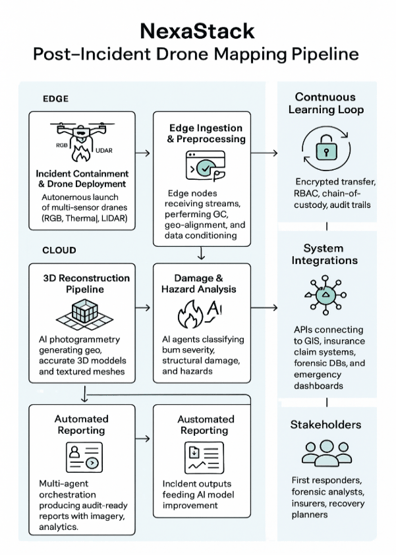
Incident Containment & Drone Deployment (EDGE)
Autonomous multi-sensor drones (RGB, Thermal, LiDAR) are launched immediately after incident containment. AI-optimised mission plans ensure complete coverage and maximum data fidelity, consistent with the diagram’s “Autonomous launch of multi-sensor drones.”
Edge Ingestion & Preprocessing (EDGE)
Incoming sensor streams are processed on NexaStack Edge nodes. These nodes handle geo-alignment, quality checks, calibration, and initial data conditioning—matching the “receiving streams, performing QC, geo-alignment, and data conditioning” shown in the image.
3D Reconstruction Pipeline (CLOUD)
AI-accelerated photogrammetry generates georeferenced point clouds, accurate 3D meshes, and textured scene models—aligned with the “AI photogrammetry generating geo-accurate 3D models and textured meshes.”
Damage & Hazard Analysis (CLOUD)
AI agents classify burn severity, structural failure indicators, and hazard zones. The output mirrors the diagram’s “AI agents classifying burn severity, structural damage, and hazards.”
Automated Reporting (CLOUD)
Multi-agent orchestration produces audit-ready incident reports with integrated imagery, analytics, and structured metadata. This corresponds to the dual “Automated Reporting” boxes in the diagram.
-
Continuous Learning Loop
Processed incident outputs feed back into the AI model improvement. Secure, encrypted transfer follows RBAC, chain-of-custody policies, and audit trails—exactly reflected in the “Encrypted transfer, RBAC, chain-of-custody, audit trails” loop. -
System Integrations
Final outputs are delivered to connected systems via APIs—GIS platforms, insurer claim systems, forensic databases, and emergency dashboards—matching the diagram’s integration block.
-
Stakeholders
The results reach first responders, forensic analysts, insurers, and recovery planners—the same stakeholder group shown at the bottom of the diagram.
Operational and Business Impact
The operational and business impact of this system is significant. Manual post-incident inspections that once took days can be reduced to just a few hours, allowing specialists to focus on high-value decisions rather than routine data collection. By shifting frontline assessment to autonomous drones, the approach also cuts down personnel exposure to unstable, hazardous environments, improving safety without compromising coverage.
The consistently generated 3D models, imagery, and structured metadata bring a new level of reliability to incident documentation. Every dataset follows the same standards, making downstream reports more dependable for insurance claims, forensic review, or municipal records. Built-in chain-of-custody controls and complete audit trails reinforce legal defensibility, ensuring the captured evidence stands up to regulatory and investigative scrutiny.
Ultimately, the clarity and speed of these insights improve decision-making across recovery, reconstruction, and future risk-mitigation planning. Stakeholders can act faster, with more confidence, because the underlying information is both trustworthy and timely.
Technical Specifications and Features
-
Multi-sensor drone payloads (thermal, RGB, LiDAR, multispectral).
-
AI-accelerated 3D photogrammetry and mesh generation.
-
Composable AI agent framework for autonomous workflow orchestration.
-
Edge compute fabric enabling low-latency inference and data processing.
-
Secure encryption, multi-level access control, and federated governance.
-
API-first architecture for integration with enterprise and cloud systems.
Why NexaStack Stands Out for This Use Case
NexaStack differentiates itself through a unique combination of advanced agentic AI infrastructure, edge-native intelligence, and sovereign governance frameworks that collectively redefine post-incident drone mapping and damage documentation:
-
Agentic AI Architecture: NexaStack’s multi-agent framework enables autonomous, distributed workflows for simultaneous 3D reconstruction, damage classification, and report generation—dramatically accelerating end-to-end incident processing compared to traditional manual or semi-automated approaches.
-
Edge and Hybrid Cloud Deployment: By performing AI inference and data processing at the edge close to the source, NexaStack minimises latency, supports operation in connectivity-challenged environments, and reduces dependency on centralised cloud resources while allowing secure hybrid cloud scalability for long-term storage and analytics.
-
Unified AI Reasoning Stack: NexaStack fuses multi-modal sensor data (thermal, RGB, LiDAR) with geospatial analysis, hazard detection, and automated report generation into a seamless, auditable pipeline. Its AI models continuously refine through federated learning, improving accuracy and adaptability across diverse incident environments.
-
Sovereign AI Security and Compliance: The platform implements granular access control, encrypted transmissions, and detailed audit trails aligned with industry standards such as ISO/IEC 27001 and NIST AI Risk Management frameworks—ensuring a trusted chain-of-custody, regulatory compliance, and protection of sensitive imagery and metadata.
Lessons Learned and Future Directions
-
Standardisation of flight plans and sensor configuration improves repeatability and operational readiness.
-
Ongoing refinement of AI damage assessment models through incident data improves accuracy.
-
Future extensions include predictive pre-incident risk scouting and integration with autonomous suppression agents.
-
Emphasis on sovereign data environments supports deployment in highly regulated sectors.
Conclusion
NexaStack’s agentic AI-powered Reconstruction Drone Agent and AI Reasoning Stack redefine post-incident fire documentation workflows by combining autonomous data capture, advanced spatial modelling, and automated, compliant reporting. This scalable, secure, and integrated approach accelerates forensic analysis and recovery planning—empowering responders, insurers, and planners with trusted, actionable data to optimise safety, efficiency, and return-to-normal operations.