Executive Summary
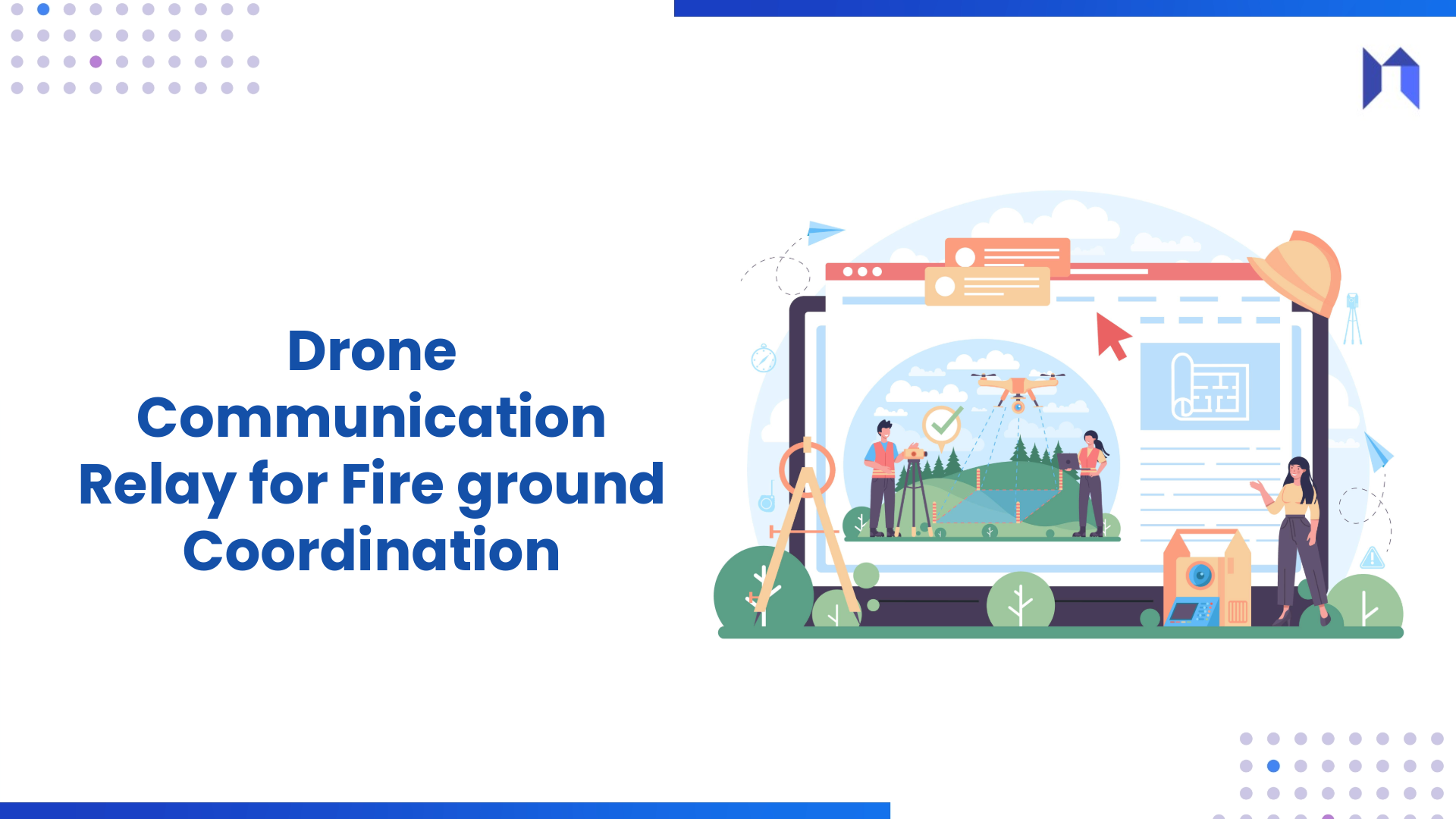
Modern firefighting operations depend on real-time analytics, agent-driven automation, and persistent, high-bandwidth mesh networks to achieve seamless incident coordination and response. Conventional mobile radios and cellular networks routinely fail in remote, large-scale, or infrastructure-compromised fire zones, resulting in dangerous communication gaps and operational delays. Tethered drones, powered by NexaStack's agentic infrastructure platform, deliver secure, resilient aerial mesh networks and edge-native intelligence at the heart of critical response workflows.
These relay drones function as autonomous nodes within NexaStack's Edge Mesh Orchestrator, enabling automated deployment, adaptive routing, low-latency data processing, and unified observability across mission teams and incident command centres. Integrated with real-time dashboards, policy-driven governance, and enterprise-grade security, the Relay Drone Agent sets a new standard for mission-critical connectivity, compliance, and operational intelligence on the fireground.
NexaStack’s unified platform powers modular agents, model orchestration, auditable logs, and dynamic scaling—ensuring consistent performance, high availability, and seamless integration with legacy and AI-driven incident workflow tools.
Industry Relevance & Use Case Scenarios
Fire and disaster management services constantly battle communication breakdowns as incident zones expand in size and complexity. Responders must coordinate in rural forests, industrial complexes, urban neighbourhoods, or rugged utility corridors—where terrain or infrastructure can halt traditional signal propagation. Tethered drones, acting as persistent relay nodes, are deployed to:
-
Rapidly bridge signal gaps in wildfire, rescue, or urban response missions.
-
Guarantee uninterrupted voice, video, and telemetry for perimeter teams, command centers, and mobile units.
-
Enable interoperability across agencies, facilitating joint operations with shared situational awareness.
Additionally, forestry services, utility maintenance crews, and environmental agencies leverage relay drones for asset tracking, perimeter surveillance, and logistics mapping in remote territories.
Customer & Operational Challenges
Responders routinely confront:
-
Signal blackouts from terrain interference—hills, canyons, dense forests, and built obstacles.
-
Failure or destruction of existing infrastructure (burned cell towers, loss of grid power).
-
Urgency to deploy portable, scalable communications infrastructure at the speed of incident escalation.
-
Difficulty adapting coverage to moving response teams and unpredictable incident spread.
Manual relay deployment is slow, risky, and rarely keeps pace with dynamic field needs—delaying rescue, increasing exposure, and reducing operational effectiveness.
Business and Technical Pain Points
-
Teams face high-risk isolation during blackout events, losing contact with command and reducing coordinated effort.
-
Traditional mobile networks cannot scale or adapt to incident expansion.
-
Field-deployed repeaters require significant time and manpower, while compatibility issues constantly hinder unified operations.
-
Increasing demand for real-time data integration—video streams, location tracking, environmental sensor feeds—drives up the complexity of resilient network solutions.
NexaStack Solution Overview
NexaStack’s Relay Drone Agent system resolves these challenges through multiple technical innovations:
-
Automated drone launch and mesh node placement: Tethered drones rapidly ascend above scene obstacles, providing line-of-sight mesh extensions.
-
Continuous operation: Rugged tethering provides both persistent power and high-bandwidth fibre/data links, allowing drones to remain airborne for extended missions—even through harsh weather or extended heat conditions.
-
Responsive Edge Mesh Orchestration: AI-driven logic automatically maps, heals, and optimizes the mesh network as teams, vehicles, and incident boundaries shift.
-
Seamless command integration: Supports standard field radios, tablets, mobile terminals, and command centre infrastructure via robust gateway protocols.
Solution Approach and Workflow
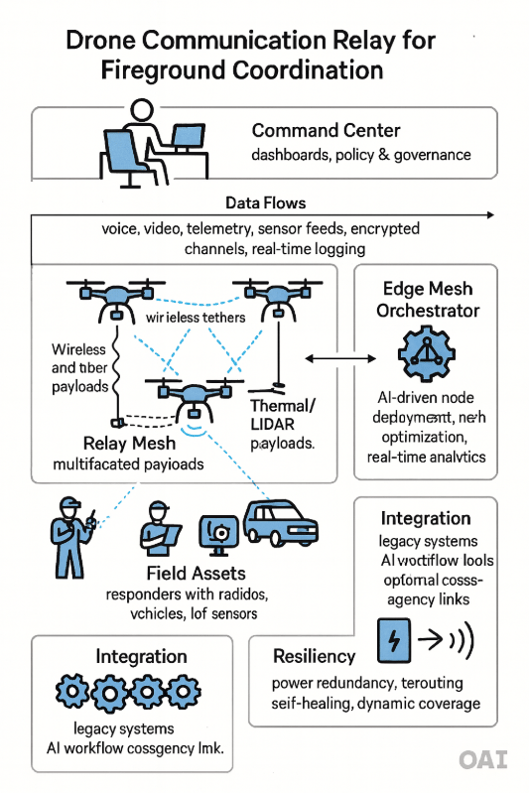 Fig 1: High-Level Architecture Diagram
Narrative
During deployment, field ops teams and communications officers identify coverage requirements based on predicted movement, terrain, and critical event zones. The orchestrator computes optimal relay drone placement, automatically factoring topography, incident expansion, and responder trajectories. Drones are rapidly dispatched—usually within minutes—to form the backbone of a self-healing, low-latency mesh. All mission elements, including new responders, mobile assets, and sensor streams, connect to the mesh seamlessly.
Key Steps
-
Initial scene survey defines mesh coverage requirements; orchestrator maps topology and opportunities for relay deployment.
-
Relay drones are positioned according to AI recommendations, considering environmental hazards, wind, and predicted movement paths.
-
Each drone acts as a secure, automated communication node.
-
The system continuously monitors
-
Node health, redundancy, and traffic loads
-
Dynamic coverage adaptation
-
Immediate rerouting/healing in case of obstructions or losses
-
Devices authenticate and join the mesh, gaining robust, encrypted connections for all incident-critical operations.
-
Maintenance and expansion can be triggered autonomously or via command dashboard recommendations.
Operational and Business Outcomes
Deploying the relay drone solution results in:
-
Zero field blackouts: Continuous, reliable comms as teams move throughout incident perimeters.
-
Rapid operational tempo: Mesh adapts instantly, deploying new resources wherever gaps occur, with minimal human intervention.
-
Streamlined incident management: All mission data—voice, video, sensor feeds—is relayed and logged in real time, allowing for immediate decision-making and comprehensive after-action review.
-
Cost and time savings: Reduces setup and field maintenance overhead, freeing resources for direct response and rescue.
-
Interagency synergy: Smooth integration with outside responders, infrastructure teams, and cross-domain command centres.
Key Specifications and Features
-
Tethered, high-power drone platforms—stable operation in harsh, smoke-filled, or windy conditions.
-
Integrated fibre-optic uplink for secure, high-bandwidth data transmission.
-
AI-driven mesh topology management—continuous monitoring, load balancing, and healing.
-
Payload options: Thermal cameras, LiDAR, 360-degree situational awareness, proximity sensors for real-time external mapping and fire detection.
-
Support for multiple device types: Radios, tablets, environmental sensors, drones, vehicles.
-
Weatherproof, impact-resistant chassis for operational durability.
-
Standard protocol gateway for interagency connectivity.
-
Extended endurance: Tethered drones remain airborne as long as incident demands persist—orders of magnitude longer than battery-only platforms.
Lessons, Best Practices, and Future Directions
Field teams recommend pre-planning relay drone sites based on predicted incident paths and critical assets. Agencies can maximize mesh effectiveness by training personnel on orchestrator dashboards and reviewing telemetry after each event for model refinement. Future product improvements aim to integrate advanced jamming detection, predictive incident expansion analytics, and enhanced environmental sensor clustering. The long-term vision extends to multi-incident, city-wide autonomous emergency mesh fabrics, instantly deployable at a moment’s notice.
Conclusion
NexaStack’s agent-driven drone communication relay solution revolutionizes how modern fireground and disaster response teams coordinate, especially when working in challenging or unpredictable environments. By combining persistent airborne relays, intelligent mesh orchestration, and complete interoperability across field devices and agencies, this technology delivers the reliability and speed today's emergencies demand—safeguarding both lives and mission outcomes.
Frequently Asked Questions (FAQs)
FAQs on using drone-based communication relays for fireground coordination.
How do drones improve communication on the fireground?
They act as airborne relays, extending radio and data signals in areas with poor connectivity.
Why are drones effective in large fire zones?
They provide elevated, mobile coverage that traditional ground radios can’t achieve.
What advantages do drones offer for team coordination?
They enhance situational awareness and maintain communication links during movement.
Can drones support multiple fire response units simultaneously?
Yes — they relay signals across teams, enabling coordinated voice, video, and sensor data sharing.