Executive Summary
A leading global bank faced growing customer service volumes, rising operational costs, and inconsistent support experiences across languages and regions. To modernize customer interactions and ensure around-the-clock assistance, they deployed Agent analyst and Agent search on a context-first agentic infrastructure to build 24/7 AI-powered customer service operations.
AI agents engage customers via voice, chat, and email across multiple languages. They autonomously greet users, authenticate identity, retrieve account information, identify potential fraud, block compromised cards, and initiate refunds — all without human intervention.
An agent analyst interprets the customer’s intent and context in real time, while Agent search retrieves precise policy, transaction, or procedural data from internal knowledge bases. When complex cases arise, the agent escalates seamlessly to human representatives with full context retained.
This deployment reduced average resolution time by 60%, improved customer satisfaction by 35%, and decreased call center operational costs by 40%, enabling the enterprise to deliver always-on, multilingual, and compliant customer support.
Customer Challenge
Business Challenges
The customer, a multinational financial services firm, struggled with inconsistent service levels and growing support demand across time zones and languages.
Key business problems included:
-
High support costs: Maintaining large 24/7 call centers was costly and inefficient.
-
Long resolution times: Agents spent excessive time switching between systems and searching for information.
-
Inconsistent experience: Quality of service varied by region, agent experience, and language proficiency.
-
High churn risk: Poor service response and delays led to low Net Promoter Scores (NPS) and customer attrition.
Business goals:
-
Deliver consistent, real-time support in multiple languages.
-
Reduce customer handling time (AHT) and improve first-contact resolution (FCR).
-
Enable autonomous resolution for routine requests (balance checks, refunds, card blocking).
-
Scale service operations without proportional cost increases.
-
Legacy IVR and chatbot systems are limited to keyword-based scripts.
-
Manual escalation and ticket creation.
-
Fragmented knowledge bases and inconsistent data access.
-
No real-time fraud identification or contextual awareness.
Compliance and business pressures:
-
Financial regulations required secure, auditable customer interactions.
-
Data residency and privacy compliance (GDPR, PCI DSS) were mandatory across regions.
-
Customer SLAs demanded rapid, consistent response across all communication channels.

Technical Challenges
Infrastructure and System Issues
-
Disparate CRM, ticketing, and fraud detection systems.
-
Voice and chat systems lacked unified AI integration.
-
Knowledge bases are stored across SharePoint, Confluence, and legacy databases.
Technical Debt and Limitations
-
Old NLP engines with poor multilingual support.
-
No unified data model for customer context.
-
Manual rule updates for chatbot intents.
Integration and Data Management Issues
-
Lack of API-level integration between fraud, payments, and support systems.
-
No contextual memory between chat and voice interactions.
-
Fragmented access control and identity verification workflows
Scalability, Reliability, and Performance Limitations
-
Could not handle high concurrency during transaction surges (e.g., salary days, holidays).
-
Limited ability to perform sentiment analysis or adaptive response generation.
-
Inconsistent handover to live agents caused repeated queries and frustration.
Security and Compliance
-
Unencrypted voice logs and partial masking of sensitive information.
-
No audit trail of AI agent decisions.
-
Weak integration with enterprise IAM for access control.

Partner Solution
Solution Overview
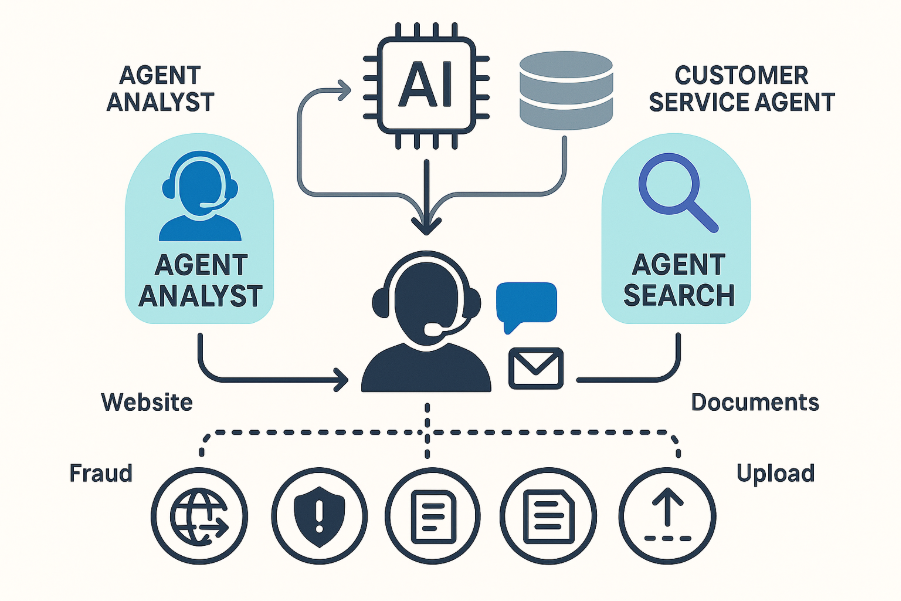 The organization deployed Agent Analyst and Agent Search to power an agent-based AI customer service system.
-
Agent analyst: Understands customer intent, validates user identity, and performs contextual actions (account check, fraud block, refund initiation).
-
Agent search: Retrieves relevant information from structured (CRM, ticketing) and unstructured (emails, docs, knowledge base) sources to provide accurate responses.
Together, they:
-
Enable seamless omnichannel communication (voice, chat, email).
-
Auto-translate interactions into customer-preferred languages.
-
Detect and act on fraud indicators in real time.
-
Generate contextual summaries and escalate complex cases with full history.
This multi-agent system transformed the support process into a real-time, context-driven, autonomous workflow — improving speed, accuracy, and personalization.
Targeted Industries
|
Industry |
Use Cases |
Value Delivered |
|
Banking & Financial Services |
Account servicing, card management, fraud reporting |
Reduced AHT, faster resolutions, higher compliance |
|
Telecommunications |
Billing disputes, network support |
24/7 multilingual help, reduced call volume |
|
E-commerce & Retail |
Order tracking, returns, and refunds |
Improved NPS, faster fulfillment |
|
Insurance |
Claim filing, policy lookup, status updates |
Reduced handling time, improved customer trust |
|
Healthcare & Life Sciences |
Appointment scheduling, billing queries |
HIPAA-compliant automation |
|
Travel & Hospitality |
Booking management, cancellations, and refunds |
Real-time rebooking, global customer coverage |
Recommended Agents
-
Agent analyst → Intent detection, contextual decisioning, workflow orchestration.
-
Agent search → Retrieval from knowledge systems, documentation, and transaction history.
Solution Approach
Multi-Channel Engagement
-
Integrates with telephony (VoIP, Twilio), chat (Slack, WhatsApp, website), and email systems.
-
Detects user intent and context from voice tone, language, and text patterns.
-
Auto-authenticates users via OTP or voice biometrics.
Contextual Decisioning
-
Agent Analyst interprets user requests and triggers secure backend workflows.
-
Validates fraud indicators (e.g., unusual login, multiple failed PIN attempts).
-
Blocks compromised cards and initiates refund workflows autonomously.
Knowledge Retrieval
-
Agent search fetches up-to-date responses from knowledge bases, transaction logs, and policies.
-
Ensures accuracy through semantic search and source attribution.
Escalation and Continuity
-
Escalates to human agents with context summary and user sentiment.
-
Preserves conversation state across voice, chat, and email.

Impact Areas
Model
-
Context-aware models improved intent accuracy by 40%.
-
Continuous learning from resolved cases reduced the escalation rate by 25%.
Data
-
Unified knowledge graph integrating CRM, fraud, and account data.
-
Real-time updates ensured consistent, current responses.
Workflow
-
End-to-end automation: greet → authenticate → resolve → escalate.
-
Seamless transitions between AI and human support.
Results and Benefits
Business Benefits
-
60% reduction in average resolution time.
-
40% lower call center operational cost.
-
35% increase in customer satisfaction (CSAT).
-
24/7 coverage in 12+ languages across regions.
Technical Benefits
-
Real-time, scalable response system with sub-second retrieval.
-
99.9% uptime with automated failover.
-
Secure, auditable transactions meeting PCI DSS and SOC 2 standards.
-
Continuous self-learning and context retention.
Customer Testimonial
“Deploying AI agents revolutionized our customer experience. Customers now get instant, multilingual, and accurate responses — while our human agents focus on high-value cases. Efficiency and satisfaction have skyrocketed.”

Lessons Learned
-
Customer Trust is Built on Transparency
AI-driven interactions must be explainable, with clear escalation to human agents when required. -
Context is the Backbone of Personalization
Without unified data across CRM, fraud, and support systems, responses can feel disjointed. Contextual data integration was key. -
Voice AI Requires Cultural Sensitivity
Training multilingual and region-specific models improved accuracy and empathy. -
Security and Compliance Drive Adoption
Customers trusted the AI only after seeing strong encryption, access controls, and audit logs in place. -
Human-AI Collaboration is Essential
The best outcomes came from AI handling routine tasks while human agents resolved nuanced issues.
Best Practices Identified
-
Start with high-volume, low-risk use cases (e.g., card block, balance check).
-
Train models on real conversational data for accuracy.
-
Use context-first architecture integrating CRM, ERP, and fraud systems.
-
Implement continuous monitoring and drift detection for NLP models.
-
Ensure auditability and explainability for every AI decision.

Future Plans
-
Expand to Proactive Customer Engagement
Leverage predictive analytics to reach customers before they raise issues (e.g., fraud alerts, payment reminders). -
Integrate Emotional Intelligence Models
Enhance voice AI with tone, emotion, and sentiment-based adaptive responses. -
Adopt Agent Trust and Agent GRC
Embed governance, compliance monitoring, and AI explainability modules for full transparency. -
Deploy Role-Based Dashboards
Offer real-time operational and compliance insights to supervisors, analysts, and executives. -
Advance Toward Autonomous Omni-Service Operations
Enable AI agents to manage end-to-end customer journeys — from issue detection to transaction completion — across all digital and voice channels.
Conclusion
By deploying Agent analyst and Agent search, the enterprise transformed its customer service into an intelligent, multilingual, and fully autonomous system. Customers now receive instant, accurate, and secure assistance 24/7, while the organization benefits from lower costs, higher satisfaction, and improved operational resilience.
The AI-powered customer service model represents the next evolution in enterprise support — always-on, context-aware, and human-aligned.
Frequently Asked Questions (FAQs)
Advanced FAQs on implementing 24/7 autonomous customer service using Agentic AI agents.
How do Agentic AI agents enable fully autonomous customer service?
They independently interpret intent, execute workflows, and resolve issues across systems without human intervention.
What types of customer interactions can autonomous agents handle end-to-end?
Account queries, order updates, refunds, service changes, and multi-step support transactions.
How do enterprises maintain control and compliance with autonomous support agents?
Through policy enforcement, role-based actions, audit trails, and escalation guardrails.
How does Agentic AI improve customer experience at scale?
By delivering instant, consistent, multilingual support with continuous learning from interactions.