AI inference—the process of using trained machine learning models to generate predictions, classifications, or decisions—has moved from experimental labs into the core of enterprise operations. From real-time fraud detection in banking to medical imaging analysis in healthcare and personalized recommendations in retail, inference workloads now power mission-critical systems that demand speed, reliability, and security.
Public cloud platforms have made it easy to experiment with AI models, offering on-demand access to GPUs and managed AI services. However, as enterprises scale inference into production, they encounter significant challenges. Costs escalate unpredictably, compliance requirements become harder to enforce, and opaque, shared environments limit infrastructure visibility.
This is where private cloud deployment fundamentally changes the equation. By running AI inference in a controlled, enterprise-owned environment, organizations can achieve predictable costs, complete operational control, and a compliance-by-design infrastructure. NexaStack extends these benefits further by combining automation, orchestration, observability, and governance into a unified platform—making private cloud AI inference scalable, practical, and enterprise-ready.
Q&A (Featured Snippet) — Why do enterprises choose private cloud over public cloud for AI inference?
A: Enterprises choose private cloud for AI inference to gain cost predictability, full infrastructure control, and compliance-by-design. Private cloud eliminates unpredictable GPU billing, enables hardware-level optimization, and enforces regulations such as GDPR, HIPAA, and PCI DSS at the infrastructure layer.
Why Private Cloud Matters for Enterprise AI Adoption
AI adoption is no longer optional—it is a strategic necessity. Enterprises that fail to operationalize AI at scale risk falling behind competitors across efficiency, customer experience, and decision-making.
-
Banks must detect fraud in milliseconds to protect customer trust.
-
Hospitals rely on AI-assisted diagnostics to reduce diagnosis times.
-
Manufacturers use AI inference to prevent downtime and improve quality.
-
Governments deploy AI for intelligence, cybersecurity, and public services.
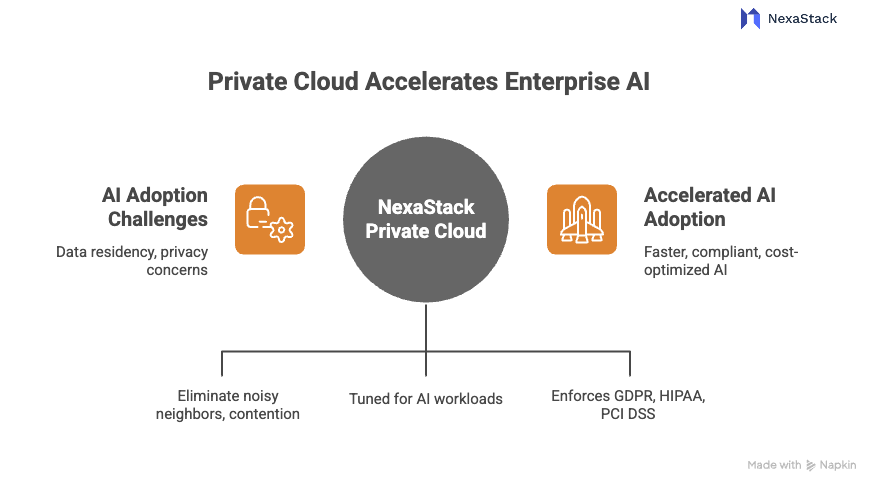
Yet, these benefits come with risk. Regulated industries must comply with strict data residency and privacy laws. Global enterprises need consistent performance across regions. Cost-conscious organizations cannot tolerate unpredictable infrastructure spending.
Private cloud directly addresses these challenges by providing:
-
Dedicated resources that eliminate noisy neighbors and performance contention
-
Customizable deployments tuned to specific AI workloads and latency requirements
-
Policy-driven compliance that enforces regulations such as GDPR, HIPAA, PCI DSS, and SOC 2 at the infrastructure level
NexaStack amplifies these advantages by delivering a ready-to-deploy, AI-native private cloud. What once required years of custom engineering can now be implemented in weeks using NexaStack’s orchestration, cost optimization, and compliance blueprints.
Example scenario:
A global pharmaceutical company operating across Europe and Asia needed to ensure patient data never left its country of origin. Using NexaStack, the organization deployed region-specific private clouds aligned with local regulations, while centrally orchestrating AI inference workflows. The result was faster drug discovery pipelines without regulatory risk.
Role of Cost, Control, and Compliance in AI Infrastructure Decisions
When enterprise leaders evaluate AI infrastructure strategies, three factors dominate every boardroom discussion: cost, control, and compliance.
Cost: Predictability Over Volatility
AI inference is continuous, not episodic. Large language models, computer vision systems, and recommendation engines often require thousands of GPU hours every day. In public cloud environments, this translates into unpredictable bills driven by usage spikes, data egress fees, and vendor pricing changes.
Private cloud stabilizes AI economics. Once infrastructure is deployed, costs become predictable and budgetable. NexaStack further optimizes spend through GPU pooling, intelligent scheduling, and elastic scaling, ensuring that expensive accelerators are never left idle.
Control: Full-Stack Visibility and Optimization
Public cloud environments abstract away hardware and networking layers, limiting an enterprise’s ability to fine-tune performance. Latency-sensitive workloads, such as autonomous systems or real-time analytics, suffer as a result.
Private cloud restores full control. Enterprises can pin GPUs to mission-critical inference workloads, optimize memory usage, customize caching layers, and design network topologies for ultra-low latency. NexaStack provides end-to-end visibility—from hardware telemetry to application pipelines—allowing teams to optimize performance continuously.
Compliance: Governance by Design
Regulations such as GDPR, HIPAA, PCI DSS, SOC 2, and FedRAMP impose strict requirements on how data is stored, processed, and audited. In public cloud, compliance is a shared responsibility, often leaving enforcement gaps.
Private cloud flips this model. Infrastructure is designed compliance-first, with encryption, role-based access control (RBAC), audit trails, and policy enforcement built in. NexaStack ships with pre-configured compliance templates, enabling enterprises to start from a certified baseline rather than building governance from scratch.
Key takeaway: With NexaStack, cost, control, and compliance are not trade-offs—they are integrated pillars of a single AI infrastructure platform.

Q&A (Featured Snippet) — Is private cloud AI inference more cost-effective than public cloud?
A: Yes. Private cloud AI inference is more cost-effective at scale. While it requires upfront investment, it significantly reduces long-term spend by eliminating usage-based pricing, optimizing GPU utilization, and avoiding network egress fees—especially for continuous inference workloads.
Challenges in Running AI Inference on Public Cloud
While public cloud is effective for prototyping, it introduces significant limitations at production scale:
-
Rising infrastructure costs: GPU instances often cost $20–$30 per hour, with additional charges for storage and data transfer.
-
Limited optimization: Hardware abstraction prevents fine-grained tuning of GPUs, memory, and networking.
-
Compliance risks: Multi-tenant environments increase the risk of data leakage and cross-border data movement.
-
Vendor lock-in: Proprietary APIs make migration costly and complex.
Case in point:
A global retail enterprise deployed recommendation models on a hyperscaler cloud. Within six months, annual inference costs exceeded $5 million, and compliance teams raised concerns about regional data processing. Migrating to a NexaStack-powered private cloud reduced costs by 40% while accelerating compliance certifications.
Benefits of Private Cloud for AI Inference
-
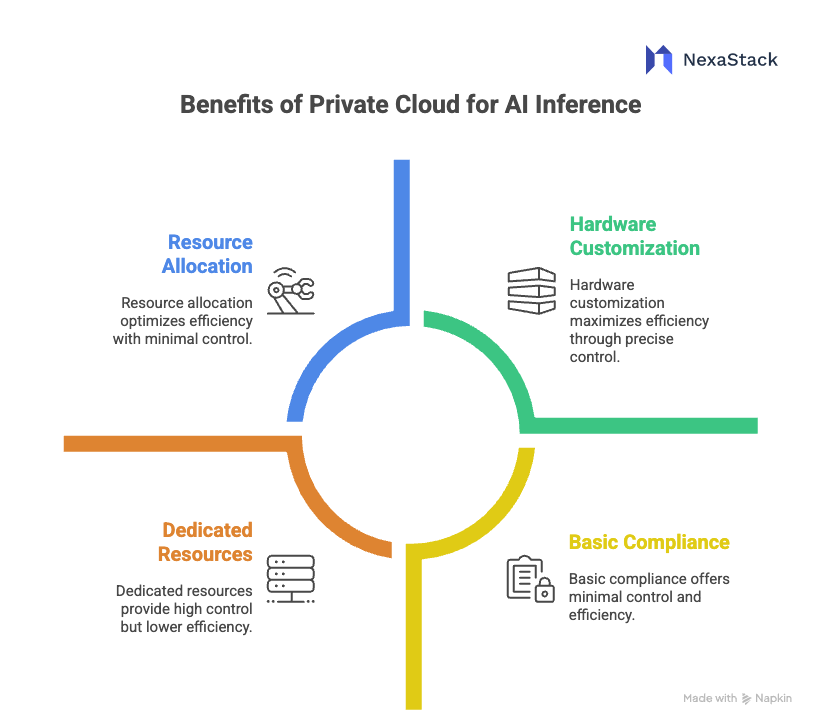
Cost Efficiency: Long-Term Optimization
Private cloud eliminates usage-based billing volatility. GPU pooling and smart scheduling ensure maximum hardware utilization. NexaStack functions like “air traffic control” for AI workloads, dynamically allocating resources where they are needed most.
-
Full Control: Hardware and Network Customization
Enterprises can configure GPUs, CPUs, memory, and networking to match workload requirements precisely. This level of control is critical for latency-sensitive inference and large-scale model serving.
-
Regulatory Compliance: Security by Design
Compliance is embedded in the infrastructure. NexaStack provides automated encryption, logging, and governance aligned with global standards, reducing audit preparation time by up to 70%.
-
Performance Optimization: Dedicated Resources
With no noisy neighbors, the private cloud delivers consistent performance. Edge-to-cloud integration enables inference to run close to data sources, improving response times for real-time applications.
Best Practices for Deploying AI Inference on Private Cloud
-
Optimize models for inference using quantization, pruning, and distillation
-
Leverage hardware acceleration by matching workloads to GPUs, TPUs, or FPGAs
-
Implement MLOps pipelines for automated deployment, monitoring, and rollback
-
Secure the pipeline end-to-end with encryption, zero trust, and anomaly detection
-
Design for high availability using redundancy, auto-healing, and failover
Q&A (Featured Snippet) — Can private cloud AI inference scale like public cloud?
A: Yes. With platforms like NexaStack, private cloud AI inference scales elastically. Enterprises can dynamically allocate GPUs, scale workloads across regions, and extend inference to edge locations—without sacrificing control or compliance.
Enterprise Use Cases of Private Cloud AI Inference with NexaStack
-
Financial Services: Real-time fraud detection and AML with PCI DSS compliance.
-
Manufacturing: Predictive maintenance and defect detection with sub-second latency at the edge.
-
Government and Defense: Secure intelligence analysis with air-gapped, zero-trust environments.
Deployment Models for Private Cloud AI Inference
-
On-premises private cloud
-
Hosted private cloud
-
Hybrid private–public models
-
Edge-enabled inference
-
Dynamic scaling with NexaStack orchestration

Security, Compliance, and Governance in Private Cloud AI
Security is non-negotiable. Private cloud AI inference with NexaStack ensures:
-
Data residency enforcement
-
Zero-trust access controls
-
Automated compliance for GDPR, HIPAA, ISO, SOC 2, and FedRAMP
A European healthcare provider reduced audit preparation time by 70% using NexaStack’s governance tools.
Future of AI Inference on Private Cloud with NexaStack
The future includes confidential computing, federated learning, AI-driven orchestration, green AI optimization, and sovereign AI initiatives. NexaStack is actively investing in these capabilities to deliver a future-ready AI foundation.
Conclusion & Key Takeaways
Private cloud has become the enterprise standard for AI inference at scale.
-
Cost: Predictable and optimized
-
Control: Full-stack flexibility
-
Compliance: Built into the foundation
With NexaStack, enterprises gain a secure, scalable, and compliant AI inference platform that transforms private cloud into a strategic advantage.

Frequently Asked Questions (FAQs)
Advanced FAQs on Private Cloud AI Inference focused on cost efficiency, control, and compliance.
How does private cloud AI inference reduce long-term inference costs?
By eliminating per-token pricing, optimizing GPU utilization, and enabling predictable cost models for high-volume inference workloads.
What level of control does private cloud inference provide over AI models?
Full control over model versions, deployment topology, scaling policies, and access boundaries across teams and applications.
How does private cloud inference support regulatory compliance?
By enforcing data residency, audit logging, access controls, and compliance-aligned inference workflows.
When is private cloud AI inference preferred over public APIs?
For regulated data, high-throughput workloads, latency-sensitive applications, and governed enterprise AI deployments.