The rapid adoption of artificial intelligence (AI) across industries—from healthcare and finance to manufacturing and autonomous systems—is driving an unprecedented need for scalable, secure, and high-performance computing infrastructure. Traditional cloud-based AI solutions often struggle to meet these demands, facing challenges such as high latency, unpredictable costs, and data privacy concerns.
AI Factory-as-a-Service (AI FaaS) offers a solution by providing enterprises with managed, dedicated infrastructure specifically optimized for AI workloads. This includes high-performance GPU and TPU clusters, secure storage, and low-latency networking, all hosted in geographically distributed data centers.
Leading providers like Equinix are at the forefront of AI FaaS, offering globally distributed, secure, and compliance-ready infrastructure. Their services blend the flexibility of the cloud with the control and predictability of private compute, enabling enterprises to run AI workloads efficiently, securely, and at scale. By leveraging AI FaaS, organizations can accelerate AI model training and inference, maintain compliance with regulations like GDPR and HIPAA, and ensure high performance for real-time AI applications.
What Is AI Factory-as-a-Service?
AI Factory-as-a-Service (AI FaaS) provides enterprises with dedicated AI infrastructure—including compute, storage, and networking—hosted in secure, geographically distributed data centers. Unlike public cloud AI services, which rely on shared resources, AI FaaS gives organizations full control over their environment while maintaining high performance and compliance.
Key features include:
-
High-performance clusters for AI training and inference, ensuring fast, predictable execution for large language models, computer vision, and real-time analytics
-
Compliance-ready environments with built-in security controls, audit trails, and data localization, helping enterprises meet GDPR, HIPAA, and other regulatory requirements
-
Predictable, scalable costs, with reserved capacity and the ability to scale resources on demand without unexpected fees
AI FaaS is particularly valuable for businesses handling sensitive data, requiring low-latency processing, or operating under strict regulations, such as healthcare, finance, government, and autonomous systems. By providing a managed, secure, and optimized infrastructure, AI FaaS enables enterprises to deploy AI workloads efficiently while maintaining control, performance, and compliance.
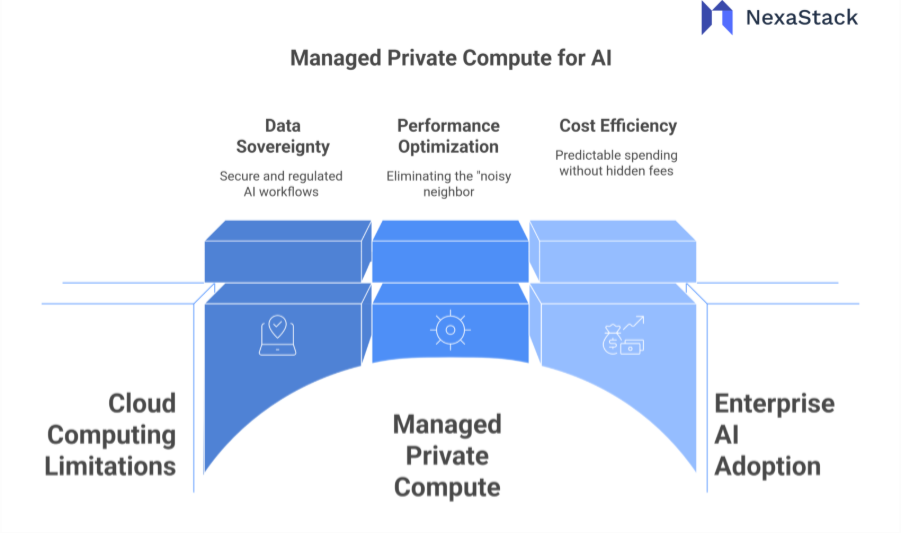
Why Managed Private Compute Matters for AI
Modern AI workloads—large language models, computer vision, and real-time analytics—require massive compute power, low latency, and strong security. Public cloud environments often struggle to meet these demands, making managed private compute a critical solution for enterprises.
- Data Sovereignty & Compliance
AI workloads often handle sensitive data, including healthcare records, financial information, and proprietary research. Enterprises must comply with regulations like GDPR, HIPAA, and CCPA. Managed private compute ensures:
-
Data stays in approved geographic regions, meeting residency requirements
-
Pre-configured security controls such as encryption, audit logs, and access management
-
Full ownership of models and datasets, avoiding vendor lock-in and maintaining data control
- Performance Optimization
Shared cloud resources can lead to unpredictable training times, inconsistent inference, and networking bottlenecks. Private AI infrastructure addresses this with:
-
Dedicated GPU/TPU clusters, eliminating “noisy neighbor” effects
-
Low-latency networking through private interconnects
-
Optimized AI frameworks pre-tuned for PyTorch, TensorFlow, and CUDA, ensuring faster training and reliable inference
- Cost Efficiency
Public cloud AI costs can escalate quickly due to pay-per-use GPU pricing, data egress fees, and idle resources. Managed private compute offers:
-
Reserved capacity with predictable pricing, helping plan budgets
-
No egress charges, since data remains within the private environment
-
Higher utilization rates, enabling continuous optimization of resources without wasting capacity
Market Drivers for AI Factory-as-a-Service
- Growing AI Compute Demands
AI models like LLMs and diffusion systems require massive, specialized compute. Public clouds often face GPU shortages, resource contention, and high costs. AI FaaS solves this with dedicated clusters, optimized workloads, and scalable infrastructure, enabling faster training and inference at predictable costs.
- Data Privacy and Regulatory Requirements
Healthcare, finance, and government sectors need secure, compliant AI environments. AI FaaS supports this with:
-
Data localization to meet regional requirements
-
Pre-compliance audits for GDPR, HIPAA, and similar regulations
-
Zero-trust security, including encryption and controlled access
- Need for Low-Latency AI Infrastructure
Real-time AI applications—autonomous vehicles, industrial IoT, and high-frequency trading—demand instant processing. AI FaaS addresses this with edge deployments near data sources, private high-speed interconnects, and hybrid architectures combining centralized training with edge inference. 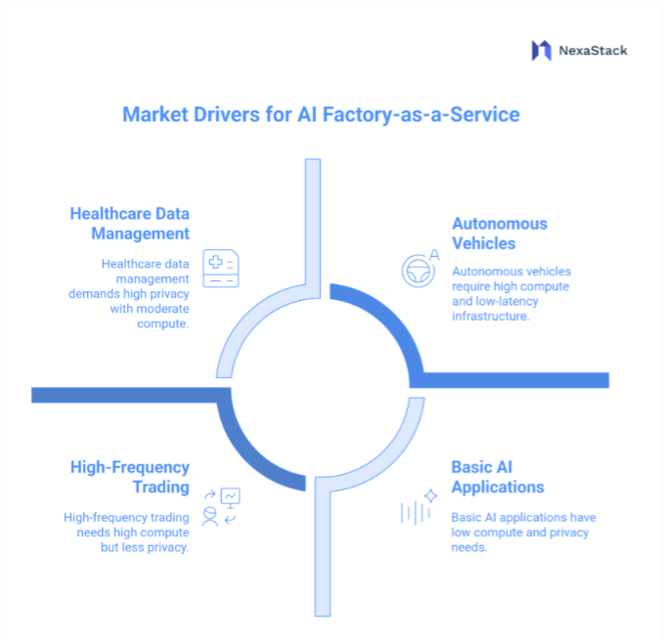
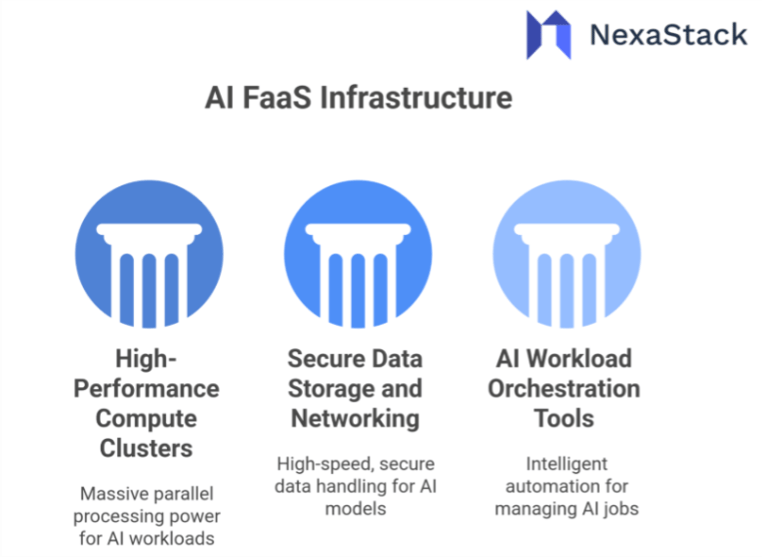
Core Components of an AI Factory-as-a-Service Model
- High-Performance Compute Clusters
AI workloads, especially large-scale training and real-time inference, require accelerated computing and scalable infrastructure. High-performance clusters combine GPUs and TPUs with flexible compute nodes to handle demanding tasks efficiently. Key elements include:
-
NVIDIA GPUs (H100, A100), Google TPUs, AMD MI300X, Groq LPUs for fast matrix operations and AI-specific acceleration
-
Bare-metal servers for dedicated, consistent performance
-
Elastic clusters that scale GPU resources dynamically for burst workloads
-
Distributed training support using frameworks like PyTorch, FSDP or Horovod for multi-node AI jobs
- Secure Data Storage and Networking
AI models process large volumes of sensitive data, making secure and high-speed storage essential. Core components include:
-
Private interconnects like Equinix Fabric or NVIDIA Quantum-2 for low-latency, high-bandwidth connections across nodes
-
Encrypted, air-gapped storage with immutable backups to protect critical datasets
-
Zero-trust data lakes using role-based access and homomorphic encryption for secure analytics without exposing raw data
- AI Workload Orchestration Tools
Efficient orchestration ensures high resource utilization, consistent model deployment, and regulatory compliance. Key tools include:
-
Kubernetes-based pipelines such as Kubeflow, Ray on K8s, and Argo Workflows for managing multi-stage AI workloads
-
MLOps platforms like MLflow, Weights & Biases, and Seldon Core for tracking experiments, monitoring model performance, and deploying models reliably
Benefits of Managed Private Compute for AI
-
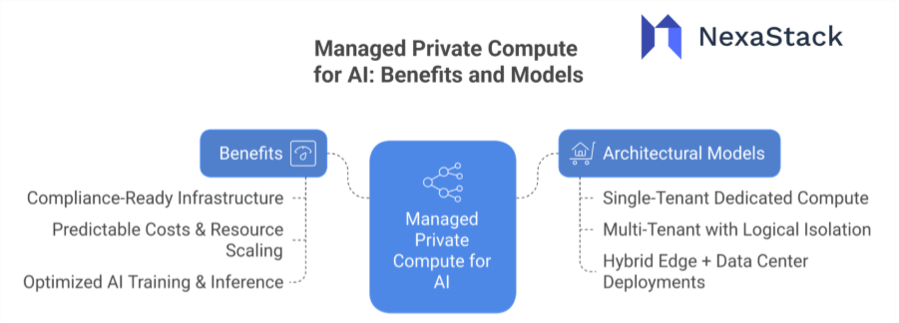
Compliance-Ready Infrastructure
Managed private compute provides pre-configured environments that meet industry regulations such as GDPR, HIPAA, and CCPA. This ensures sensitive data is handled securely, audit requirements are met, and enterprises can confidently run AI workloads in regulated industries.
-
Predictable Costs and Scalable Resources
With dedicated infrastructure, organizations avoid unexpected cloud bills. Reserved capacity and on-demand scaling allow predictable spending while easily adjusting resources as AI workloads grow, ensuring efficiency without overspending.
-
Optimized AI Training and Inference
Dedicated hardware and tuned infrastructure maximize training speed and inference performance. Enterprises benefit from high GPU/TPU utilization, low-latency networking, and frameworks optimized for large-scale AI models, resulting in faster insights and reliable AI operations.

Architectural Models for AI Factory-as-a-Service
-
Single-Tenant Dedicated Compute: Offers exclusive hardware and full isolation for maximum security, predictable performance, and compliance. Ideal for regulated industries like defense, healthcare, and finance. Enterprises can customize GPU clusters for large-scale AI training, ensuring consistent performance and control over sensitive data.
-
Multi-Tenant with Logical Isolation: Shares physical infrastructure while maintaining secure separation via virtualization and containerization. This cost-efficient model suits SaaS providers, research institutions, and mid-sized enterprises, delivering scalable AI resources without compromising security.
-
Hybrid Edge + DataCenterDeployments: Combines centralized training with edge inference for low-latency, real-time AI applications. Key technologies include NVIDIA EGX, 5G MEC, and federated learning, enabling autonomous vehicles, industrial automation, and smart city solutions to operate efficiently with fast, localized decision-making.
Role of Providers like Equinix in AI Factory-as-a-Service
Providers like Equinix play a crucial role in enabling enterprise-grade AI FaaS by offering globally distributed, secure, and high-performance infrastructure. Key contributions include:
-
Global Data Centers Close to Data Sources: Strategically located facilities reduce latency for real-time AI applications and enable local data processing to meet regulatory requirements.
-
Secure, Low-Latency Interconnects: Direct, high-speed connections to public clouds (AWS, Azure, Google Cloud) and private networks ensure fast, reliable data transfer across hybrid AI environments.
-
Compliance-Ready Infrastructure: Equinix data centers meet strict industry standards such as GDPR, HIPAA, and regional data residency laws, helping enterprises maintain data privacy and regulatory compliance.
-
Scalable Hybrid AI Architectures: Flexible infrastructure allows enterprises to deploy AI workloads across cloud and edge environments, scale compute resources as needed, and optimize performance for both training and inference.

Best Practices for Deploying AI Factory-as-a-Service
-
Align AI Workload Needs with Infrastructure: Match AI workloads to the right hardware. LLMs need high-memory GPUs (H100, MI300X), while computer vision or real-time inference may use specialized chips (L4, Groq LPUs). Consider memory bandwidth, mixed-precision support, and modular designs to optimize performance and cost.
-
Continuous Performance & Compliance Monitoring: Monitor compute, storage, and network layers to catch performance issues and compliance gaps early. Track GPU usage, inference latency, model accuracy, and data access patterns. Tools like Dynatrace, Datadog, Prometheus/Grafana, MLflow, and W&B provide visibility and actionable insights.
-
Leverage Policy-as-Code for Governance: Automate compliance with machine-readable policies that enforce security and regulatory rules in real-time. Integrate with Terraform, CI/CD pipelines, and runtime environments to ensure consistent governance across hybrid AI infrastructures.
Future Outlook for AI Factory-as-a-Service
The future of AI Factory-as-a-Service points toward broader adoption and deeper integration across enterprise AI ecosystems. AI-optimized colocation services will continue to expand, offering enterprises the ability to deploy high-performance AI workloads in secure, scalable facilities close to their data sources.
We also expect significant growth in federated and sovereign AI models, enabling organizations to collaborate on AI training while keeping sensitive data localized to comply with regulatory and national requirements. This approach will be crucial for industries like healthcare, finance, and government, where data privacy is non-negotiable.
Finally, there will be a strong convergence of AI cloud and edge infrastructure, creating hybrid ecosystems that combine the scalability of centralized cloud resources with the responsiveness of edge deployments. This will allow enterprises to optimize AI training in data centers while delivering real-time inference at the edge, ensuring low-latency, high-performance applications for robotics, autonomous systems, and IoT. 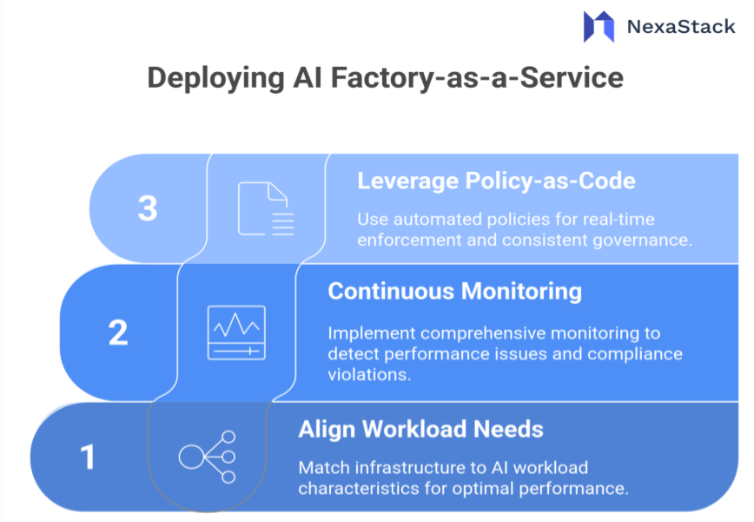
Conclusion
AI Factory-as-a-Service (AI FaaS) is reshaping how enterprises deploy and scale AI by addressing the core challenges of performance, security, and cost efficiency. Leading providers like Equinix enable organizations with:
-
Globally distributed, AI-optimized infrastructure for efficient model training and low-latency inference
-
Secure interconnects that bridge cloud and edge environments for fast, reliable data transfer
-
Compliance-ready architectures that meet GDPR, HIPAA, and regional data regulations
By combining the flexibility of the cloud with the control of dedicated infrastructure, AI FaaS helps enterprises accelerate AI deployment, reduce costs, and maintain consistent performance—making it an ideal solution for mission-critical, regulated, and latency-sensitive AI applications.