AI is already reshaping enterprise operations—powering customer support, analytics, automation, and cybersecurity. But while many organizations achieve early success with pilots, most struggle with scaling AI across the enterprise in a consistent and secure way.
The challenge is rarely the models—it is the project-by-project AI adoption approach. When each team builds its own data pipelines, AI deployment workflows, and governance controls, efforts are duplicated, systems become fragmented, and enterprise AI deployment becomes slow and expensive.
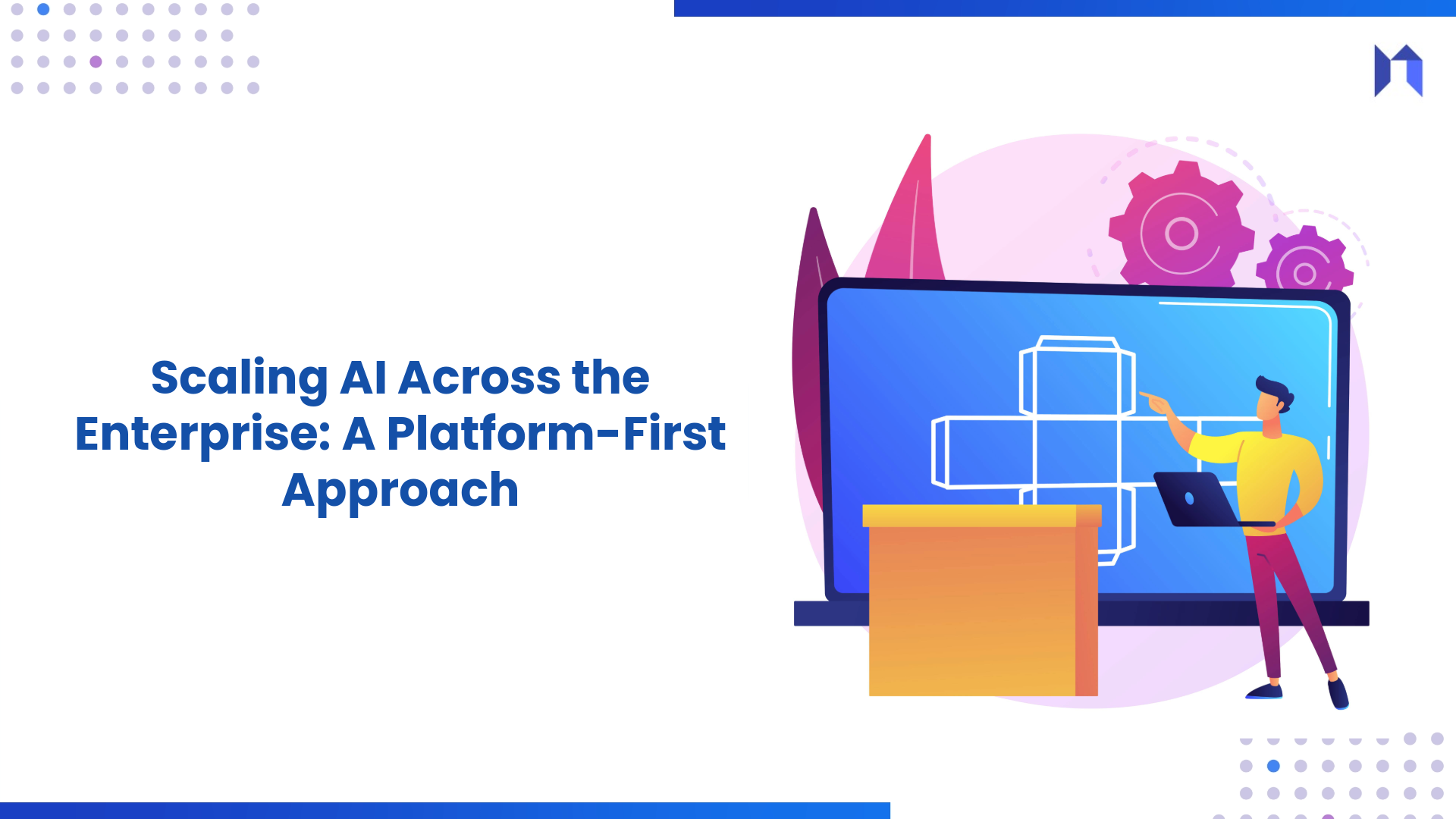
A platform-first AI approach solves this by delivering shared infrastructure, reusable AI components, centralized AI governance, and unified data access. This enables organizations to operationalize AI across teams—turning isolated experiments into a repeatable, scalable enterprise AI platform capability.

Why Scaling AI Remains a Challenge for Enterprises
Even with executive sponsorship, funding, and talent, enterprises face structural barriers that prevent secure AI adoption at scale.
1. Lack of Unified Infrastructure
Most enterprises operate across:
-
Multiple cloud providers
-
Legacy enterprise applications
-
Department-specific software systems
As a result:
-
AI models are deployed inconsistently across environments
-
Data cannot move easily between systems
-
Performance and reliability vary by use case
Without a unified hybrid AI infrastructure, enterprises struggle to replicate success beyond initial deployments.
2. Siloed Data and Teams
AI systems depend on context—and context comes from enterprise data. Yet data is often fragmented across departments with different ownership models, standards, and access policies.
At the same time, business teams, data scientists, and platform engineers operate in silos. This results in:
-
Duplicate AI engineering efforts
-
Slower decision-making cycles
-
Difficulty building end-to-end agentic AI workflows
3. Inconsistent Governance
Scaling AI introduces new requirements for AI governance and compliance, including:
-
Data privacy and protection
-
Bias and fairness monitoring
-
Regulatory compliance
-
Model auditability and explainability
When governance is handled independently per project:
-
Policies are applied unevenly
-
Audits become reactive
-
Trust in AI-driven decisions erodes
4. High Operational Costs
Enterprise AI scaling requires:
-
Continuous monitoring and AI observability
-
Model retraining and lifecycle management
-
Infrastructure scaling and optimization
-
Ongoing system maintenance
Without shared AI lifecycle management (MLOps/LLMOps), costs and operational complexity grow rapidly.

Shifting from Project-First to Platform-First Mindset
Most organizations begin with a project-first AI model, where teams solve isolated problems using tools they choose independently. While this can deliver early wins, those results are rarely repeatable.
A platform-first mindset treats AI as a core operational capability—similar to networking, storage, or cybersecurity. The focus shifts to building a shared enterprise AI platform that supports multiple teams, workflows, and use cases consistently.

The Limitations of Project-First AI Adoption
Fragmented Initiatives and Silos
When teams design their own pipelines and tools, enterprises accumulate incompatible systems. This fragments AI orchestration, limits reuse, and blocks cross-functional automation.
High Costs and Duplication of Effort
Teams repeatedly rebuild the same components—data ingestion, training workflows, deployment pipelines, and monitoring systems. This leads to:
-
Wasted budget
-
Slower time-to-production
-
Increased strain on platform and data engineering teams
Inconsistent Governance and Compliance
Without centralized controls, governance is enforced differently across projects. This increases compliance risk and exposes security gaps in enterprise AI deployment.
What Is a Platform-First Approach?
A platform-first approach standardizes AI development and deployment through a shared enterprise AI platform.
Instead of building from scratch, teams assemble solutions using:
-
Standardized and reusable AI pipelines
-
Approved model frameworks
-
Centralized AI and agent orchestration
-
Built-in security, governance, and compliance
This ensures faster development, lower operational overhead, consistent governance, and reliable scaling across business units.
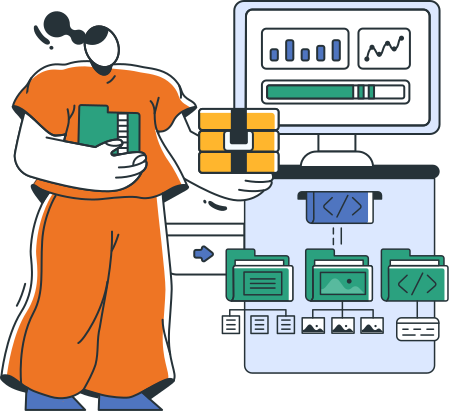
 Fig 2: Platform-First AI Adoption
Core Principles of Platform-First AI
A platform-first strategy enables AI to scale reliably across the enterprise. Two principles define this model:
1. Unified Infrastructure and Context Management
An enterprise AI platform unifies:
-
Compute across cloud, on-prem, and hybrid environments
-
Secure, governed data access
-
Identity and permission management
-
Shared memory and context for multi-agent systems
This enables context-first AI, where agents operate with a consistent understanding, security posture, and enterprise data access across environments.
2. Built for Reusability and Scalability
Once AI workflows are created, they should not be rebuilt for every use case. A platform-first approach emphasizes:
-
Reusable workflows and components
-
Standard deployment templates
-
Shared model and feature libraries
This transforms scaling into a configuration-driven process rather than a complex engineering effort.
Key Components of an Enterprise AI Platform
Compute and Data Infrastructure
A robust platform provides elastic compute (CPU, GPU, TPU), unified data access layers, data lineage, cataloging, and versioning. These capabilities ensure efficient AI workload execution, data trust, and cross-team collaboration.
Agent Orchestration and Workflow Automation
Enterprise AI depends on coordinated execution. The platform must support:
-
Agent orchestration and multi-agent collaboration
-
Event-driven workflow automation
-
Human-in-the-loop oversight
This keeps automation adaptive and aligned with real business logic.
Security, Compliance, and Governance Layers
Scalable AI requires built-in guardrails, including:
-
Role-based access controls
-
Policy enforcement by design
-
End-to-end audit trails
When governance is embedded into the enterprise AI platform, compliance becomes automatic rather than a deployment bottleneck.
Observability, Monitoring, and FinOps Alignment
To sustain performance and cost control, enterprises need AI observability and monitoring. The platform must track performance, usage patterns, and cost allocation to ensure AI remains aligned with business value.

How NexaStack Enables Platform-First AI
NexaStack enables enterprises to move beyond isolated pilots by delivering a shared, scalable agentic AI platform. It centralizes context sharing, agent orchestration, and secure system integration—making AI operational at scale.
Context-First Agent Infrastructure
NexaStack allows agents to retain memory, state, and historical context. This ensures consistent behavior, richer personalization, and coordinated execution across workflows.
Seamless Integration with Existing Systems
NexaStack integrates with ERP, CRM, data lakes, analytics platforms, and public or private clouds. This enables enterprise AI adoption without disrupting existing systems.
Scalable Multi-Agent Coordination
NexaStack supports agent hierarchies, delegation models, and distributed automation—allowing complex business processes to scale across teams and environments.
Continuous Feedback and Improvement
Built-in telemetry and observability enable agents to learn from outcomes, improve workflows, and adapt continuously instead of remaining static after deployment.
Enterprise Use Cases at Scale
Customer Experience and Operations Automation
AI agents personalize interactions, coordinate workflows, and automate operations—reducing response times and improving consistency across channels.
Cybersecurity and Incident Response
AI continuously monitors threats, prioritizes alerts, and initiates containment—supporting AI-driven SOC automation and faster response.
Data Engineering and Analytics Pipelines
NexaStack automates ingestion, transformation, and reporting—delivering cleaner data, faster insights, and reduced manual effort.
Cross-Industry AI Scaling Examples
| Industry | Enterprise AI Applications | Outcome |
|---|---|---|
| Manufacturing | Predictive maintenance, quality control, supply chain automation | Reduced downtime |
| Healthcare | Clinical decision support, care coordination | Improved outcomes |
| Finance | Fraud detection, risk scoring, and underwriting automation | Faster, compliant decisions |
Best Practices for Scaling AI with a Platform-First Approach
-
Embed AI governance and compliance into the platform
-
Enable adoption with reusable workflows and playbooks
-
Support hybrid and multi-cloud AI deployment
-
Measure business outcomes, not just model accuracy
Future Outlook
Toward Autonomous Enterprise Operations
Enterprises are moving from task automation to autonomous workflows. Multi-agent systems will increasingly coordinate operations while humans focus on strategy and oversight.
Preparing for Next-Generation AI and Regulations
As models and regulations evolve, enterprises need adaptive platforms with built-in governance. NexaStack provides this foundation through unified orchestration and policy enforcement.
Conclusion
The Strategic Value of Platform-First AI
A platform-first enterprise AI strategy transforms AI from fragmented projects into a scalable operational capability—reducing duplication, accelerating deployment, and ensuring governance.
Why NexaStack Makes This Possible
NexaStack serves as the backbone for scaling AI across the enterprise, combining shared context, centralized orchestration, seamless integration, and built-in compliance. This enables organizations to operationalize AI securely, efficiently, and sustainably—turning experimentation into long-term advantage.