Large Language Models (LLMs) have quickly moved from experimentation to powering core business functions—from customer interactions to analytics, automation, and decision support. As AI becomes more deeply embedded in daily operations, the focus is shifting from what LLMs can do to how they can be managed, scaled, and governed with confidence.
This is where LLMOps comes in, the discipline that ensures LLMs are deployed, monitored, and maintained in a consistent and controlled way. At the center of this discipline is the model registry, a critical yet often overlooked component.
A model registry serves as a strategic control system for the AI lifecycle—tracking, validating, securing, and auditing every model. As AI environments grow more complex, this structured oversight becomes essential for reducing risk, maintaining reliability, and supporting safe, rapid innovation.
In a world where AI influences customer trust, security, and compliance, model registries are emerging as a foundational pillar of responsible and scalable enterprise AI.
What is a Model Registry — In Business Terms?
A model registry is the system of record for your organization’s AI models — similar to how an ERP is a system of record for financials or CRM for customer data.
It allows enterprises to:
-
Maintain a single source of truth for all AI models
-
Control which models go into production
-
Track who built, approved, or modified each model
-
Maintain audit logs for compliance and risk
-
Accelerate deployment across business units
Think of it as AI governance and lifecycle management, all in one place. For large enterprises, this centralization is critical for reducing redundancy, enforcing standards, and ensuring responsible AI deployment.
The Strategic Role of Model Registries in Enterprise LLMOps
A model registry serves as the central nervous system of enterprise AI, ensuring that LLM initiatives scale in a controlled, efficient, and compliant manner. For C-suite leaders, its strategic value aligns directly with key business priorities:
-
Operational Efficiency: By centralizing all models, metadata, and versions in one place, registries eliminate fragmentation across teams and environments. This creates smoother workflows, reduces rework, and ensures consistent standards across the organization.
-
Risk and Compliance Control: Registries provide built-in traceability—capturing model lineage, training data sources, approval history, and deployment activity. This is crucial for meeting requirements under GDPR, HIPAA, and new AI governance laws, helping the enterprise reduce legal and regulatory exposure.
-
Faster Time to Market: With structured versioning, automated checks, and streamlined deployment pathways, teams can move models from experimentation to production far more quickly. This accelerates innovation and shortens the time required to deliver AI-driven capabilities to customers.
-
Cost Optimization: Registries prevent redundant model creation, minimize unnecessary retraining costs, and reduce downtime from deployment issues. Leadership gains clearer visibility into which models are being used, how often, and where inefficiencies can be eliminated.
-
Enterprise Governance: With consistent approval processes, access controls, and standardized documentation, a registry ensures AI is deployed responsibly across all business units. This brings transparency, accountability, and alignment to the entire AI portfolio.

Why Enterprises Can’t Scale LLMs Without Model Registries
- Centralized Model Management
Without a registry, models often exist across cloud buckets, personal laptops, isolated dev environments, or ad-hoc repositories.
This leads to:
-
Version confusion
-
Security gaps
-
Lost artifacts
-
Slow audits
-
Inconsistent deployments
A registry brings order, visibility, and operational discipline.
- End-to-End Traceability and Compliance
For leadership teams concerned with regulatory exposure, registries offer:
-
Complete model lineage
-
Training data documentation
-
Risk & performance metadata
-
Automatic audit trails
This dramatically reduces compliance cost and prevents regulatory violations — a top CISO/CIO priority.
- Versioning and Reproducibility
Executives often see teams “fixing” AI behaviour without knowing what changed.
A registry tracks:
-
Every version
-
Every prompt configuration
-
Every update
-
Every deployment history
This supports consistency, faster debugging, and operational reliability.
- Safe Deployment and Instant Rollback
Business operations cannot afford LLM downtime.
Registries enable:
-
Controlled releases
-
Canary deployments
-
Quick rollbacks when outputs degrade
This protects customer experience, SLAs, and brand reputation.
- Cross-Functional Collaboration
Enterprises typically have multiple AI teams working in silos.
A registry gives:
-
Common visibility
-
Shared governance
-
Standardized processes
-
Better resource alignment
This directly accelerates enterprise-wide AI scaling.
Model Registries vs. Traditional MLOps Tools
Traditional MLOps tools like Git or simple model storage work well for classic ML models, but cannot handle the complexity of modern LLMs. LLM workflows involve prompts, embeddings, guardrails, safety checks, and multi-step RAG pipelines—elements that require detailed tracking, versioning, and stronger governance.
A modern model registry is built for these needs. It provides richer metadata, automated compliance, better traceability, and seamless integration with LLM pipelines. This ensures large language models are managed, deployed, and updated with the reliability and control required for enterprise-scale AI.
|
Capability |
Model Registry |
Traditional ML Repository |
|
Artifact Management |
Handles complex LLM assets—prompts, embeddings, RAG pipelines, fine-tuned models |
Stores basic code and model files |
|
Governance |
Built-in access controls, approval workflows, and audit logs for enterprise oversight |
Minimal governance; limited visibility and tracking |
|
Compliance |
Automated lineage, documentation, and traceability are required for AI regulations |
Manual processes that are time-consuming and error-prone |
|
Scalability |
Designed for enterprise-wide LLM adoption across multiple teams and environments |
Effective mainly at a small, team-level scale |
|
Integration |
Connects seamlessly with LLM frameworks, vector databases, CI/CD pipelines, and governance tools |
Primarily integrates with code repositories and dev workflows |
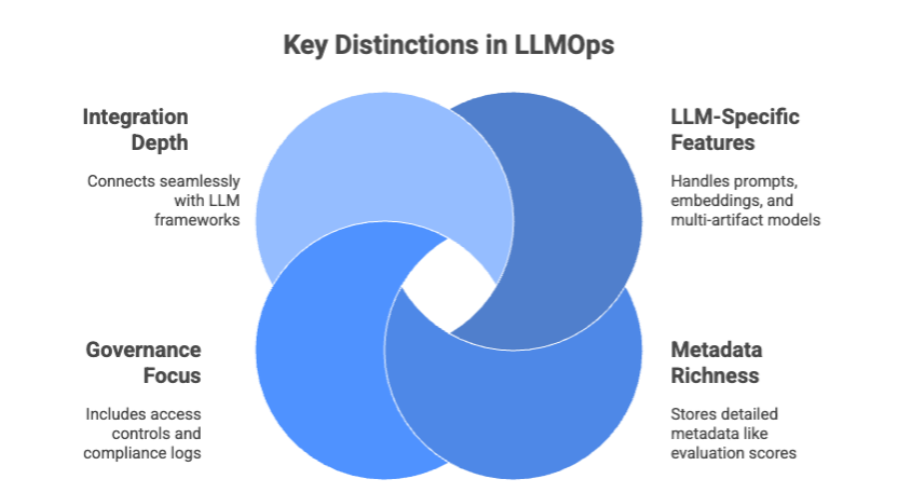
LLM-Specific Needs Driving Registry Adoption
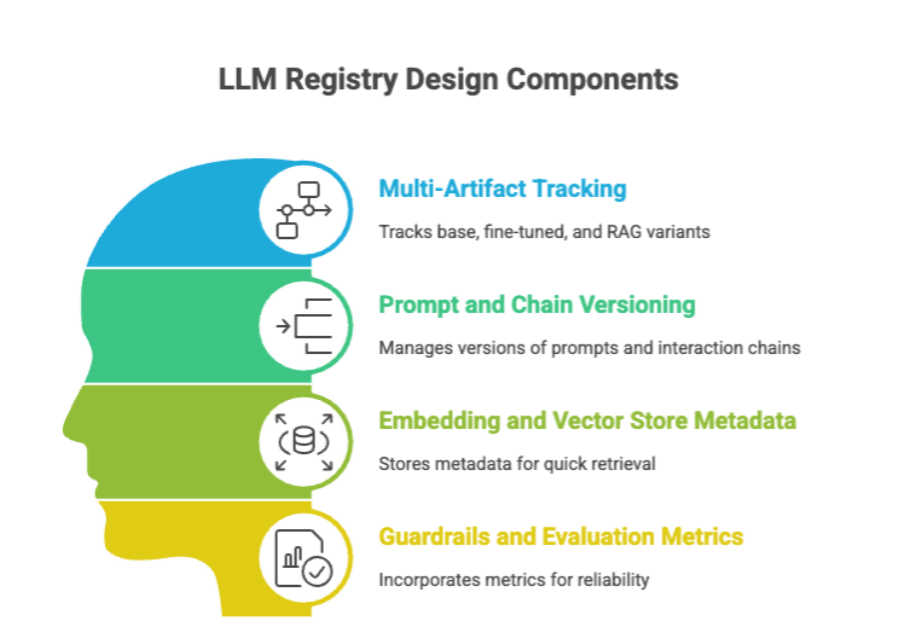
As enterprises scale LLM initiatives, they encounter complexities that traditional ML tools cannot manage. Modern LLM systems consist of many moving parts that must be governed with discipline. Model registries address these challenges by providing the structure and control required for safe, enterprise-grade AI operations.
- Multiple Artifacts for a Single Use Case
LLM applications typically blend several elements—base models, fine-tuned versions, RAG pipelines, vector databases, guardrails, and evaluation reports. Managing these separately often leads to confusion, duplicated work, and uncertainty about what is actually running in production.
A registry keeps every artifact linked and versioned, creating clarity around approvals, dependencies, and deployment history. This reduces risk and ensures that the right components are used consistently across the organization.
- Prompt & Chain Versioning
Prompts and chains act as the “logic layer” of LLM systems, and even small changes can shift output quality or behavior. With a registry, these changes are tracked, versioned, and documented, allowing teams to quickly identify what changed, why it changed, and revert when needed. This stabilizes production systems and prevents unpredictable model behavior.
- Embeddings & Vector Store Metadata
Embedding models and vector databases power search, retrieval, and knowledge applications. Their configurations must remain aligned across teams and environments.
Registries store key metadata—embedding versions, vector configurations, and update timelines—ensuring consistent performance and avoiding data drift or mismatches during retrieval.
- Safety, Guardrails & Evaluation Scores
Responsible AI requires rigorous oversight. Registries track safety checks, bias evaluations, hallucination testing, benchmark results, and approval workflows. This ensures only validated models reach production and provides a clear governance trail for audits, compliance, and internal accountability.
- Lifecycle Visibility & Change Control
LLMs evolve fast, and models often undergo continuous updates. Registries give full visibility into model lifecycle events—training updates, retraining triggers, rollout decisions, and retirement timelines—helping organizations avoid outdated or unapproved models silently entering production.
Together, these capabilities allow model registries to turn complex LLM ecosystems into stable, well-governed, and scalable AI environments—ensuring clarity, accountability, and long-term reliability across the organization.
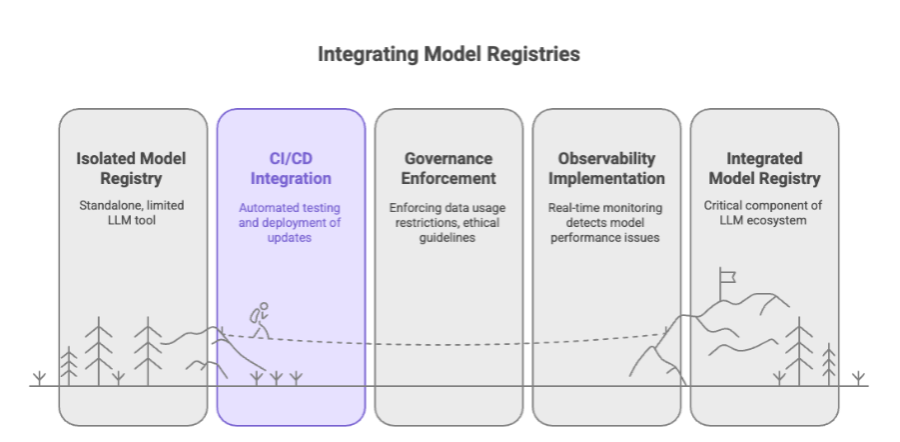
Integrating Registries Across the Enterprise AI Stack
As AI systems grow in scale and complexity, model registries deliver the most value when they are fully integrated into the broader enterprise AI ecosystem. These integrations create stability, control, and a continuous improvement loop across fast-moving LLM environments.
- CI/CD for AI
LLMs update frequently, and releases must be managed without disrupting operations.
Integrating registries with CI/CD pipelines enables:
-
Automated validation of new model versions
-
Smooth promotion of approved models to production
-
Built-in rollback when issues arise
-
Consistent deployment processes across teams
This makes releases faster and safer, supporting rapid innovation while maintaining reliability.
- Governance & Policy Enforcement
As AI becomes core to business processes, strong governance is essential.
Registry integrations help enforce:
-
Role-based access and approval steps
-
Compliance and documentation requirements
-
Ethical and security policy checks
-
Audit logging for transparency and accountability
This ensures that only trusted, reviewed models reach production and reduces the risk of unverified changes.
- Observability & Feedback Loops
LLM performance can drift over time, making continuous monitoring critical.
Connecting registries to observability tools allows teams to:
-
Track performance and accuracy in real time
-
Identify drift or safety violations early
-
Feed live metrics back into the registry
-
Trigger retraining or rollback when needed
This keeps AI systems aligned with business goals, even as data and conditions evolve.
Choosing the Right Registry: What Executives Should Consider
Selecting a model registry is a strategic decision that shapes how effectively an enterprise can scale AI. The focus should be on capabilities that support security, governance, efficiency, and long-term value.
-
Security & Compliance: The registry must protect sensitive data and meet regulatory standards like GDPR, HIPAA, and ISO 27001. Strong access controls, encryption, and audit logs are essential to minimize legal and operational risks.
-
Integration with Enterprise Architecture: It should integrate smoothly with your cloud platforms, data systems, DevOps pipelines, and identity management tools. Seamless integration reduces friction and accelerates deployment across business units.
-
Team Skills: Open Source vs. Managed
-
Open-source tools (e.g., MLflow) offer flexibility but require engineering effort.
-
Managed cloud-native registries (Vertex AI, SageMaker, Azure ML) deliver security and ease of use with lower maintenance overhead.
Choose based on your internal skill sets and desired level of control.
-
Scalability Across the Organization: The registry should support growing AI workloads, multiple teams, and global operations without compromising performance or governance.
-
Cost Efficiency & ROI: A good registry reduces redundant development, speeds up deployment, and simplifies audits—resulting in lower AI operating costs and higher long-term return on investment.
-
Governance & Auditability: Look for built-in approval workflows, version control, lineage tracking, and documentation. These features ensure responsible AI use and prepare the organization for emerging AI regulations.
Conclusion: Model Registries Enable Responsible, Scalable, and Trustworthy AI
As AI becomes embedded in core operations, organizations need systems that ensure stability, reliability, and clear governance. Model registries provide that foundation by bringing structure to complex LLM ecosystems and ensuring every model is tracked, validated, and aligned with organizational standards.
A well-implemented registry delivers meaningful advantages:
-
Greater trust through transparent model lineage and documentation
-
Reduced risk by preventing unapproved or unstable models from reaching production
-
Better consistency across teams and workflows
-
Faster delivery by streamlining development and deployment
-
Stronger compliance with built-in audit and approval processes
-
Long-term scalability as AI adoption grows
By combining governance with operational efficiency, model registries transform AI from scattered efforts into a dependable, enterprise-ready system. Ultimately, they create the groundwork for AI that is responsible, scalable, and aligned with the organization’s long-term goals.