Executive Summary
Time-critical logistics and emergency payload delivery in restricted or high-risk zones demand fast, reliable, autonomous aerial operations. NexaStack’s Drone Swarm Logistics Agent replaces slow, ground-bound or manned delivery workflows by deploying coordinated multi-drone fleets under the control of the NexaStack Multi-Agent Scheduler. The platform uses real-time route-planning, dynamic swarm coordination, payload management, and adaptive scheduling powered by NexaStack’s Agentic AI Blueprint and Unified Inference Engine.
The edge/hybrid computing architecture ensures secure operations even in connectivity-challenged or hazardous environments. Together, these capabilities enable safe, rapid and scalable deployment of medical kits, sensors or extinguishing materials into zones inaccessible or unsafe for conventional delivery means.
Industry Use Cases and Relevance
-
Emergency Medical Response: Rapid delivery of vaccines, blood products, diagnostics or medical kits into disaster zones, remote terrain, or outbreak areas.
-
Fire & Hazard Response: Transport of extinguishing materials or sensors into fires, chemical sites or inaccessible terrains to enable early suppression.
-
Infrastructure & Sensor Deployment: Delivery of environmental sensors, structural health monitors or IoT payloads into restricted or hazardous zones such as mines, offshore platforms or disaster-affected infrastructure.
-
Humanitarian & Remote Logistics: Supply of essential goods into remote, road-inaccessible, or conflict-affected areas where ground logistics are unreliable.
Customer and Operational Challenges
Traditional delivery and logistics operations struggle in restricted, remote or hazardous zones:
-
Ground vehicles or manned aircraft expose personnel to risk, and are slowed by terrain, traffic or damaged infrastructure.
-
Conventional route-planning cannot adapt dynamically to changing conditions, payload constraints or swarm-coordination needs.
-
Manual coordination of multiple drones or delivery assets is error-prone and not optimised for urgent mission scale.
-
Data governance, traceability and secure workflow for high-risk payloads (medical, hazardous) are often not built into logistics platforms.
Business and Technical Pain Points
-
Delay in delivering critical payloads increases risk to lives, infrastructure or operations.
-
Independent drone operations without orchestration lack efficiency and scalability when many drones must be coordinated.
-
Lack of real-time adaptive mission planning means drones may not adjust to obstacles, payload changes or environmental shifts.
-
Absence of secure, automated workflows for payload verification, chain-of-custody, mission audit, and governance in restricted zones.
NexaStack AI-Powered Solution
The NexaStack Drone Swarm Logistics Agent addresses these challenges end-to-end:
-
Mission Launch & Swarm Deployment (EDGE) – Multiple drones are dispatched from a launch hub, payloads pre-loaded (medical kits, sensors, extinguishers), mission parameters set via Multi-Agent Scheduler.
-
Dynamic Route & Coordination (EDGE + CLOUD) – The scheduler computes optimal routes, battery/fuel constraints, payload capacities, no-fly zones and dynamically reassigns drones mid-mission if conditions change.
-
In-Flight Autonomous Adjustment – Drones detect obstacles or hazards and communicate within the swarm to reroute, reduce mission risk, and ensure timely delivery.
-
Payload Delivery & Return (EDGE) – The swarm executes drop-or-deliver operations (landing, hover-drop, tethered delivery) and returns or redeploys as required.
-
Secure Data & Mission Audit (CLOUD) – All mission telemetry, payload confirmation, time-stamp, and chain-of-custody data are captured, stored and accessible for audit/compliance.
-
Continuous Learning Loop – Mission outcomes feed back into models for improved route-planning, energy-use optimisation, swarm coordination, and delivery efficiency.
Detailed Workflow Description
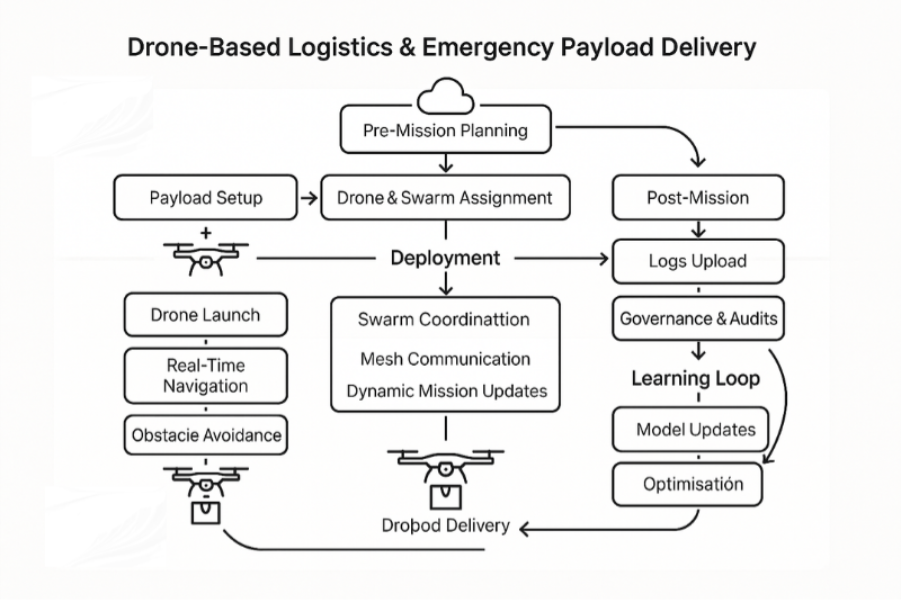
Pre-Mission Planning
-
Hub launches drones with specified payloads (medical kits, sensors, extinguishing material).
-
Scheduler assigns drones, defines swarm roles, and plans optimal flight paths considering terrain, payload weight, and no-fly regions.
Deployment & Edge Execution
-
Drones launch from an edge base, and onboard compute handles real-time navigation and obstacle avoidance.
Swarm Coordination & Edge/Central Interaction
-
Edge-based drone agents coordinate among themselves via a mesh network; the central agent monitors and dynamically updates the mission plan.
Payload Delivery & Mission Completion
-
Delivery operations executed; confirmation captured; drones return or redeploy for next mission.
Post-Mission Data & Governance
-
Mission logs, payload delivery data, drone status uploaded to cloud; audits, governance and analytics performed.
Learning & Optimisation
-
Mission data used to improve models for future deployments (battery management, route optimisation, swarm behaviour).
Stakeholders
-
Emergency services & first responders
-
Healthcare organisations (remote clinics, med-kits suppliers)
-
Fire & hazard-management agencies
-
Infrastructure/utility companies (remote sensor deployments)
-
Logistics operators & humanitarian organisations
-
Compliance & regulatory bodies (governance of restricted-zone missions)
Operational and Business Impact
-
Faster deliveries into restricted or hazardous zones — previously taking hours or days, now possible in minutes.
-
Reduced risk to personnel by leveraging autonomous drone deployment instead of ground or manned operations.
-
Scalable swarm-based delivery enables higher mission throughput with coordination rather than single-unit operations.
-
Audit-ready mission logs and governance support compliance for sensitive payloads (medical, hazardous) and restricted-zone operations.
-
Efficiency gains: lower operational cost, fewer delays, improved reliability and accessibility in remote areas.
Technical Specifications and Features
-
Multi-drone swarm support with role assignments (leader/follower, backup)
-
Payload-agnostic delivery (medical kits, extinguishers, sensors)
-
Adaptive route-planning engine considering terrain, no-fly zones, and battery life
-
Real-time swarm coordination mesh network
-
Edge compute nodes for on-board processing + cloud for central orchestration
-
Secure telemetry, chain-of-custody, audit logging, governance controls
-
API-first integration for logistics systems, emergency-response dashboards and IoT platform
Why NexaStack Stands Out for This Use Case
-
Agentic AI Architecture: NexaStack’s multi-agent framework enables real-time swarm coordination, adaptive route and mission planning, and distributed drone fleet control—moving beyond simple single-drone dispatch.
-
Edge/Hybrid Deployment: Enables operations in restricted, connectivity-challenged zones with low-latency edge processing and seamless cloud augmentation for coordination and data governance.
-
Unified Reasoning Stack: Integrates mission planning, payload logistics, swarm coordination and secure governance in one platform, reducing integration complexity and accelerating time-to-deployment.
-
Governance & Compliance-Ready: Built-in audit trails, chain-of-custody tracking for payloads, role-based access and mission logging ensure regulatory and enterprise-grade readiness.
Lessons Learned and Future Directions
-
Standardising payload types and drone launch hubs improves mission readiness and repeatability.
-
Regular mission-data feedback improves swarm coordination, energy optimisation and delivery reliability.
-
Future extensions include autonomous drop-zones, tethered resupply missions, integration with autonomous ground vehicles, and predictive delivery modelling for emergency-prepositioning.
Conclusion
NexaStack’s Drone Swarm Logistics Agent and Multi-Agent Scheduler redefine logistics and emergency payload delivery into restricted zones by combining autonomous swarm deployment, intelligent route and mission planning, edge/hybrid architecture and governance-ready operations. The result: faster, safer, scalable logistics for medical, sensor, or extinguishing payloads—empowering responders, logistic operators and infrastructure stakeholders to act with confidence and precision.