Executive Summary
A leading automotive manufacturer sought to improve efficiency and reliability across its welding robot fleet. The robots consumed high levels of energy, required frequent maintenance, and faced unplanned downtime due to undetected issues in sensors and actuators.
By deploying IoT-based monitoring with Agent Analyst and Agent SRE, the company enabled real-time data acquisition from robotic sensors, tracked critical metrics (energy usage, operating temperature, cycle counts), and introduced predictive maintenance and process optimization.
This transformation shifted maintenance from reactive repairs to proactive intervention, reduced downtime, and extended equipment life cycles, resulting in a 30% reduction in downtime, 25% lower energy costs, and significantly improved reliability.
Customer Challenge
Business Challenges:
-
High downtime from unplanned maintenance events.
-
Inefficient energy use across robotic welding cells.
-
Lack of visibility into operating conditions and performance.
-
Inability to track wear-and-tear in real time
Business Goals:
-
Maximize the uptime and availability of robots.
-
Reduce energy consumption per cycle.
-
Enable predictive maintenance to extend the robot's lifespan.
-
Achieve consistent welding quality across all shifts.
Existing Solution Limitations:
-
Manual inspection processes missed early warning signs.
-
SCADA systems had limited IoT/AI integration.
-
Inconsistent logging of energy and temperature data.
-
No autonomous coordination between robots.
Compliance and Business Pressures:
-
Automotive safety standards require strict process control.
-
Supply chain timelines demand zero unexpected delays.
-
ESG goals required measurable energy efficiency improvements.
Technical Challenges
Infrastructure and System Issues
-
Legacy PLCs lacked modern IoT data streaming.
-
Robots produced siloed data not connected to analytics platforms.
Technical Debt and Limitations
-
Static monitoring dashboards with no predictive intelligence.
-
The reactive maintenance approach increased costs.
Integration and Data Management Issues
-
Multiple robot vendors with different data formats.
-
Difficulty unifying sensor, actuator, and controller data.
Scalability, Reliability, and Performance Limitations
-
Existing monitoring couldn’t scale beyond a few pilot robots.
-
Limited ability to process high-frequency telemetry data.
Security and Compliance
-
Lack of encryption for IoT telemetry streams.
-
Weak access controls across robot monitoring systems.
Partner Solution
Solution Overview
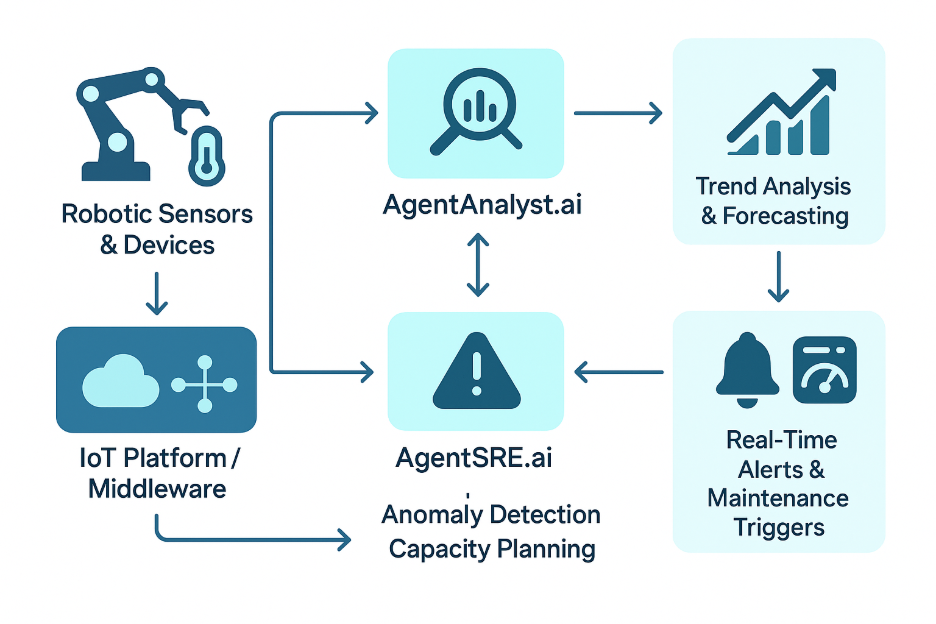
The customer deployed an IoT-enabled, agentic AI platform integrating robotic sensors, IoT middleware, and agent-based analytics:
-
Agent Analyst: Analyzes real-time IoT telemetry (temperature, cycle count, energy usage) to detect long-term performance trends.
-
Agent SRE: Issues real-time alerts when parameters deviate from normal, triggering predictive maintenance or autonomous coordination between robots.
Targeted Industries
|
Industry |
Use Cases |
Value Delivered |
|
Automotive (Primary) |
Welding robots, assembly lines |
Reduced downtime, predictive maintenance |
|
Manufacturing |
CNC machines, industrial robotics |
Improved energy efficiency, cost savings |
|
Electronics |
Assembly robotics, SMT lines |
Higher quality consistency |
|
Aerospace & Defense |
Precision welding and assembly |
Reliability and compliance |
Recommended Agents
-
Agent Analyst → IoT data analytics and consumption trend analysis.
-
Agent SRE → Real-time alerts, anomaly detection, and predictive maintenance.

Solution Approach
Real-Time IoT Data Acquisition
-
Stream sensor data (energy, heat, vibration) into the IoT platform.
-
Enable secure communication between robots and monitoring agents.
Predictive Analytics with Agent Analyst
-
Analyze cycle count trends and energy efficiency.
-
Identify patterns of drift before failures occur.
- Issue alerts for overheating, overconsumption, or cycle irregularities.
- Trigger automated workflows to dispatch maintenance teams.
Autonomous Coordination
-
Reallocate workload to healthy robots during downtime.
-
Maintain consistent throughput across welding cells.
Impact Areas
-
Workflow: From reactive repair to predictive, automated maintenance.
-
Data: Unified telemetry data for robots across vendors.
-
Operations: Reduced downtime, optimized cycle efficiency.

Results and Benefits
Business Benefits:
-
30% reduction in downtime from predictive maintenance.
-
25% reduction in energy consumption per cycle.
-
20% extension in the lifespan of robotic components.
-
Improved welding quality and consistency.
Technical Benefits:
-
Real-time IoT telemetry streaming.
-
Automated alerting system integrated with workflows.
-
Scalable, secure architecture for multi-site deployment.
Customer Testimonial
"The IoT platform with AgentAnalyst.ai and AgentSRE.ai has fundamentally changed how we run our robotic assembly line. We no longer wait for failures — the system tells us before they happen."
— Head of Smart Manufacturing, Global Automotive OEM

Lessons Learned
-
Real-time IoT data quality is critical — sensor calibration matters.
-
Integration complexity arises with multi-vendor robotics systems.
-
Cultural change needed: maintenance teams must trust the AI alert
Best Practices Identified
-
Start with a pilot deployment on a single robotic cell.
-
Build a unified IoT data model for robots across vendors.
-
Layer AI-driven predictive insights on top of IoT telemetry.
-
Ensure strong IoT security protocols.
Future Plans
-
Expand IoT monitoring to painting and assembly robots.
-
Develop digital twins of robotic cells for simulation and planning.
-
Integrate sustainability dashboards to measure energy impact.
-
Extend to supply chain robotics for end-to-end visibility and control.
Conclusion
By connecting robotic systems with IoT platforms and agentic AI, the automotive manufacturer achieved a step-change in uptime, energy efficiency, and quality assurance. This IoT-enabled approach ensures predictive, autonomous, and sustainable robotic operations at scale.