Executive Summary
A major challenge for fire departments, disaster response teams, and public utilities is rapid, accurate identification of hydrants, reservoirs, and accessible water sources in the critical first minutes of an emergency. Outdated or incomplete asset maps risk delaying suppression and rescue—especially amid construction, urban expansion, or post-disaster changes.
Pre-incident drone mapping leverages autonomous aerial vehicles (UAVs) equipped with advanced cameras, LiDAR, and multispectral sensors to create living, high-precision maps of all water-related emergency assets. These maps are regularly updated and used during incident planning, drills, and live responses, ensuring teams have instant access to up-to-date infrastructure intelligence through the NexaStack Command Interface.
Drones can cover large, diverse geographies—including rural farm districts, dense city blocks, industrial parks, and flood-prone regions—capturing orthomosaics, 3D terrain, and change detection analytics to support both firefighting and multi-hazard response (e.g., chemical spill mitigation and flood rescue). With agentic workflow orchestration, all captured data seamlessly integrates into actionable digital overlays, reports, and operational dashboards for real-world emergencies and resilience planning.
Example (Real-World Deployment)
A metropolitan fire agency integrates NexaStack’s Hydrant Mapping Drone Agent into its emergency response workflow. After a major construction surge and recent tornado damage, planners trigger a citywide drone mission to remap all hydrants, water storage tanks, accessible ponds, and reservoirs.
UAVs fly programmable routes—using GIS-based planning—covering every neighbourhood, parkland, and industrial site. As the data is gathered, the agent detects asset locations using AI-powered feature extraction (hydrant shape, color, GPS, LiDAR returns). In parallel, drones collect elevation and obstruction data to flag any blocked access, low-pressure zones, or damaged infrastructure.
During a live fire event two weeks later, a battalion chief consults the NexaStack Command Interface, instantly visualizing all hydrant and reservoir positions within the affected grid, along with historical flow, last inspection date, and current status. Units are dispatched to the most reliable water sources along optimal routes, including backup options should a hydrant be inaccessible. Photos, video, and condition metadata from the recent drone mission are used to support rapid mutual aid, cross-agency dispatch, and insurance investigation.
Recommended Agent(s)
-
Hydrant Mapping Drone Agent: Plans flights, collects data via drones, processes imagery/LiDAR, precisely locates and validates asset locations, identifies hazardous obstructions, and feeds data into NexaStack’s mapping engine.
-
NexaStack Geospatial Fusion AI: Fuses UAV data with existing GIS, infrastructure databases, and real-time environmental sensors; powers mobile and web command dashboards, alerting teams of asset status, coverage gaps, or emergency reprioritizations.
Solution Approach
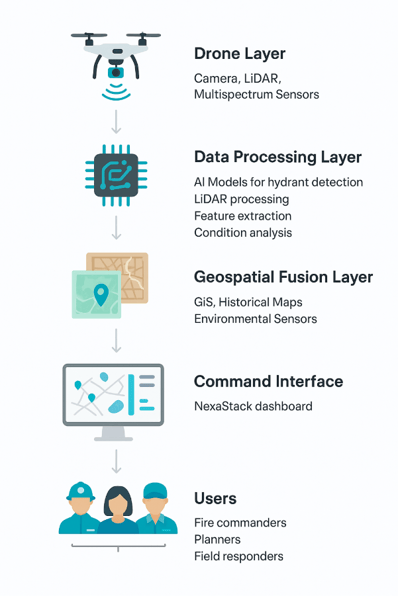
-
Automated Flight Planning
-
Scenario Mapping: Flight plans are generated based on areas of interest, last update date, construction/development records, and known infrastructure changes.
-
Geofencing and Grid Optimization: UAVs are routed to efficiently cover target geographies, ensuring that no asset is missed.
- Sensor Data Collection
-
LiDAR & Visual Capture: Drones collect point clouds and high-res imagery; multispectral sensors can identify water quality, temperature, or contamination risks.
-
Live Data Streaming: Data is uploaded to NexaStack servers for immediate processing or stored locally for rapid disaster zone mapping when connectivity is limited.
-
AI-Driven Asset Detection
-
Feature Extraction: AI models trained on hydrant shapes, water tank features, color, and GPS identify assets even when partially obstructed.
-
Condition Analysis: Inspect asset health, alert for damage, overdue inspections, or obstacles (vehicles, construction debris, vegetation).
-
Geospatial Data Fusion & Interactive Visualization
-
Change Detection: Compare new maps with historical records to identify new hydrants, retired assets, or changes in water bodies (such as rivers or retention ponds after a flood.
-
Command Dashboard Integration: Responder units and incident commanders have real-time access to asset maps, routing tools, and backup resource options.
- Continuous Updating and Audit Trail
-
Regular Drone Missions: Scheduled and event-triggered missions keep water asset intelligence current across seasons, weather events, and urban development.
-
Traceability: All mapping runs, detected changes, manual overrides, and asset investigations are logged for compliance, insurance, and interagency review.
Impact Areas
|
Area |
Description |
|
Workflow |
End-to-end automation—from flight planning and mission approval to live map updates and responder access. |
|
Data |
Multi-source, precise, and current asset intelligence—supports rapid incident planning and operational audits. |
|
Governance |
Meets municipal, insurance, and public safety standards for infrastructure documentation, digital audit trail, and continuous improvement. |
|
Resilience |
Enhances disaster preparedness, mutual aid coordination, and long-term resource management across jurisdictional boundaries. |
|
Sustainability |
Enables better water management, reduces waste, and supports environmental monitoring initiatives. |
Conclusion
Drone-powered water resource mapping is a transformative innovation for modern emergency services. By automating asset location, condition assessment, and continuous database refreshes, platforms like NexaStack arm responders with the critical intelligence required to save lives, property, and maximize resource use during fires, floods, and accidents.
Large-scale aerial mapping and AI-driven analysis eliminate guesswork, streamline multi-agency coordination, and ensure regulatory compliance far beyond legacy manual methods—ushering in a new standard for public safety and infrastructure management.