Artificial Intelligence (AI) has moved from labs to the strategic core of enterprises. From finance and healthcare to retail and manufacturing, AI now powers decision-making, streamlines operations, and drives customer value.
But building a model is only the first step—the bigger challenge is AI lifecycle management. Like a living system, models must be monitored, adapted, and eventually retired. Without it, models lose accuracy, drift out of compliance, or develop bias, risking customer trust and regulatory penalties.
This is where AI lifecycle automation becomes critical. Automating training, deployment, monitoring, and retirement keeps models scalable, reliable, and compliant, transforming AI into a sustainable business function that delivers long-term value. 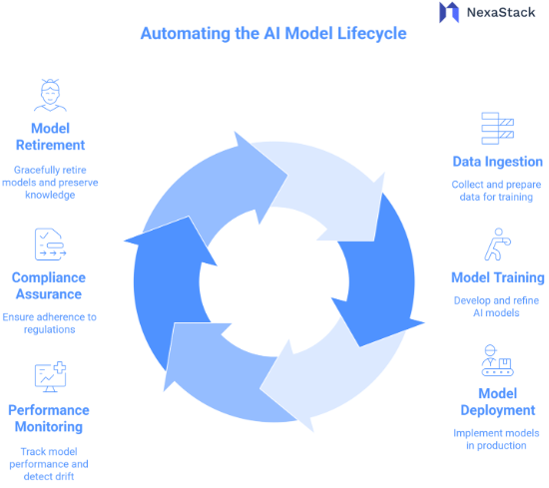
Why AI Model Lifecycle Management Matters
AI models aren’t one-time builds—they need continuous improvement, governance, and adaptation. Without lifecycle management, models degrade as data, markets, and regulations evolve, leading to inaccuracy, bias, and a loss of trust.
With automation, lifecycle management ensures models:
-
Evolve with business needs
-
Stay compliant and ethical
-
Maintain accuracy and scale
-
Build lasting stakeholder trust
In short, it transforms AI from an experiment into a reliable and scalable business function.
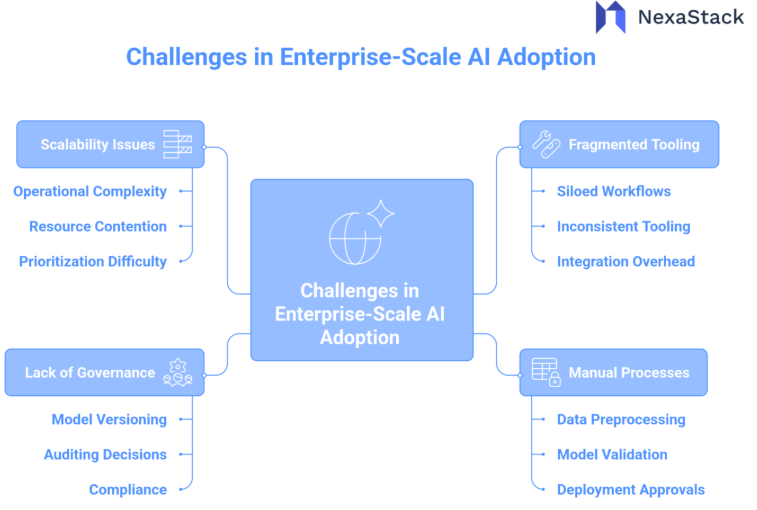
Challenges in Enterprise-Scale AI Adoption
Enterprises struggle to scale AI beyond pilots due to:
-
Fragmented Tools: Disconnected platforms slow collaboration and cause failures.
-
Manual Workflows: Data prep and deployment take weeks, making models obsolete quickly.
-
Governance Gaps: Versioning, audit trails, and compliance are nearly impossible to manage manually.
-
Managing Scale: Thousands of models with varied cycles overwhelm teams without automation.
Takeaway: Lifecycle automation turns these bottlenecks into efficiency, compliance, and growth.
Understanding the AI Model Lifecycle
The AI model lifecycle mirrors that of any operational system, but because models are dynamic and sensitive to external changes, managing them is crucial. At a high level, it includes four main stages: 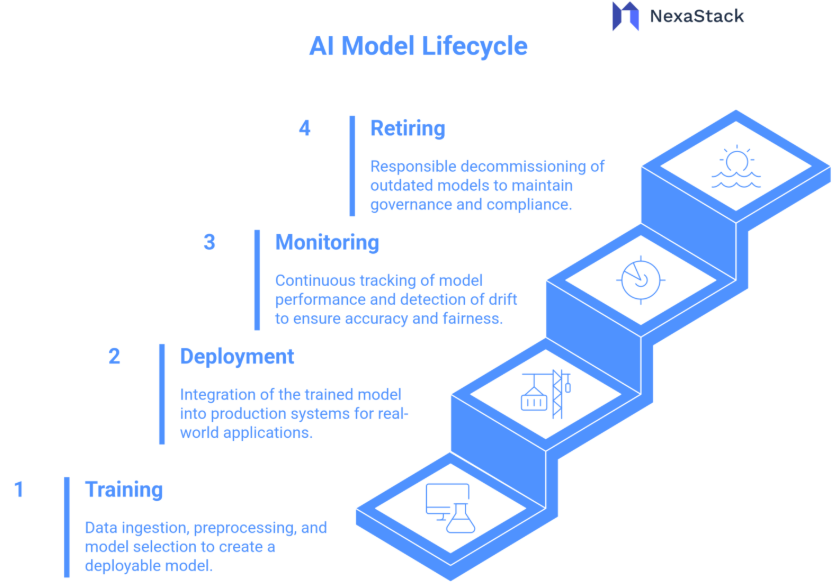
Key Stages: Training, Deployment, Monitoring, Retiring
Each stage is a checkpoint, and automation makes it faster, reliable, and scalable.
-
Training: Data prep consumes 70–80% of time; automation cuts effort and speeds experimentation.
-
Deployment: CI/CD pipelines handle versioning, compatibility, and rollouts with minimal downtime.
-
Monitoring: Automated drift and fairness checks trigger alerts and retraining before accuracy drops.
-
Retiring: Automation flags weak models, manages deprecation, and archives for compliance.
The Importance of Automation in Each Phase
Automation is essential for scaling AI. Each stage benefits in unique ways:
-
Training: AutoML, hyperparameter tuning, and preprocessing pipelines accelerate experiments without manual trial-and-error.
-
Deployment: CI/CD automates validation and rollout, minimizing downtime and risks.
-
Monitoring: Dashboards track accuracy, latency, and fairness, with triggers for retraining or rollback.
-
Retirement: Rules-based automation flags underperforming models and manages smooth deprecation.
This shifts teams from manual firefighting to focusing on innovation and value creation.
Automating Model Training
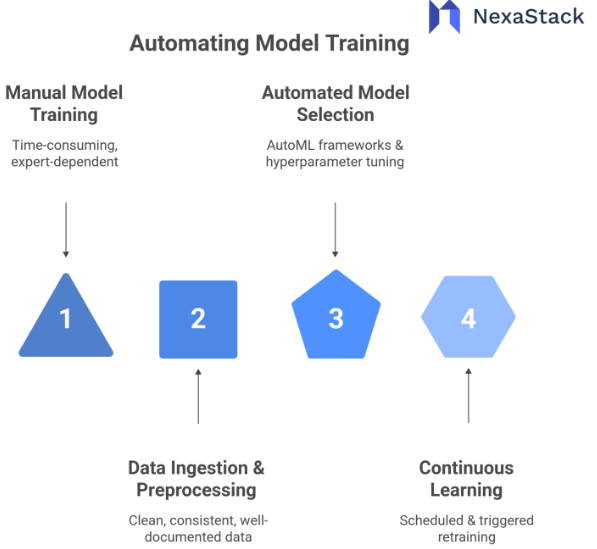
Manual model training is slow and prone to error, so organizations are adopting automation. It accelerates development while improving reliability and scalability. Here’s how it works step by step:
Data Ingestion and Preprocessing
Raw data is messy and comes from multiple sources like databases, APIs, or logs. Before training, it must be cleaned, normalized, and transformed.
-
Automation Saves Time: Pipelines pull new data, remove duplicates, fix missing values, and format it for use.
-
Example: An e-commerce firm automatically ingests daily sales data, cleans it, and feeds it into a recommendation engine.
Automated Model Selection and Hyperparameter Tuning
Traditionally, data scientists tested algorithms and tweaked hyperparameters manually, a process that took weeks.
-
AutoML Advantage: Platforms test multiple algorithms (e.g., XGBoost, deep learning) and select the best one.
-
Hyperparameter Tuning: Automated methods like grid search or Bayesian optimization quickly find optimal settings.
-
Example: A financial firm uses AutoML to build a credit-risk model overnight with improved accuracy and fairness.
Continuous Learning and Retraining Strategies
Models degrade if they don’t adapt to new data. Continuous learning ensures they stay relevant.
-
Scheduled Retraining: Updates models weekly/monthly with fresh data.
-
Trigger-Based: Retrains when drift is detected (e.g., changing customer behavior).
-
Incremental Learning: Adds knowledge continuously without full retraining.
-
Example: A ride-hailing app retrains its demand predictor daily to adjust for traffic, weather, and events.
Monitoring and Governance
Once models are in production, they must be tracked for performance, fairness, compliance, and reliability. This phase is critical for trust and risk mitigation, and automation makes monitoring proactive, scalable, and auditable.
- Performance Tracking and Drift Detection
AI models lose accuracy as behaviors and conditions shift—this drift weakens outcomes if left unchecked.
-
Continuous Oversight: Track precision, recall, latency, and data distribution.
-
Proactive Alerts: Tools flag anomalies early.
-
Retraining Triggers: Automated pipelines retrain models when drift exceeds thresholds.
-
Rollback Options: Systems revert to earlier validated versions for stability.
- Bias, Fairness, and Ethical Compliance
Bias in outputs can harm customers, erode trust, and invite regulatory action.
-
Bias Checks: Automated frameworks test outputs across groups.
-
Impact Detection: Spot disproportionate false positives/negatives.
-
Audit Reports: Auto-generated logs help meet GDPR, HIPAA, or sector rules.
-
Responsible Pipelines: Embedding fairness checks keeps innovation ethical.
- Automated Alerts and Remediation
Traditional failures surface late; automation prevents this with real-time responses.
-
Real-Time Detection: Issues identified before major disruption.
-
Tiered Escalation: Teams are notified while safeguards run automatically.
-
Fallback Mechanisms: Backup models ensure continuity.
-
Auto Rollbacks: Restore stable versions until fixes are deployed.
-
Business Resilience: Ensures uptime, compliance, and customer trust.
Cross-Industry Use Cases
AI lifecycle automation is being applied across industries to boost efficiency, compliance, and trust.
Finance
-
Fraud Detection: Automated retraining adapts models to evolving fraud tactics.
-
Drift Monitoring: Continuous checks flag unusual transaction patterns early.
-
Regulatory Compliance: Governance pipelines generate audit-ready logs for Basel III, AML, etc.
-
Business Value: Faster fraud prevention reduces losses and maintains trust.
Healthcare
-
Clinical Governance: Automated documentation ensures full traceability for medical compliance.
-
Diagnostics Updates: Retraining keeps AI diagnostic tools accurate with new medical knowledge.
-
Fairness Checks: Automated tests prevent biased treatment outcomes.
-
Regulatory Alignment: Archiving ensures compliance with FDA, HIPAA, and EMA requirements.
Manufacturing
-
Predictive Maintenance: IoT-driven models retrain automatically as conditions change.
-
Production Optimization: Automated anomaly detection improves quality control.
-
Continuity: Backup systems prevent downtime and disruptions.
-
Business Value: Greater uptime, lower costs, and reduced waste.
Benefits of Lifecycle Automation
Automation in the AI lifecycle drives efficiency, trust, and faster ROI by replacing manual bottlenecks with scalable workflows.
Reduced Operational Costs
-
Lower Workload: Automates data prep, retraining, and deployment.
-
Error Reduction: Fewer manual steps mean fewer failures.
-
Resource Optimization: Autoscaling uses cloud/hardware efficiently.
-
Value: Savings can be reinvested into innovation.
Improved Trust and Compliance
-
Bias Checks: Automated pipelines reduce ethical and legal risks.
-
Regulatory Alignment: Continuous, audit-ready compliance reporting.
-
Transparency: Logs and lineage make AI explainable.
-
Impact: Builds trust with regulators, customers, and employees.
Faster Time-to-Value
-
Rapid Deployment: CI/CD puts models into production in days, not months.
-
Continuous Updates: Automated retraining keeps models relevant.
-
Seamless Integration: APIs/microservices embed AI into enterprise systems quickly.
-
Competitive Edge: Faster iterations mean quicker market advantage.
Challenges and Considerations
Lifecycle automation brings great value but requires balancing automation with human oversight, strong infrastructure, and governance.
Tooling Investments
-
Infrastructure: Needs cloud, orchestration, and high-performance storage.
-
Specialized Tools: AutoML, CI/CD, monitoring dashboards, and governance platforms.
-
Costs: High upfront spend, offset by long-term efficiency gains.
-
Integration: New tools must fit seamlessly into existing IT and security systems.
Human Oversight
-
Ethical Safeguards: Sensitive decisions still need human judgment.
-
Accountability: Regulations often enforce a “human-in-the-loop.”
-
Contextual Judgment: Business/cultural nuances can’t be automated.
-
Balance: Automation should enhance—not replace—responsibility.
Managing Scale
-
Model Volume: Enterprises may run thousands of models.
-
Central Registries: Prevent versioning chaos and maintain lineage.
-
Orchestration: Complex across hybrid environments without automation.
-
Governance: Role-based access, audit trails, and oversight avoid “AI sprawl.”
The Future of AI Lifecycle Automation
AI lifecycle automation is moving toward self-managing ecosystems that optimize performance with minimal human input. The future is adaptive, resilient, and intelligent.
Multi-Agent Systems
-
Collaborative Automation: Distributed agents handle stages like training, deployment, and compliance.
-
Decentralized Efficiency: Agents coordinate to detect and fix issues quickly.
-
Dynamic Adaptation: Updates, rollouts, and checks run in parallel.
-
Impact: Greater resilience—failures in one area are balanced by others.
RLaaS and Autonomous Ops
-
Self-Optimization: RLaaS enables models to learn from real-time rewards and penalties.
-
Autonomous Operations: Systems evolve retraining, rollback, and resource strategies without rules coded in advance.
-
Scalability: Decision-making scales across teams and geographies.
-
Value: Industries like logistics/energy gain adaptable systems that respond instantly to disruptions.
Self-Managing AI Ecosystems
-
Self-Healing: Models retrain, validate, and redeploy automatically.
-
Minimal Oversight: Humans step in only for governance and high-risk cases.
-
Continuous Alignment: AI stays in sync with shifting business/data contexts.
-
Strategic Edge: Early adopters lead in scale, efficiency, and regulatory adaptability.
Conclusion
Enterprises that embed automation across the AI lifecycle gain resilience, scalability, and cost efficiency. Automation reduces friction, ensures compliance, and keeps models trustworthy. In today’s fast-changing environment, lifecycle automation is business-critical, not optional.
Key Takeaways for CIOs and AI Leaders
-
Automation is Essential: Manual workflows can’t scale enterprise AI.
-
Governance Matters: Automation must pair with human oversight for ethics and compliance.
-
Cross-Industry Proof: Finance, healthcare, and manufacturing show clear ROI.
-
Trust as an Asset: Bias detection and transparency build confidence with regulators, employees, and customers.
Roadmap for Implementation
-
Phase 1 – Automate training pipelines (data prep, feature engineering, hyperparameter tuning).
-
Phase 2 – Implement CI/CD workflows for faster, safer deployments.
-
Phase 3 – Add monitoring and governance (drift detection, bias audits, compliance).
-
Phase 4 – Prepare for self-managing AI via multi-agent systems and reinforcement learning.