Fleet Coordination Challenges
Robots are assigned dynamically to tasks based on fleet capacity, priorities, and throughput goals, ensuring efficient operations without overloading any individual unit
Fleet movement is coordinated to prevent collisions, congestion, and deadlocks, optimizing shared spaces and safely integrating human workers into operational areas
Overall fleet performance is maximized by minimizing empty travel, adapting to changing conditions, and handling failures gracefully for uninterrupted operations
Different robot types and vendors are integrated seamlessly, leveraging specialized capabilities while maintaining unified orchestration across the entire fleet
Capabilities
Intelligent Task Allocation
Assign tasks dynamically based on robot location, capabilities, and priority, optimizing workload, efficiency, and fleet throughput
Traffic Management
Prevent collisions and congestion using real-time path planning, chokepoint management, and human-aware navigation zones
Fleet Optimization
Improve fleet performance through utilization analysis, charging schedules, predictive maintenance, and adaptive scaling in real time
Heterogeneous Fleet Support
Coordinate diverse robot types and vendors under a unified system, leveraging all capabilities for smooth fleet orchestration
Featured Solutions

Fleet Task Optimizer for Dynamic Allocation
Robot Fleet Coordinators assign tasks intelligently based on location, capabilities, and priority. Optimized allocation improves throughput, balances workload, and reduces travel time across the fleet
Explore Now

Traffic Management for Collision-Free Operations
Real-time path planning, chokepoint management, and dynamic rerouting prevent collisions, congestion, and deadlocks while coordinating robot movement with human operators
Explore Now

Fleet Performance Optimizer for Continuous Efficiency
Continuous monitoring and adaptive scheduling optimize utilization, charging, and predictive maintenance, maximizing operational efficiency and fleet throughput in dynamic conditions
Explore Now
Heterogeneous Fleet Orchestration Across Robots
Coordinate AMRs, AGVs, drones, and robotic arms from multiple vendors under a unified system, leveraging diverse capabilities for seamless fleet operations
Explore Now
Featured Industries

Manufacturing
Efficient Production Logistics
Automated robots deliver materials to production lines, transport work-in-progress items, move finished goods, and support kitting and sequencing for continuous manufacturing efficiency
Discover More

Healthcare Facilities
Safe & Timely Delivery
Robots handle medication and supply delivery, lab specimen transport, linen and waste management, and food service logistics, ensuring safe, timely operations in healthcare environments
Discover More
Retail Operations
Streamlined Retail Logistics
Robotic fleets automate backroom-to-floor replenishment, manage inventory movement, process returns, and support micro-fulfillment centers to enhance speed and accuracy
Discover More
Multi-Industry Adaptation
Flexible Fleet Deployment
Robot fleets adapt across warehouses, manufacturing, healthcare, and retail, delivering scalable, efficient, and safe operations tailored to specific industry workflows
Discover More
Integration Capabilities
Upstream System Connection
Connect with WMS, MES, ERP, and order management systems to streamline operations and ensure synchronized task execution across the enterprise
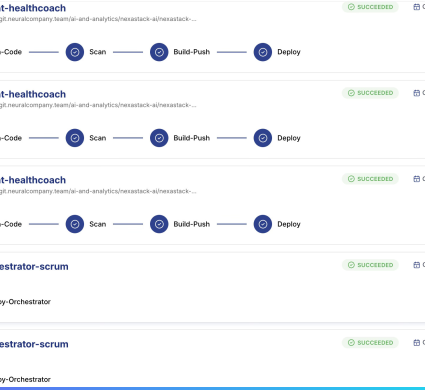
Robot Platform Integration
Integrate AMRs, AGVs, robotic arms, and custom robot interfaces under a unified control layer for seamless fleet orchestration
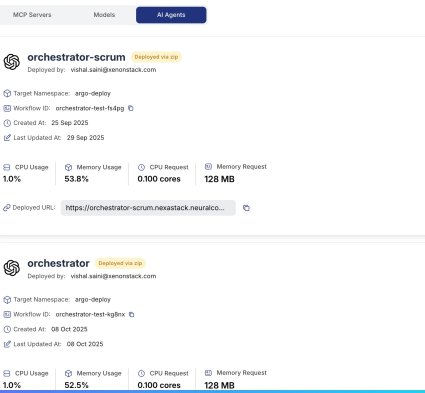
Facility & Analytics Integration
Coordinate with building systems, conveyors, safety controls, and dashboards for real-time monitoring, performance reporting, and actionable insights
Trusted by leading companies and Partners



.svg)
Related Resources and Blogs
Model Risk Management in Financial Institutions
Model risk management in financial institutions ensures compliance, accuracy, governance, and reliability of AI and analytical models
Explore Further

The New Face of Model Risk Managing AI and LLMs at Scale
Explore the new face of model risk managing AI and LLMs at scale with context-driven, autonomous risk operations
Explore Further