
AI and machine learning (ML) workloads are expanding faster than traditional infrastructure can evolve. As models grow larger and data pipelines become more demanding, organizations face persistent challenges such as hardware fragmentation, network bottlenecks, and poor GPU/CPU utilization. These limitations slow down training cycles, increase operational costs, and make large-scale AI deployment difficult to manage.
Composable Compute Infrastructure offers a powerful alternative. Instead of relying on rigid, fixed hardware configurations, it enables enterprises to dynamically assemble compute, storage, and networking resources based on real-time workload requirements. This flexibility helps eliminate common performance bottlenecks, improves system efficiency, and accelerates both model training and inference workflows.
In this blog, we explore how composable infrastructure reshapes AI operations—delivering the scalability, speed, and resource optimization required for modern AI and ML environments.
Overview of Composable Compute Infrastructure for AI Workloads
AI workloads are highly dynamic: during model training, GPUs and memory bandwidth are the primary bottlenecks, while inference prioritizes low-latency performance. Traditional infrastructure, designed around static server configurations, often fails to adapt to these shifting needs. As a result, organizations over-provision hardware, face delays in training cycles, and struggle to achieve predictable performance at scale.
Composable Compute Infrastructure provides an alternative by decoupling physical resources from fixed servers. Instead of tying CPUs, GPUs, storage, and network capacity to specific machines, composable systems pool them and assign them through software. This creates flexible, adaptable environments where resources can be provisioned, increased, reassigned, or reclaimed instantly across AI pipelines.
What is Composable Compute Infrastructure?
Composable Compute Infrastructure is a software-driven architecture that treats hardware components—CPUs, GPUs, accelerators, storage, and networking—as fluid, standalone resources. Through an orchestration layer, these components are dynamically combined into “virtual servers” tailored to each workload.
Instead of purchasing large, fixed GPU servers for everything, organizations maintain a shared pool of resources that can be assembled on the fly. A training job may require dozens of GPUs, while an inference system may only need a small GPU slice with high-bandwidth networking. Composable infrastructure ensures both can be fulfilled without waste or manual reconfiguration.
This flexibility allows organizations to optimize hardware usage, simplify operations, and scale AI workloads far more efficiently.
Why It Matters for AI and ML Applications
AI workloads vary significantly across their lifecycle. Deep learning training demands heavy parallel computing; inference workloads require consistent low-latency performance; and data preprocessing requires high I/O throughput. Traditional systems—built around fixed hardware ratios—cannot adapt quickly enough.
Composable infrastructure resolves this problem by enabling:
-
Real-time resource allocation
-
GPU and CPU pooling across teams
-
Dynamic scaling during training or inference surges
-
Software-defined control to avoid idle, stranded compute
For enterprises deploying large-scale AI, this agility reduces project delays, minimizes capital expenditure, and improves utilization of expensive AI hardware. 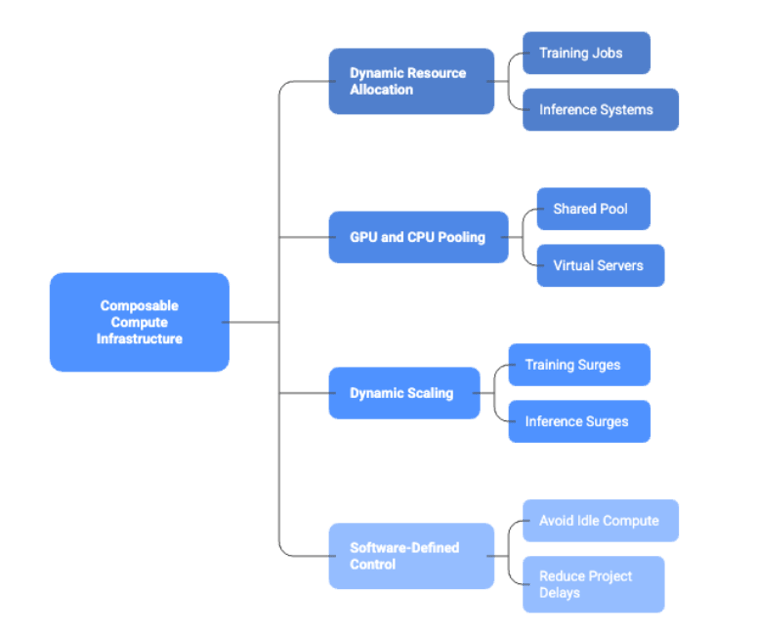
Challenges of AI Workloads on Traditional Infrastructure
-
Hardware Resource Fragmentation: In traditional servers, compute, storage, and networking are locked together. GPUs may remain idle because they’re tied to a server with insufficient CPU power, or vice versa. This fragmentation causes inefficiencies, slows training cycles, and increases operational overhead.
-
Latency and Bandwidth Bottlenecks: Moving data between compute nodes and storage during training often becomes a major bottleneck. Legacy networking and storage architectures struggle to keep up with the massive datasets used in modern AI workflows.
-
Inefficient GPU/CPU Utilization: Fixed hardware allocations lead to either over-provisioning or chronic underutilization. AI teams often purchase large GPU servers only to leave them idle between experiments, driving up both CapEx and OpEx.
Core Components of Composable Compute Infrastructure
-
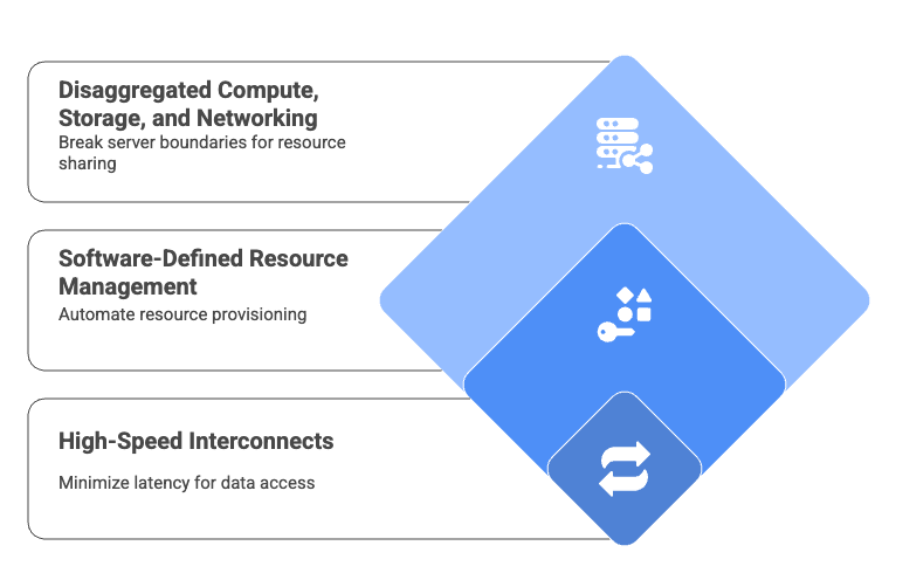
Disaggregated Compute, Storage, and Networking: Composable infrastructure breaks apart traditional server boundaries, pooling resources into shared, software-managed layers. Compute (GPUs/CPUs), storage (NVMe, SSDs), and networking (high-speed fabrics) operate independently, allowing administrators to allocate them precisely where needed. This disaggregation enables GPU sharing across multiple AI workloads, maximizing utilization and reducing costs.
-
Software-Defined Resource Management: Intelligent orchestration tools, such as Kubernetes, OpenStack, and infrastructure-as-code (IaC) frameworks, automate resource provisioning. These platforms dynamically assign hardware based on workload priorities, ensuring optimal performance for AI training and inference without manual intervention.
-
High-Speed Interconnects: Technologies like NVMe-over-Fabrics, InfiniBand, and Compute Express Link (CXL) minimize latency between storage and compute nodes. By enabling near-instant data access, these interconnects eliminate I/O bottlenecks, significantly accelerating AI model training.
How Composable Compute Infrastructure Breaks AI Workload Bottlenecks
-
Dynamic Resource Allocation for AI Tasks: Instead of static hardware assignments, composable infrastructure scales resources up or down in real time. During intensive training phases, additional GPUs and memory can be allocated instantly, then released for other workloads once completed.
-
Eliminating Over-Provisioning in AI Pipelines: By matching resources to actual demand, organizations avoid paying for idle hardware. Early adopters report 30-40% cost savings compared to fixed infrastructure.
-
Accelerating Data Movement for Model Training: High-speed interconnects and disaggregated storage ensure that data flows seamlessly between nodes, reducing epoch times and speeding up experimentation cycles.
Benefits of Composable Compute Infrastructure in AI
Performance & Throughput Gains
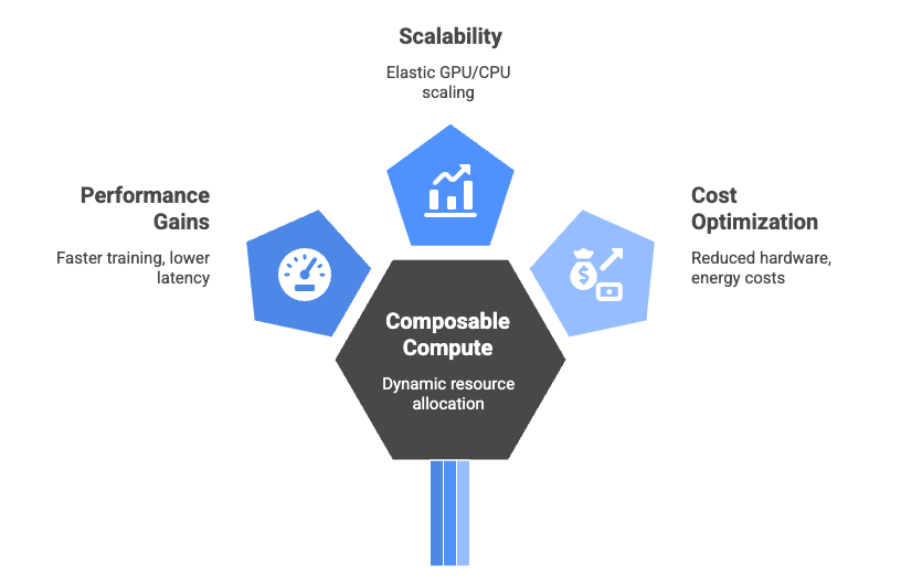
Composable environments allow seamless scaling of GPU clusters and provide rapid access to large datasets. This results in faster training, reduced iteration time, and lower inference latency.
Key advantages:
-
Real-time GPU allocation for large training jobs
-
Faster data pipelines using NVMe-oF and CXL
-
Guaranteed resources for high-priority inference workloads
Organizations see 30–50% faster epoch times and improved reliability in latency-sensitive applications.
Scalability & Flexibility
AI workloads fluctuate dramatically. Composable infrastructure absorbs these fluctuations by dynamically assembling the needed compute environment.
Benefits include:
-
Elastic GPU and CPU scaling
-
Multi-tenant AI workloads without performance loss
-
Seamless integration with cloud and edge resources
This flexibility supports rapid experimentation and shortens development cycles.
Cost Optimization
AI hardware—especially GPUs—is expensive and frequently underutilized in static environments. Composable systems reduce costs by eliminating idle hardware and enabling pay-as-you-grow models.
Cost improvements:
-
30–50% lower total cost of ownership
-
Reduced energy and cooling needs
-
Rational hardware purchasing based on actual demand
Composable Compute Infrastructure for AI Training and Inference
Optimizing Deep Learning Model Training
Training modern deep learning models (e.g., LLMs, vision transformers) requires massive parallel compute power, often spanning hundreds of GPUs working in sync. Traditional fixed infrastructure struggles with:
-
Underutilized GPUs during non-peak phases.
-
I/O bottlenecks when feeding data to accelerators.
-
Long job queues due to static resource allocation.
How Composable Infrastructure Transforms Training
-
Dynamic GPU Allocation: Instead of locking GPUs to specific servers, composable infrastructure pools all available accelerators and assigns them on demand.
Example: A single training job can scale from 8 to 64 GPUs as needed, then release them when complete. -
Faster Data Pipeline: Disaggregated NVMe storage + high-speed interconnects (e.g., InfiniBand, CXL) prevent data starvation.
-
Benchmark: 30-50% faster epoch times vs. traditional NAS/SAN storage.
-
Elastic Multi-Node Scaling: Composable software (e.g., HPE Synergy, Liqid) automatically provisions additional compute nodes when workloads expand.
-
Real-world impact: A 3-day training job is completed in <1 day by doubling GPU resources mid-task
Reducing Latency in AI Inference at Scale
While training is batch-oriented, inference is latency-sensitive:
-
Autonomous vehicles require <10ms response times.
-
Fraud detection APIs must process 100K+ requests/sec.
-
Legacy infrastructure causes queueing delays when multiple models compete for GPUs.
Composable Solutions for Low-Latency Inference
-
Guaranteed QoS for Critical Models: Software-defined policies reserve GPU/CPU slices for high-priority inference workloads.
Example: A voice assistant always gets 10% of GPU capacity even during training spikes. -
Just-in-Time Resource Provisioning: Inference pods automatically scale horizontally during traffic surges.
Case study: An e-commerce site handles Black Friday traffic spikes without over-provisioning. -
Edge-Optimized Deployments: Composable principles allow fractional GPU sharing across edge nodes.
Result: A smart factory runs 10x more CV models per edge server vs. fixed deployments.
Integration with Cloud and Edge AI
Hybrid Cloud AI Deployments
Composable infrastructure bridges on-prem and cloud environments. Organizations can keep sensitive workloads local while bursting to the cloud for additional GPU capacity.
Advantages:
-
Cloud elasticity without vendor lock-in
-
Reduced cloud costs through selective offloading
-
Kubernetes and IaC-based hybrid orchestration
This model is ideal for AI teams that require both performance and compliance.
AI Workload Distribution Across Edge Devices
Edge AI benefits from composable principles by enabling centralized resource management across distributed sites.
Capabilities include:
-
Dynamic GPU/CPU sharing across edge nodes
-
OTA model updates and federated learning
-
Sub-millisecond inference latency
Industries such as manufacturing, automotive, and energy see accelerated deployments and reduced hardware costs.
Future Trends and Best Practices
Emerging Technologies
Several innovations will shape the next evolution of composable infrastructure:
-
DPUs for offloading networking and security tasks
-
AI-driven orchestration that predicts resource needs
-
Photonics-based interconnects for higher bandwidth
-
Liquid-cooled composable racks for dense AI workload
Best Practices for Deployment
Successful adoption of composable AI infrastructure involves:
-
Starting with small pilot projects
-
Using Kubernetes-native composability tools
-
Automating environments using IaC
-
Monitoring GPU utilization and interconnect performance
Organizations should evolve gradually, validating performance gains before scaling to mission-critical workloads.
Conclusion
Composable Compute Infrastructure is redefining how enterprises build and scale AI workloads. By dynamically allocating CPUs, GPUs, storage, and network bandwidth, it removes the inefficiencies of traditional infrastructure and unlocks higher performance at lower cost. As AI models become larger and more demanding, composable systems deliver the flexibility, scalability, and efficiency needed to support next-generation applications across cloud, data center, and edge environments.
The future of AI infrastructure isn’t fixed—it’s composable.
Frequently Asked Questions (FAQs)
Advanced FAQs on Composable Compute Infrastructure for high-performance AI workloads.
How does composable compute remove bottlenecks in AI pipelines?
It dynamically pools GPUs, CPUs, memory, and storage, allowing AI workloads to access exactly the resources they need without fixed, siloed hardware limits.
Why is composability critical for modern AI and LLM training?
Training and fine-tuning large models require flexible scaling of heterogeneous resources — composability ensures compute can grow or reconfigure instantly based on workload demand.
How does composable compute improve utilization efficiency?
By disaggregating hardware and allocating resources on demand, organizations eliminate idle capacity and significantly increase compute ROI.
Can composable infrastructure support mixed AI workloads at scale?
Yes — it allows simultaneous execution of training, inference, streaming, and multi-agent workloads by dynamically optimizing the resource topology for each task.